
How Offline Lamination Films Build Functional Thermoforming Sheets
In the thermoforming packaging industry, many buyers first focus on the base sheet material, such as PET, PP, PS or PVC.
This guide focuses on offline lamination film for thermoforming sheets, including CPP film, PE film and PE/EVOH/PE barrier film.
However, in real packaging projects, the final performance is often not decided by the base sheet alone. It is strongly influenced by the functional film layer laminated onto the sheet.
For applications such as meat trays, seafood trays, sushi boxes, candy and chocolate packaging, ready meal trays, chilled food packaging and skin pack tray materials, buyers often need more than a standard sheet. They may require:
- High barrier performance to extend shelf life
- Easy-peel sealing for clean opening
- Easy-tear performance for consumer convenience
- Anti-fog clarity for chilled display
- Stable sealing to reduce leaks and channel leaks
- Skin pack compatibility for better product presentation
- Printed patterns, gold/silver effects or premium decoration
- Stable thermoforming without delamination, whitening or print damage
These functions are often achieved through offline lamination films, such as CPP film, PE film, PE/EVOH/PE high-barrier film, printed film, anti-fog film, easy-peel film, easy-tear film and other functional films.
WANSYN can help customers evaluate suitable offline lamination films and structures for producing functional thermoforming sheets and rolls.
Choosing the right offline lamination film helps build functional laminated sheets with barrier, sealing, anti-fog, easy-peel and skin pack performance.
Quick Answer: Why Offline Lamination Matters for Functional Thermoforming Sheets
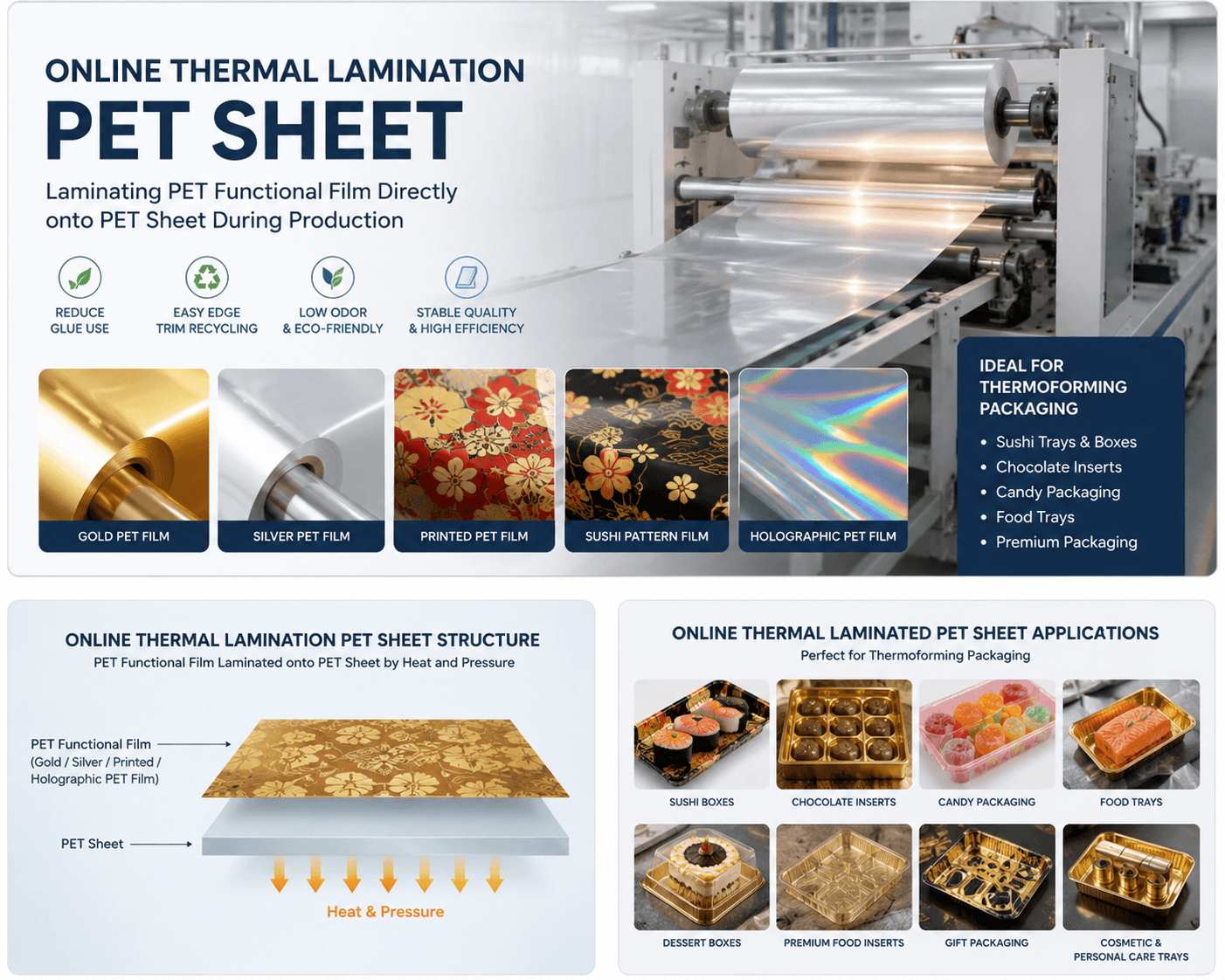
Offline lamination is a flexible process used to combine a base sheet with functional films after the sheet is produced. Compared with PET-to-PET online thermal lamination, offline lamination is better suited for complex functional structures, such as high-barrier sheets, easy-peel sheets, anti-fog sheets, printed sheets, and tray materials for VSP / skin pack applications.
In simple terms:
Online thermal lamination is more suitable for PET-to-PET decorative sheet structures.
Offline lamination is more suitable for multi-layer, multi-material and functional thermoforming sheet structures.
1) What Is Offline Lamination Film?
Offline lamination film refers to a functional film, printed film, sealing film or barrier film laminated onto a base sheet through a separate lamination process after the base sheet has been produced.
A typical process can be understood as:
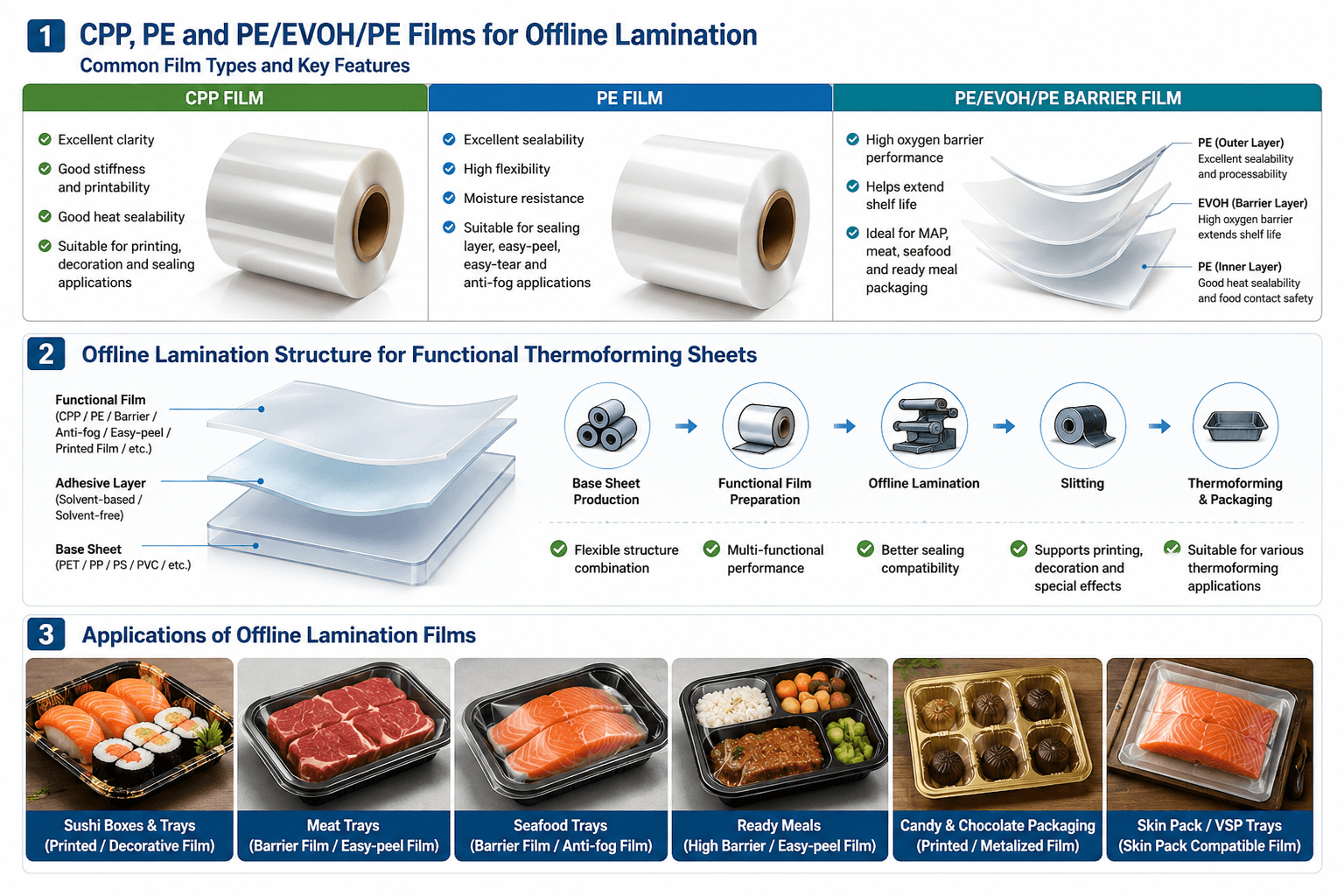
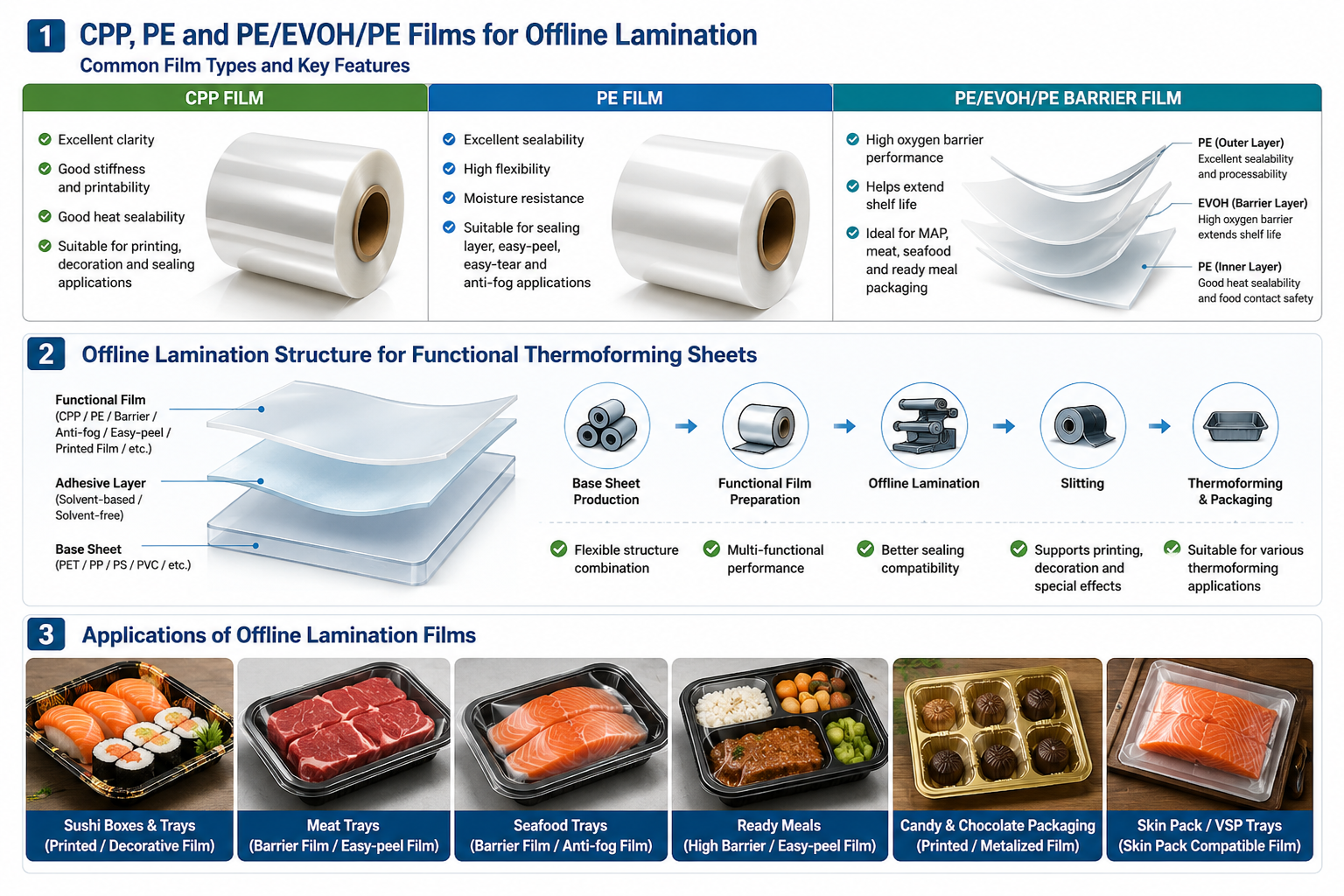
Base sheet production → functional / printed / barrier film preparation → offline lamination → slitting → thermoforming
Compared with online thermal lamination, offline lamination offers more structural flexibility and can be used to achieve more complex functional combinations, such as:
- PET/CPP
- PET/PE
- PP/CPP
- PS/CPP
- PET + PE/EVOH/PE
- PET + printed CPP film
- PP/PE + high-barrier film
- Structures designed for easy-peel, easy-tear, anti-fog, barrier or skin pack tray applications
Offline lamination is not just “adding one film layer.” It is a practical way to build functional laminated sheets for different packaging requirements.
2) Why Do Functional Sheets Often Need Offline Lamination?
Many packaging functions cannot be achieved by a single-layer sheet alone. They often require a functional film layer.
High Barrier
Barrier films such as EVOH, PA, PE/EVOH/PE or PA/EVOH/PE can help improve oxygen barrier performance, moisture control and shelf-life performance.
Easy-Peel / Easy-Tear
Special sealing layers or peelable layers can help trays seal properly while allowing consumers to open the package cleanly.
Anti-Fog
Anti-fog films or anti-fog layers can reduce condensation and improve product visibility in chilled display.
Skin Pack / VSP Compatibility
Vacuum skin packaging requires the bottom tray or bottom web to work together with the top skin film, sealing system, temperature, pressure, product shape and equipment conditions.
Offline lamination can help create bottom tray structures with suitable sealing layers, barrier layers or surface compatibility for VSP / skin pack applications.
Printing and Decoration
Sushi patterns, wood grain designs, gold/silver effects and holographic decoration can also be achieved by laminating printed or decorative films onto the sheet.
That is why offline lamination is important: it helps the base sheet gain a complete set of packaging functions.
3) Common Films Used for Offline Lamination
3.1 CPP Film
CPP film is commonly used in offline lamination, especially for projects requiring printing, decoration or certain heat-sealing compatibility.
Common directions include:
- Printed CPP film
- CPP sealing film
- Anti-fog CPP film
- Gold / silver decorative CPP film
- Sushi pattern CPP film
CPP film has good flexibility and heat-seal adaptability. It is often laminated with PET, PP or PS sheets to create functional thermoforming sheets.
Typical applications:
- Sushi boxes
- Japanese-style food trays
- Candy packaging
- Chocolate tray inserts
- Dessert boxes
- Chilled food packaging
3.2 PE Film
PE film is often used as a sealing layer, inner layer or functional layer in offline laminated structures. It is suitable for packaging structures that require heat sealing, moisture resistance, flexibility or easy-peel performance.
Common directions include:
- PE sealing film
- Printed PE film
- Anti-fog PE film
- Easy-peel PE film
- Easy-tear PE film
- PE-based high-barrier composite film
PE film is widely used where sealing performance is important, especially in tray packaging that needs to match a lidding film system.
Typical applications:
- Meat trays
- Seafood trays
- Deli food trays
- Salad trays
- Ready meal packaging
- Food trays requiring lidding seal
3.3 PE/EVOH/PE High-Barrier Film
For MAP packaging, chilled foods, seafood, meat, deli products and ready meals, standard films may not meet shelf-life requirements.
In these cases, PE/EVOH/PE high-barrier film can be considered.
EVOH is a commonly used high-barrier material, especially for improving oxygen barrier performance. A PE/EVOH/PE structure can provide a PE sealing surface while introducing an EVOH barrier layer to support longer food shelf life.
Typical applications:
- MAP meat trays
- MAP seafood trays
- Deli and ready meal packaging
- High-barrier food trays
- Chilled food packaging
- Tray base materials or laminated sheet structures requiring oxygen barrier
However, whether PE/EVOH/PE barrier film is suitable for a project depends on more than whether EVOH is included. Buyers should also consider:
- OTR target
- WVTR target
- Test conditions
- Corner thinning after thermoforming
- Seal integrity
- Microleak risk
- Lamination compatibility with the base sheet
3.4 Easy-Peel Film / Easy-Tear Film
Many food trays do not only need to “seal well.” They also need to “open well.”
Easy-peel or easy-tear films can help achieve:
- Clean opening
- Less stringing
- Less tray tearing
- Stable sealing strength
- Better consumer experience
These films are commonly used for:
- Deli food trays
- Salad trays
- Ready meal packaging
- Chilled food trays
- Food packaging requiring lidding seal
However, easy-peel or easy-tear performance is not determined by the film name alone. It must be tested together with:
- Sheet structure
- Lidding film system
- Sealing temperature
- Pressure
- Dwell time
- Target peel force
3.5 Anti-Fog Film
Fogging is common in chilled display packaging, especially for sushi, seafood, meat, salad and chilled food applications.
Anti-fog films can help improve packaging clarity and shelf presentation.
Common applications:
- Sushi boxes
- Seafood trays
- Meat trays
- Salad trays
- Chilled food packaging
Anti-fog performance is usually affected by the material structure, surface condition, condensation environment, storage temperature and packaging format. Therefore, testing under real application conditions is recommended.
3.6 Functional Films and Bottom Tray Structures for Skin Pack / VSP
VSP / skin pack packaging requires higher material matching performance.
The bottom tray or bottom web must work with the upper skin film to meet sealing, forming, barrier, low-temperature resistance and presentation requirements.
Offline lamination can be used to develop better bottom tray structures, such as:
- Tray sheets with a PE sealing layer
- Tray sheets with an EVOH barrier layer
- Laminated sheets for chilled or frozen applications
- Heat-seal surfaces compatible with skin film
It is important to emphasize:
Skin pack performance is not decided by the tray sheet alone. It depends on the bottom tray material, top skin film, equipment, sealing parameters and product shape together.
3.7 Printed Films and Decorative Films
Printed films are suitable for projects requiring brand identity, pattern design or visual differentiation.
Common printing directions include:
- Sushi pattern
- Wood grain pattern
- Food pattern
- Brand logo
- Seasonal promotion pattern
- Premium gift box pattern
Gold, silver, holographic and iridescent decorative films are mainly used to improve shelf appeal and premium appearance.
Typical applications:
- Chocolate tray inserts
- Candy packaging
- Gift packaging
- Seasonal promotional packaging
- Premium food trays
- Cosmetic and personal care blister inserts
For these films, buyers should pay attention to:
- Color stability after forming
- Surface scuff resistance
- Pattern distortion
- Food packaging suitability
- Lamination strength with the base sheet
- Thermoforming stability after lamination
4) Offline Lamination Film vs Online Thermal Lamination Film
Online Thermal Lamination Film
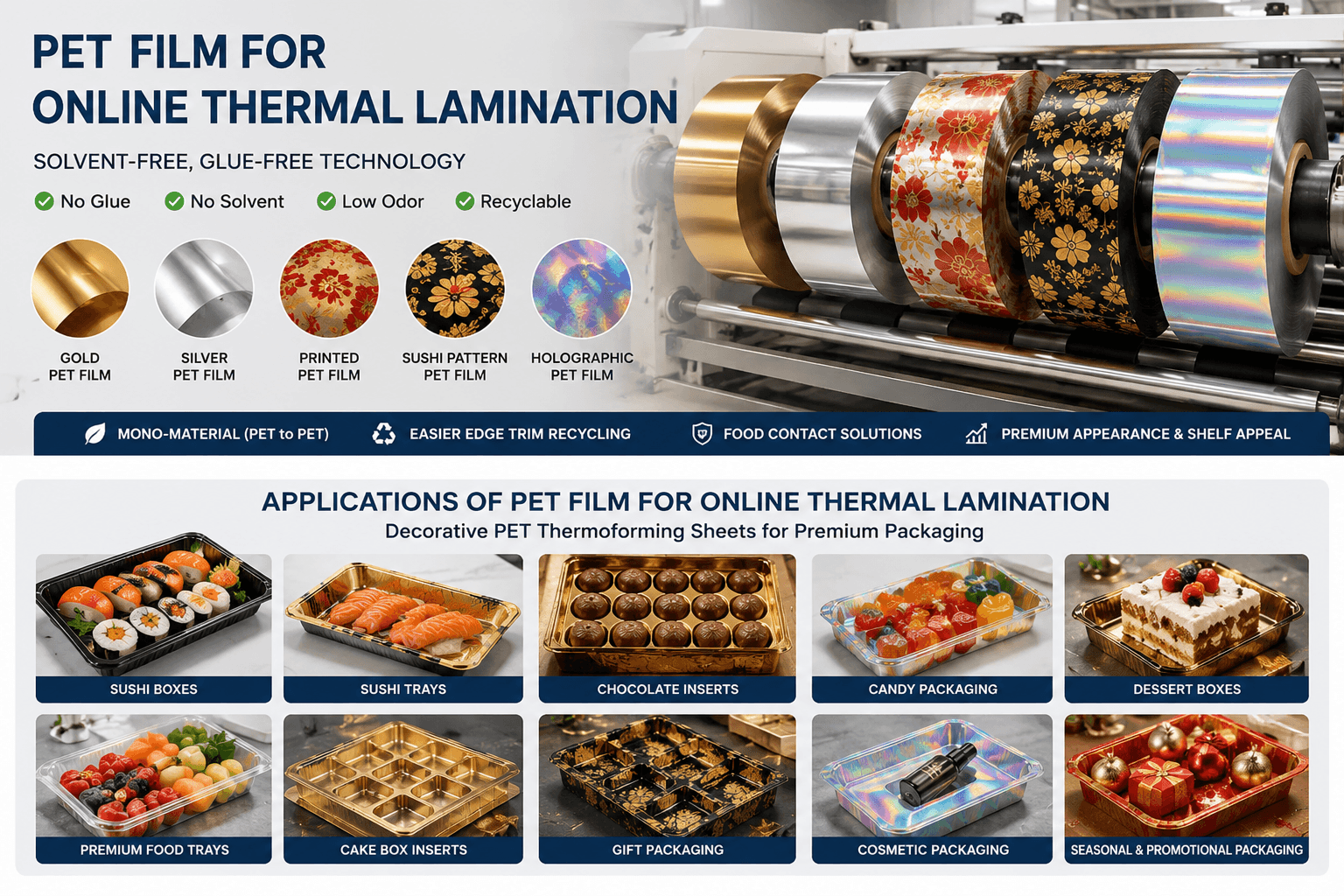
Online thermal lamination is more suitable for matching PET functional film with a PET sheet production line, such as gold PET film, silver PET film and printed PET film.
Its advantages include:
- Glue-free and solvent-free process
- Clearer PET-to-PET structure
- Easier edge trim management within a PET stream
- More suitable for decorative PET thermoforming sheets
Suitable directions:
- Gold PET sheet
- Silver PET sheet
- Printed PET sheet
- Holographic / iridescent PET sheet
- PET-to-PET decorative structures
Offline Lamination Film
Offline lamination is more suitable for multiple film materials and multiple structure combinations, such as CPP film, PE film, PE/EVOH/PE high-barrier film, easy-peel film, anti-fog film and functional films for skin pack trays.
Its advantages include:
- More flexible structure design
- More functional combinations
- Suitable for high barrier, easy-peel, easy-tear, anti-fog and skin pack projects
- Suitable for multi-material and multi-layer functional film combinations
- Better suited for complex packaging requirements
In one sentence:
Online thermal lamination focuses more on PET-to-PET decorative sheets.
Offline lamination focuses more on functional sheets and complex performance combinations.
5) What Functional Sheet Requirements Can Offline Lamination Achieve?
5.1 High-Barrier Sheets
By using PE/EVOH/PE, PA/EVOH/PE or other barrier films, offline lamination can help improve oxygen barrier, moisture control and shelf-life performance.
Suitable for:
- MAP meat
- MAP seafood
- Deli foods
- Ready meals
- Chilled foods
- High-barrier food trays
5.2 Easy-Peel / Easy-Tear Sheets
With suitable PE or CPP sealing layers and peelable layers, offline lamination can improve opening performance.
Suitable for:
- Deli trays
- Salad trays
- Chilled food trays
- Ready meal packaging
- Consumer-friendly packaging
5.3 Anti-Fog Sheets
By using anti-fog films or anti-fog layers, offline lamination can improve chilled display clarity.
Suitable for:
- Sushi boxes
- Seafood trays
- Meat trays
- Salad trays
- Chilled food packaging
5.4 Skin Pack Bottom Tray Materials
By combining sealing layers, barrier layers or low-temperature functional layers, offline lamination can help develop bottom tray materials suitable for VSP / skin pack packaging.
Suitable for:
- Frozen fish
- Seafood
- Meat
- Premium chilled foods
- VSP / skin pack packaging projects
5.5 Printed and Premium Decorative Sheets
By laminating printed films, gold films, silver films or holographic films, offline lamination can help create a premium visual appearance.
Suitable for:
- Sushi boxes
- Chocolate tray inserts
- Candy packaging
- Gift packaging
- Seasonal promotional packaging
- Cosmetic and personal care thermoformed packaging
6) How to Choose CPP Film, PE Film or PE/EVOH/PE Barrier Film
Choosing a film should not be based only on price or material name. It should be based on the final application and required function.
6.1 If the Priority Is Printing and Appearance
Consider:
- Printed CPP film
- Printed PET film
- Gold / silver decorative film
- Holographic / iridescent film
Suitable for: sushi boxes, candy packaging, chocolate inserts, gift packaging and dessert boxes.
6.2 If the Priority Is Sealing Performance
Consider:
- PE sealing film
- Easy-peel film
- Easy-tear film
- PE-based composite film
Suitable for: meat trays, seafood trays, deli trays and packaging that requires lidding seal.
6.3 If the Priority Is Shelf Life and High Barrier
Consider:
- PE/EVOH/PE high-barrier film
- PA/EVOH/PE high-barrier film
- Other EVOH barrier films
- High-barrier composite films
Suitable for: MAP meat, MAP seafood, ready meals, deli foods and chilled foods.
6.4 If the Priority Is Skin Pack / VSP Packaging
Evaluate together:
- Bottom tray structure
- Skin film type
- Sealing layer compatibility
- Barrier requirement
- Low-temperature requirement
- Machine parameters
- Product shape and height
For skin pack projects, the bottom tray material, top skin film and equipment conditions should be evaluated together from the beginning.
7) Applications of Offline Lamination Films
Offline lamination films can be used in many thermoforming sheet projects, including:
- Sushi boxes
- Sushi trays
- Meat trays
- Seafood trays
- Frozen fish packaging
- Deli food trays
- Ready meal packaging
- Skin pack bottom trays
- Candy packaging
- Chocolate tray inserts
- Dessert boxes
- Cake box inserts
- Premium food tray inserts
- Gift packaging inserts
- Cosmetic and personal care thermoformed packaging
- Pharmaceutical or high-barrier packaging needs
These applications may require printing, sealing, anti-fog, barrier, easy-peel, easy-tear, skin pack compatibility or decorative effects.
8) RFQ Checklist: What Information Should Buyers Provide?
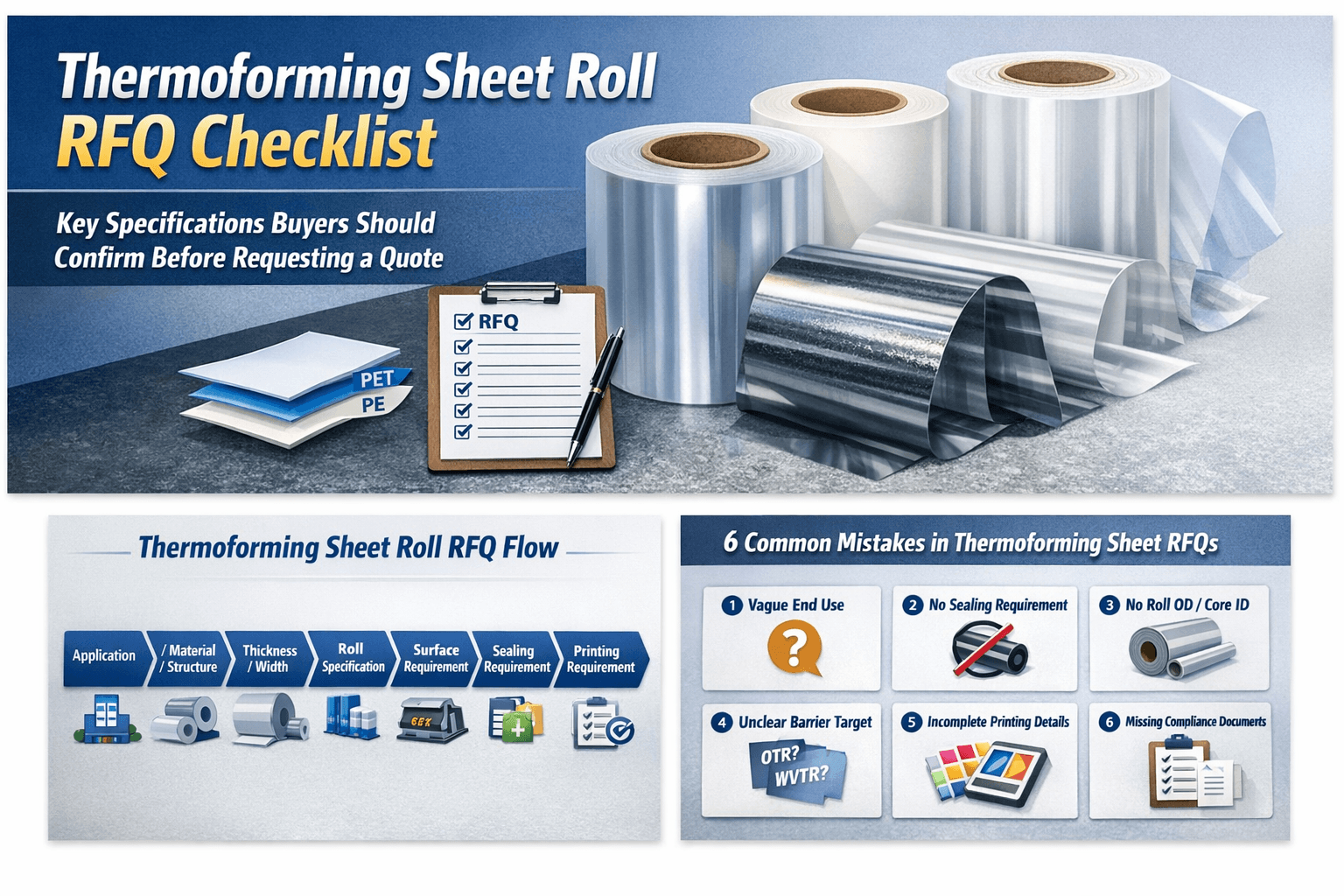
To help us recommend a suitable CPP film, PE film or PE/EVOH/PE high-barrier film, buyers can provide the following information:
Application: sushi box / meat tray / seafood tray / frozen fish / candy / chocolate / ready meal / skin pack / other
Base sheet: PET / PP / PS / PVC / other
Film type: CPP / PE / PE/EVOH/PE / PA/EVOH/PE / printed film / gold or silver film / anti-fog film / easy-peel film / skin pack functional film
Printing required: yes / no; artwork available: yes / no
Sealing required: yes / no; lidding film type: ____
High barrier required: yes / no; OTR/WVTR target: ____
Anti-fog required: yes / no
Easy-peel / easy-tear required: yes / no; target peel force: ____
Skin pack application: yes / no; skin film available: ____
Sheet thickness: ____ mm
Sheet width: ____ mm
Film thickness: ____ μm
Food contact requirement: EU / FDA / other
Target order quantity: ____ kg or ____ tons
Current issue: unstable sealing / fogging / microleaks / print scuffing / delamination / whitening after forming / weak skin pack bonding / other
9) How WANSYN Can Support
WANSYN can help customers evaluate suitable films and laminated structures for offline lamination projects.
We can support:
- CPP film for offline lamination with PET / PP / PS sheets
- PE film as sealing layer or functional layer
- PE/EVOH/PE high-barrier film for MAP or high-barrier packaging
- PA/EVOH/PE and other higher-performance barrier structures
- Easy-peel film, easy-tear film and anti-fog film evaluation
- Bottom tray material structure evaluation for skin pack applications
- Sushi pattern printed film
- Gold / silver / holographic decorative films
- Film selection matched with thermoforming sheets
- Food packaging application suggestions
- RFQ specification review and sample testing
If you are looking for CPP film, PE film or PE/EVOH/PE high-barrier film for offline lamination, or if you want to develop thermoforming laminated sheets for sushi boxes, meat and seafood trays, frozen fish skin pack packaging, candy and chocolate packaging or ready meal packaging, WANSYN can help evaluate the right film and sheet structure.
FAQ
Q1: What films are commonly used for offline lamination?
Common options include CPP film, PE film, printed film, gold/silver decorative film, anti-fog film, easy-peel film, easy-tear film, PE/EVOH/PE high-barrier film and functional films for skin pack tray materials.
Q2: What is the difference between CPP film and PE film?
CPP film is often used for printing, decoration and certain heat-sealing applications. PE film is more commonly used as a sealing layer, moisture-resistant layer, easy-peel layer or functional layer. The final choice should depend on the base sheet, sealing method and thermoforming requirements.
Q3: What applications are suitable for PE/EVOH/PE high-barrier film?
PE/EVOH/PE high-barrier film is suitable for MAP meat, MAP seafood, deli foods, ready meals and chilled foods that require oxygen barrier and shelf-life performance.
Q4: Can offline lamination achieve easy-peel and easy-tear performance?
Yes. With suitable PE or CPP sealing layers, peelable layers or easy-tear structures, offline lamination can help achieve better opening experience. However, sealing temperature, pressure, dwell time and target peel force must be tested together.
Q5: Can offline lamination be used for skin pack packaging?
Yes. Offline lamination can be used to develop bottom tray structures for skin pack packaging, such as adding sealing layers, barrier layers or low-temperature functional layers. However, skin pack performance must be matched with the top skin film, equipment parameters and product shape.
Q6: Can printed CPP film be used for sushi box laminated sheets?
Yes, it can be evaluated. Sushi pattern CPP film can be laminated with PET, PP or PS sheet for sushi boxes or Japanese-style food trays. Thermoforming depth, print durability and lamination strength should be tested.
If you are looking for offline lamination film for meat trays, seafood trays, sushi boxes or skin pack packaging, WANSYN can help evaluate the right film and sheet structure.
Conclusion
For thermoforming packaging, film selection directly affects the final laminated sheet’s appearance, sealing, barrier, anti-fog performance, easy-peel or easy-tear behavior, skin pack compatibility and downstream forming stability.
Online thermal lamination is more suitable for PET-to-PET solvent-free, glue-free decorative sheet structures.
Offline lamination is more suitable for achieving more complex functional sheet requirements through CPP film, PE film, PE/EVOH/PE high-barrier film, easy-peel film, anti-fog film and skin pack functional films.
If you are developing sushi boxes, meat trays, seafood trays, frozen fish skin pack packaging, candy and chocolate packaging, ready meal trays or high-barrier food trays, WANSYN can help you evaluate suitable films, sheet structures and thermoforming solutions.