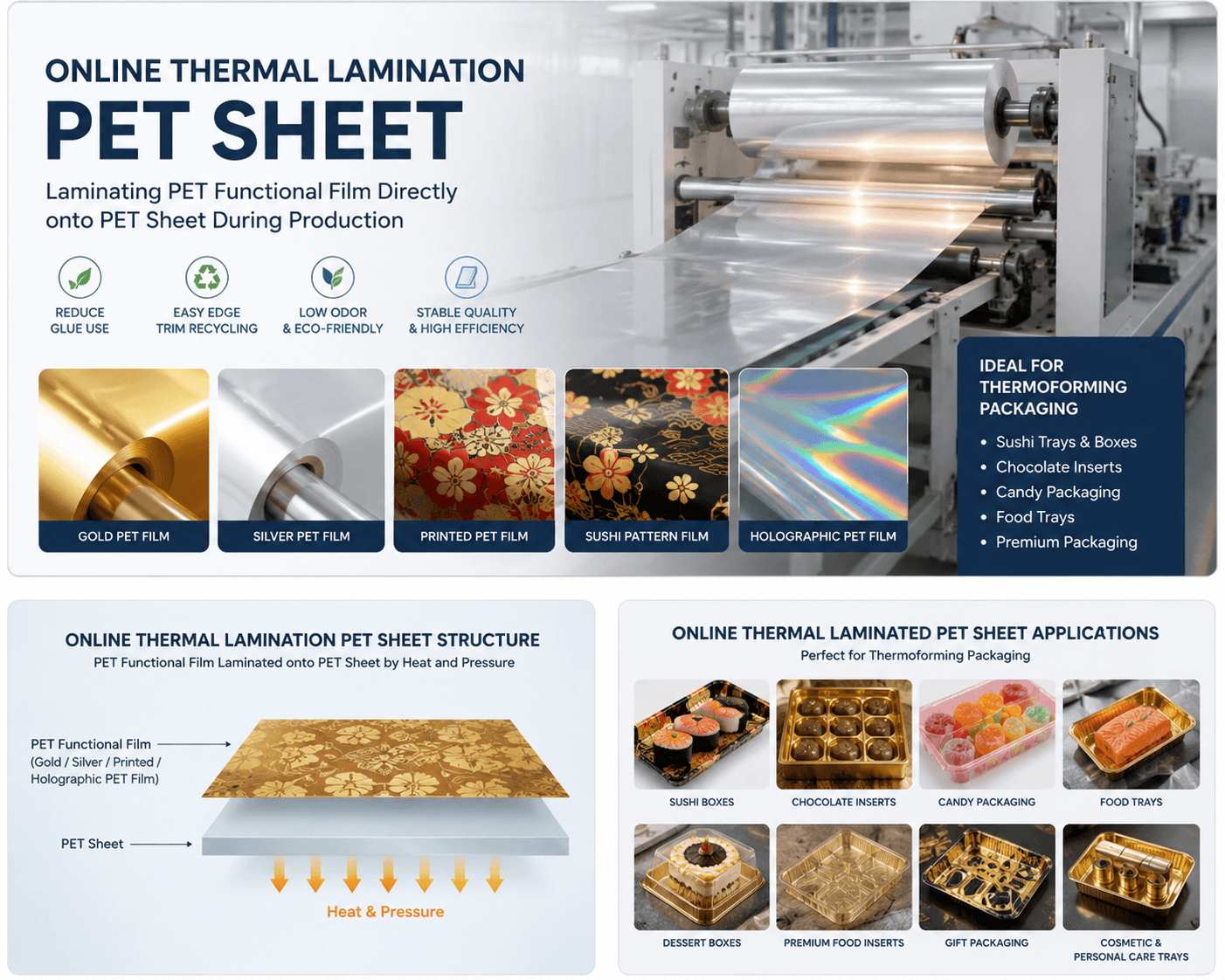

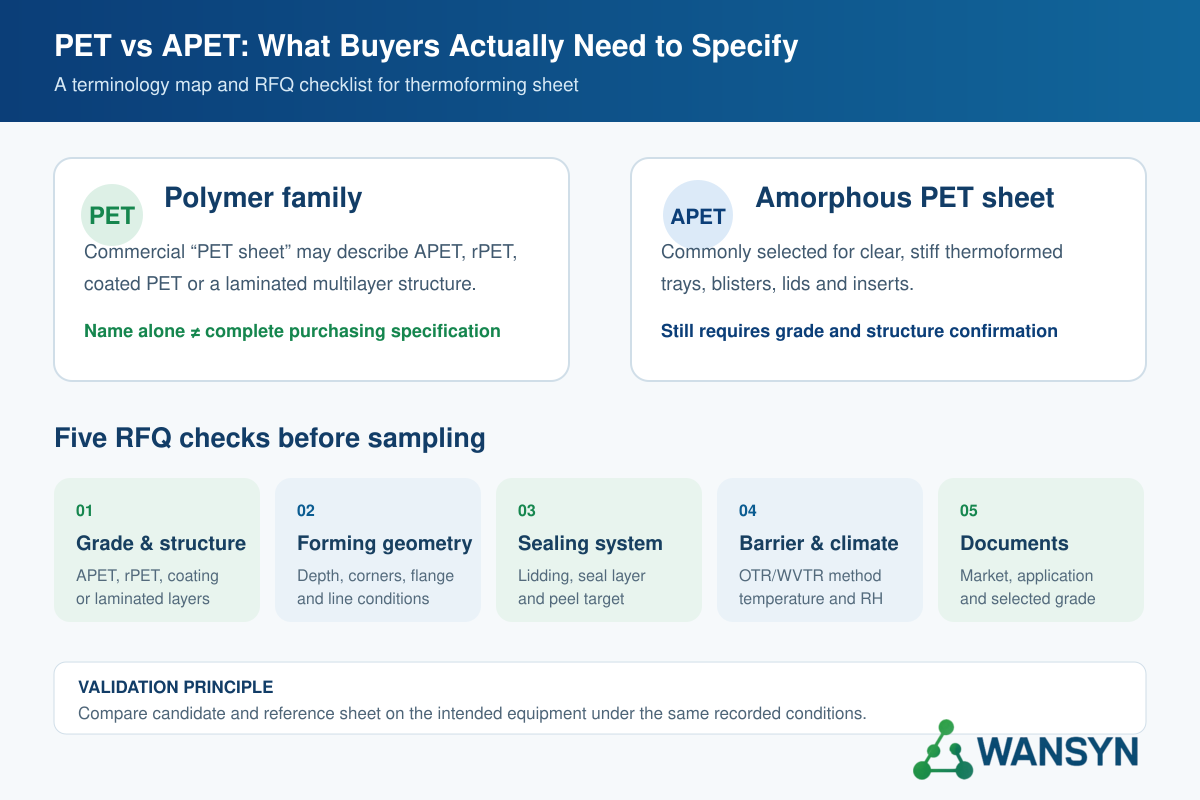
Buyers often ask about PET vs APET sheet as if the terms always describe two completely different materials. In packaging, PET is the polymer family, while APET usually refers to amorphous PET sheet commonly selected for clear thermoformed packaging. A quotation labelled only “PET sheet” may still be APET, recycled-content PET, a laminated PET structure or another grade. The name alone is not a sufficient purchasing specification.
WANSYN supplies PET-based thermoforming sheet and functional laminated structures as part of an annual functional-sheet capacity of 6,000 metric tons. To avoid material mismatches, buyers should define the structure, forming conditions, sealing system and end-use requirements together.
What Does APET Mean?
APET means amorphous polyethylene terephthalate. In practical thermoforming packaging, APET sheet is commonly associated with clear, stiff sheet that can be heated and formed into trays, blisters, lids and inserts.
However, APET does not automatically mean:
- A specific recycled-content percentage
- A food-contact declaration for every market
- A fixed impact or temperature rating
- A sealing layer
- An oxygen-barrier structure
- Suitability for every forming depth or package design
Those requirements must be specified separately and verified for the selected grade and structure.
PET, APET, rPET and Laminated PET Are Not the Same Specification
APET sheet
Usually refers to amorphous PET sheet selected for clear thermoforming. The buyer should still specify thickness, width, recycled content if required, transparency, color and forming conditions.
rPET sheet
Contains recycled PET at a stated level or in a stated layer design. The percentage, source, color, intrinsic-viscosity requirements and applicable documentation should be agreed. “rPET” should not be treated as one universal grade.
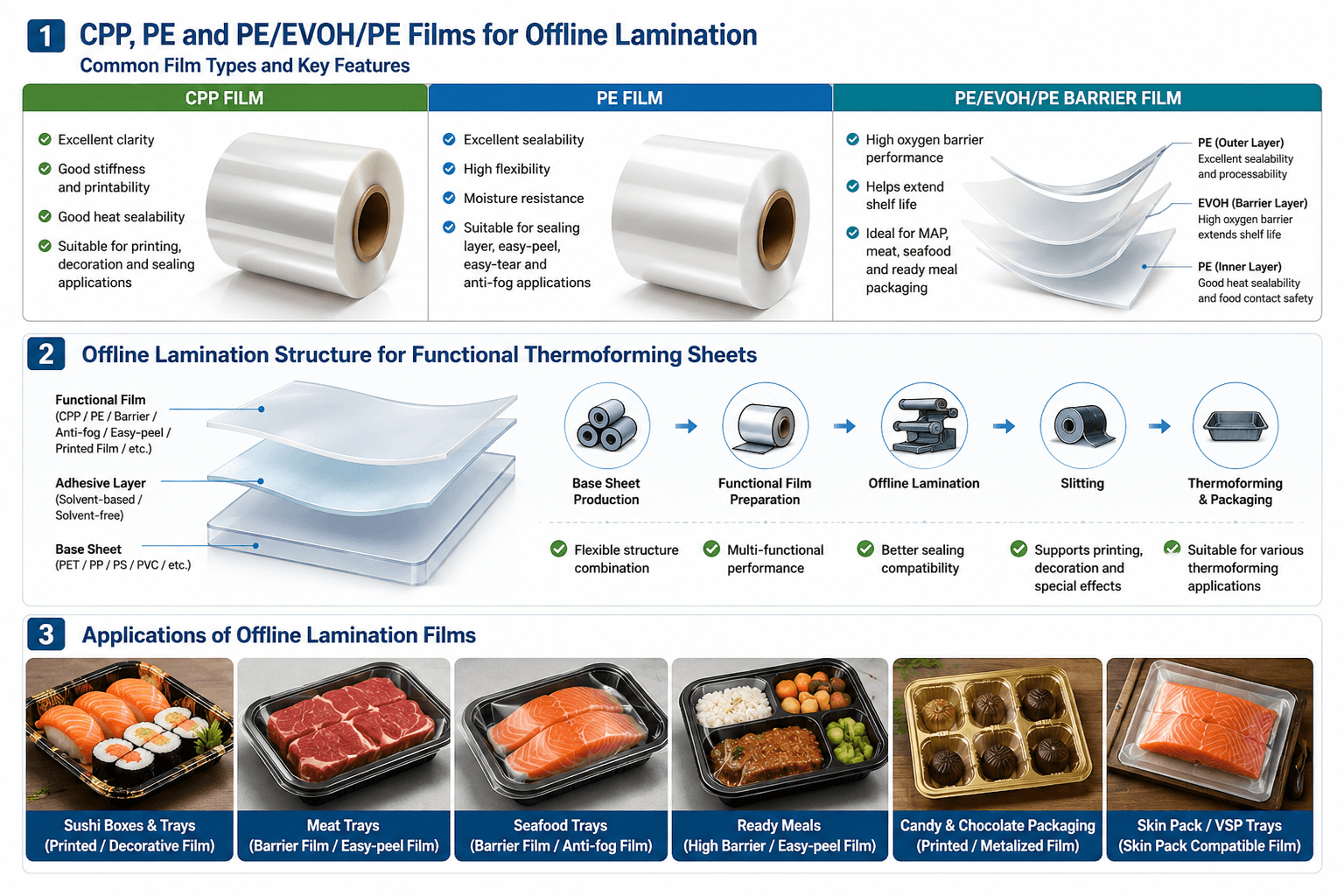
PET/PE or PET/CPP laminated sheet
Adds another layer for sealing, peel, moisture protection, decoration or other functions. Layer orientation matters: the buyer must identify which side contacts the product, which side is sealed and which surface faces the forming tool.
PET/EVOH/PE high-barrier sheet
Uses a multilayer structure for oxygen-barrier and sealing requirements. Flat-sheet OTR or WVTR data must state the test method, temperature and relative humidity. Finished-package performance also depends on forming depth, layer thinning, seal integrity, lidding material and storage conditions.
When the Difference Matters to a Thermoformer
The practical PET vs APET sheet decision starts with the process and package, not with terminology alone.
Heating and forming window
Sheet temperature, heater settings, dwell time, forming depth, cavity geometry and line speed affect material distribution. A trial should check corners, sidewalls, flange flatness, web handling and trim behavior.
Clarity and appearance
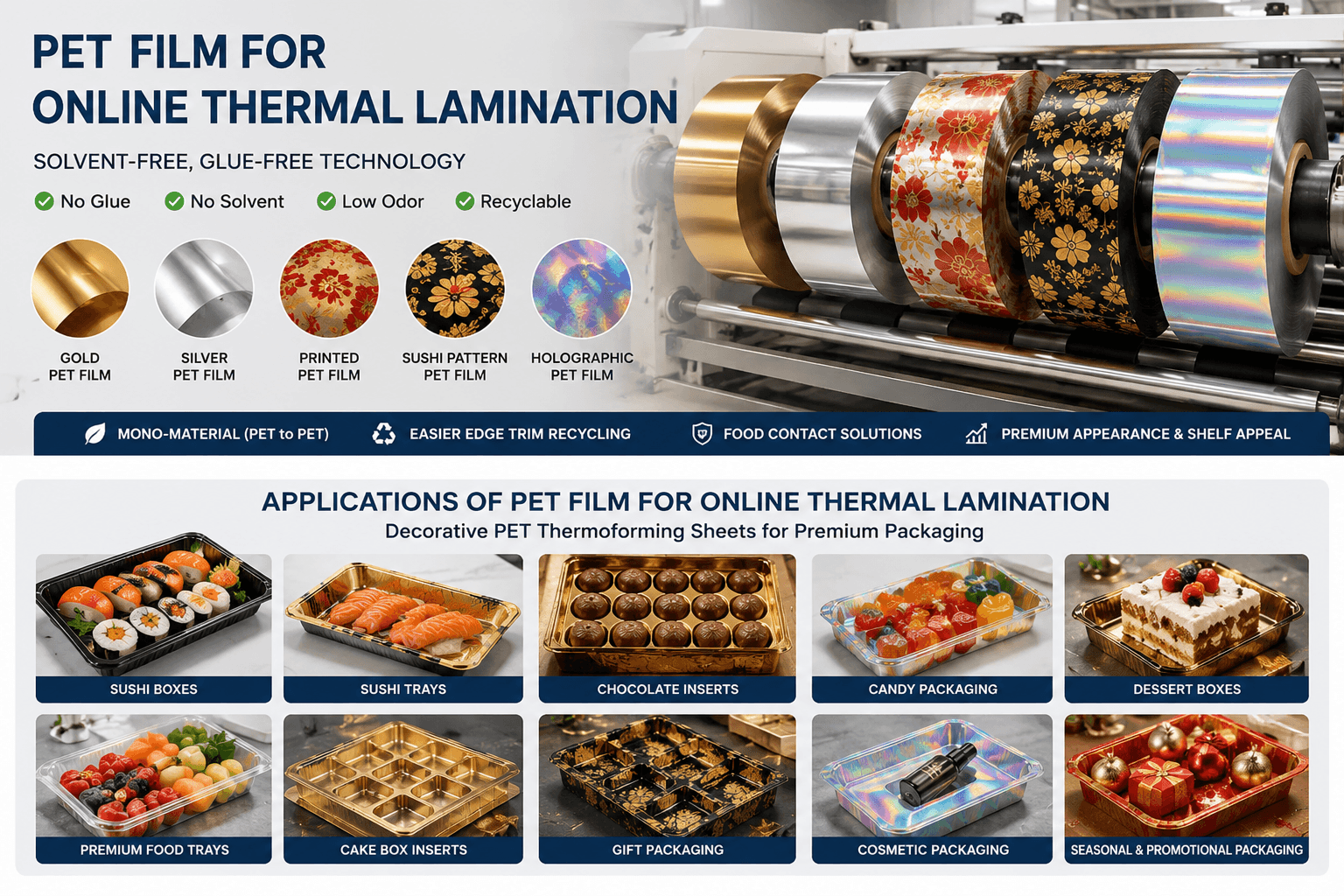
For clear retail packaging, define haze, color and surface appearance using an agreed reference or method. Recycled content, coatings, printing, metallization and lamination can change the appearance.
Sealing requirements
Mono APET does not automatically seal to every lidding film or tray system. If the package requires heat sealing or easy peel, specify the sealing layer, lidding material, sealing temperature window, target seal strength and peel behavior.
Barrier requirements
If shelf life or modified-atmosphere packaging is relevant, state the product, atmosphere, storage temperature, package geometry and target OTR/WVTR with test conditions. Do not infer shelf life from a headline barrier value alone.
Temperature exposure
Disclose chilled, frozen, hot-fill, microwave or other temperature conditions. Suitability must be tied to the named grade, structure, package design and test method.
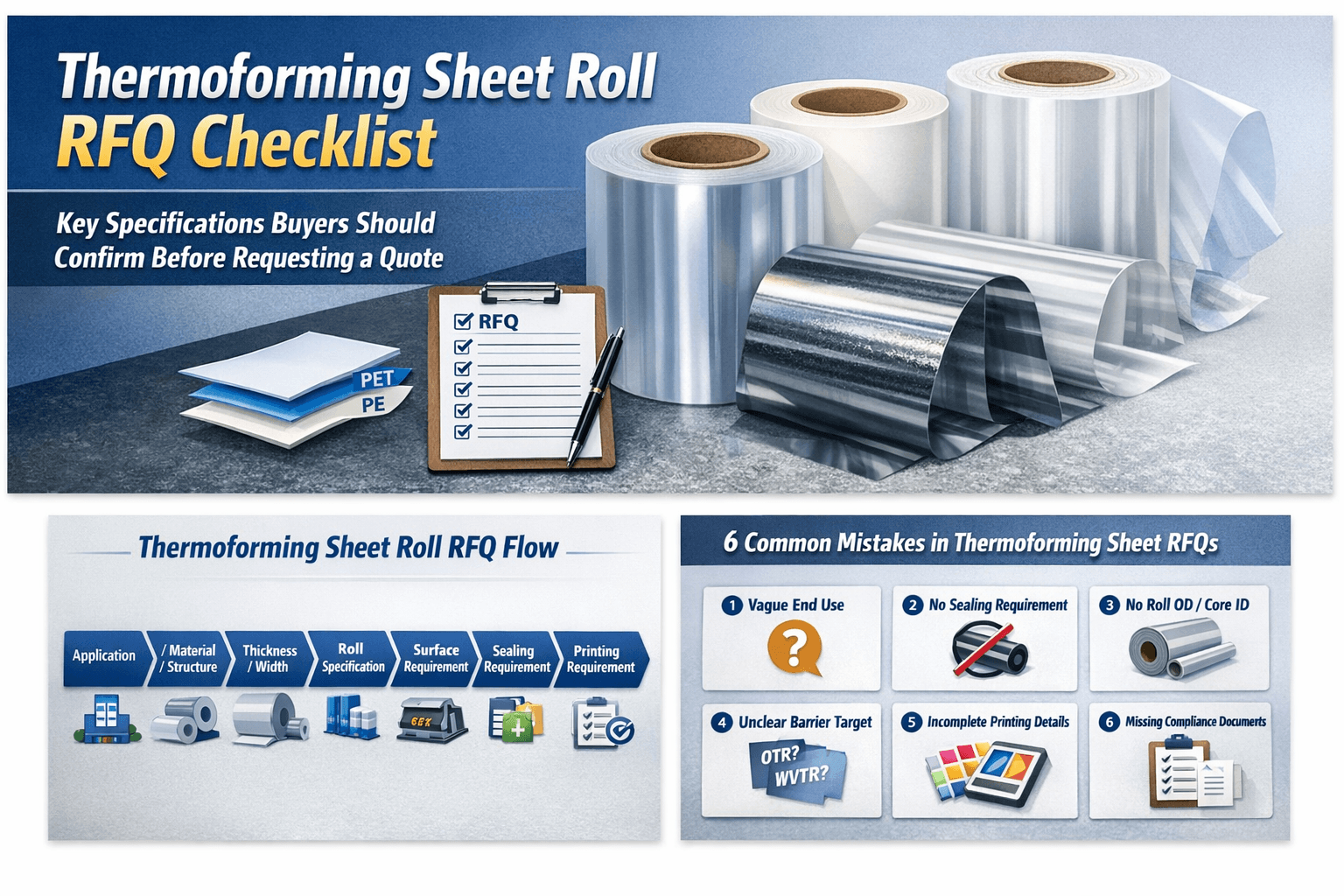
PET/APET Sheet RFQ Checklist
A useful PET vs APET sheet RFQ converts the intended application into measurable supply and trial requirements.
Provide the following information for an accurate recommendation and quotation:
- Application and packaged product
- Mono APET, rPET or proposed laminated structure
- Thickness and tolerance
- Width and tolerance
- Core size, roll outside diameter and winding direction
- Thermoformer model, heating method and line speed
- Forming depth, cavity geometry and flange requirements
- Required transparency, color, printing or metallization
- Sealing layer and lidding material
- Barrier target with test conditions, if relevant
- Recycled-content requirement and required documentation
- Trial quantity and annual purchasing volume
How to Validate a New Sheet
Run a representative trial on the intended equipment and record:
- Heating window and web stability
- Thickness distribution after forming
- Corner whitening, brittleness or stress marks
- Flange flatness and trim quality
- Seal and peel behavior where applicable
- Transparency and visual appearance
- Finished-package performance under actual storage and distribution conditions
The result should be compared with the current reference sheet under the same process and test conditions.
Related WANSYN Resources
- PET Sheet Rolls for Thermoforming Packaging
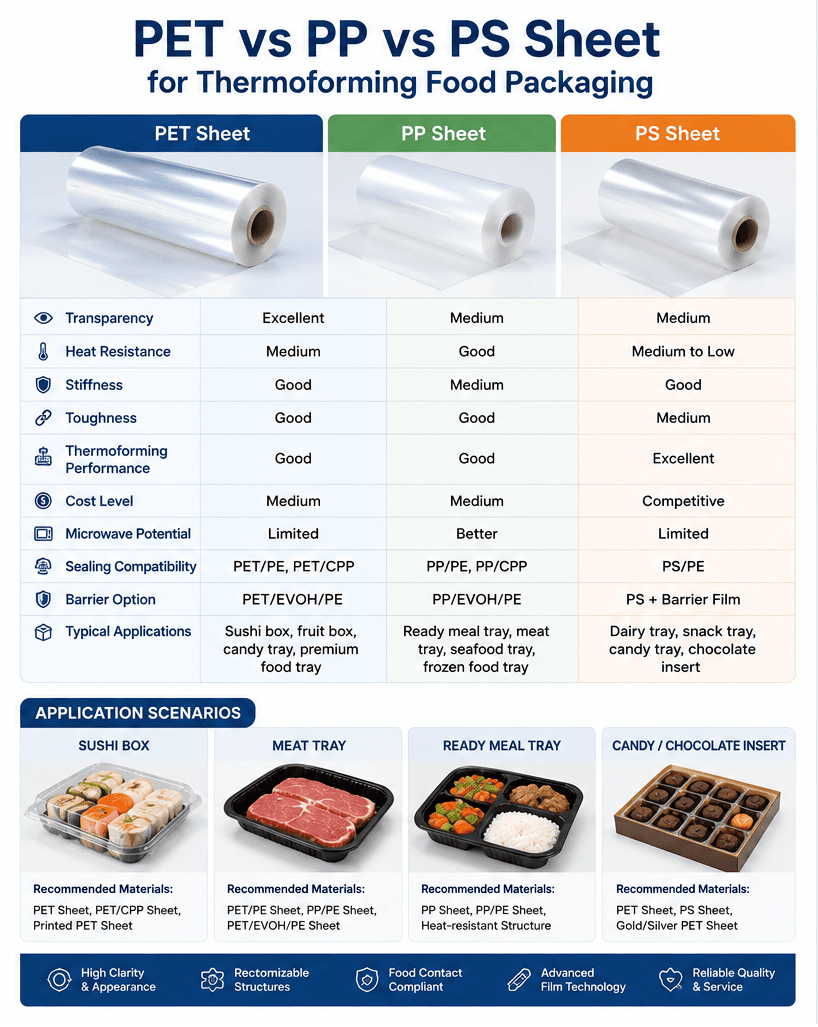
- PET vs PP vs PS for Thermoforming Food Packaging
- Laminated PET/PE, PS/PE and PP/PE Sheet Structures
- High-Barrier and MAP Thermoforming Sheets
- Thermoforming Sheet Roll RFQ Checklist
Frequently Asked Questions
Is PET sheet the same as APET sheet?
PET is the polymer family; APET usually describes amorphous PET sheet used for thermoforming. A supplier may use “PET sheet” as a general commercial name, so the exact grade and structure must be confirmed.
Does APET contain recycled material?
Not necessarily. Recycled content should be specified separately, including the required percentage, layer design and documentation.
Can APET be heat sealed directly?
It depends on the sealing system. Many projects use a sealing layer or laminated structure. Specify the lidding material, sealing temperature and peel target before material selection.
Is APET suitable for frozen or hot applications?
No universal answer applies. Temperature suitability depends on the grade, structure, package design and test conditions. Disclose the complete temperature cycle during the RFQ stage.
What is the difference between mono APET and PET/EVOH/PE?
Mono APET is a single-polymer PET sheet structure, while PET/EVOH/PE combines forming, oxygen-barrier and sealing functions. Layer structure, forming depth and seal integrity must be validated for the finished package.
Request a PET/APET Sheet Review
Send the package application, target structure, thickness, width, forming depth, sealing system, barrier target and annual volume through the WANSYN contact page. We will identify missing specification items before sampling or quotation.