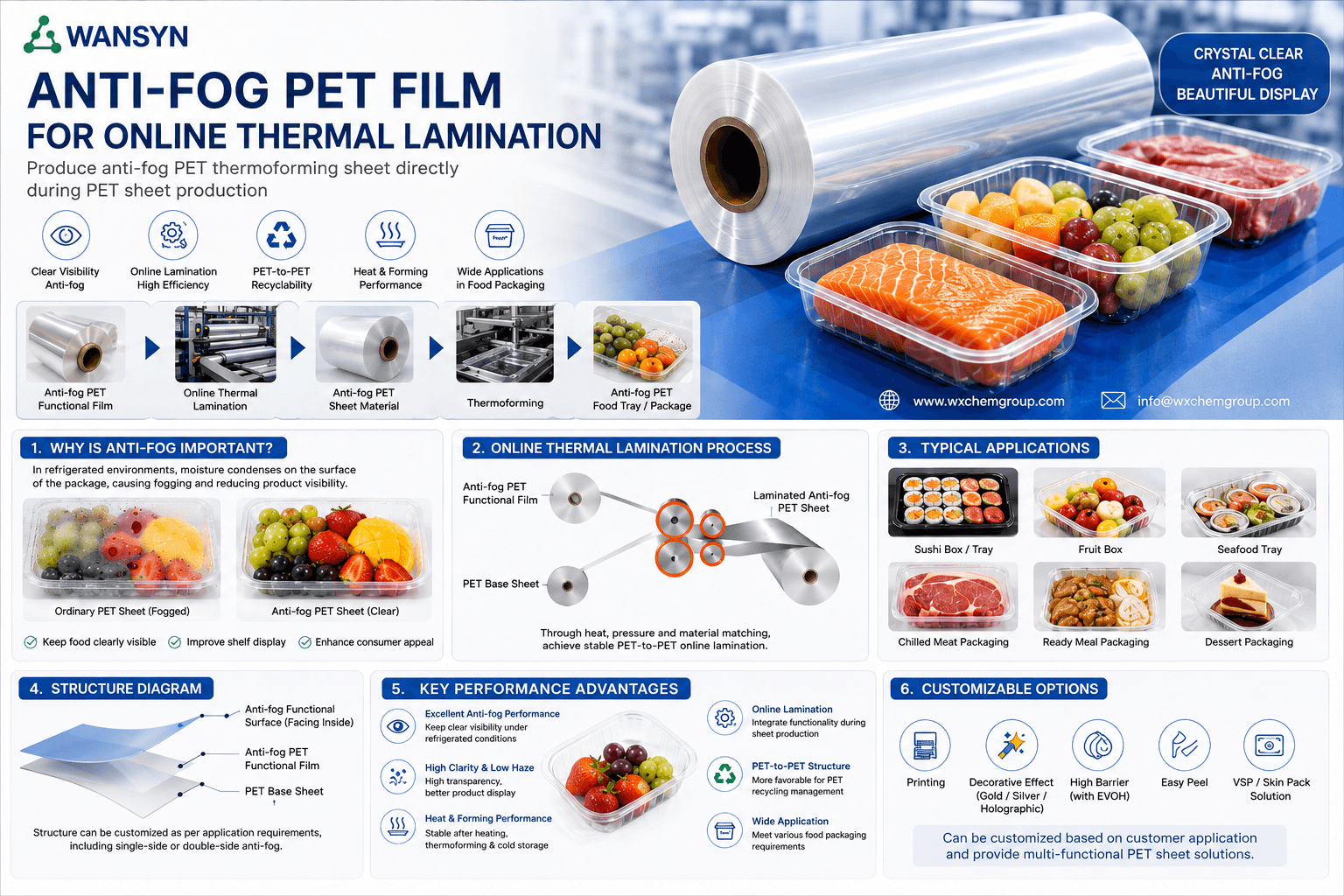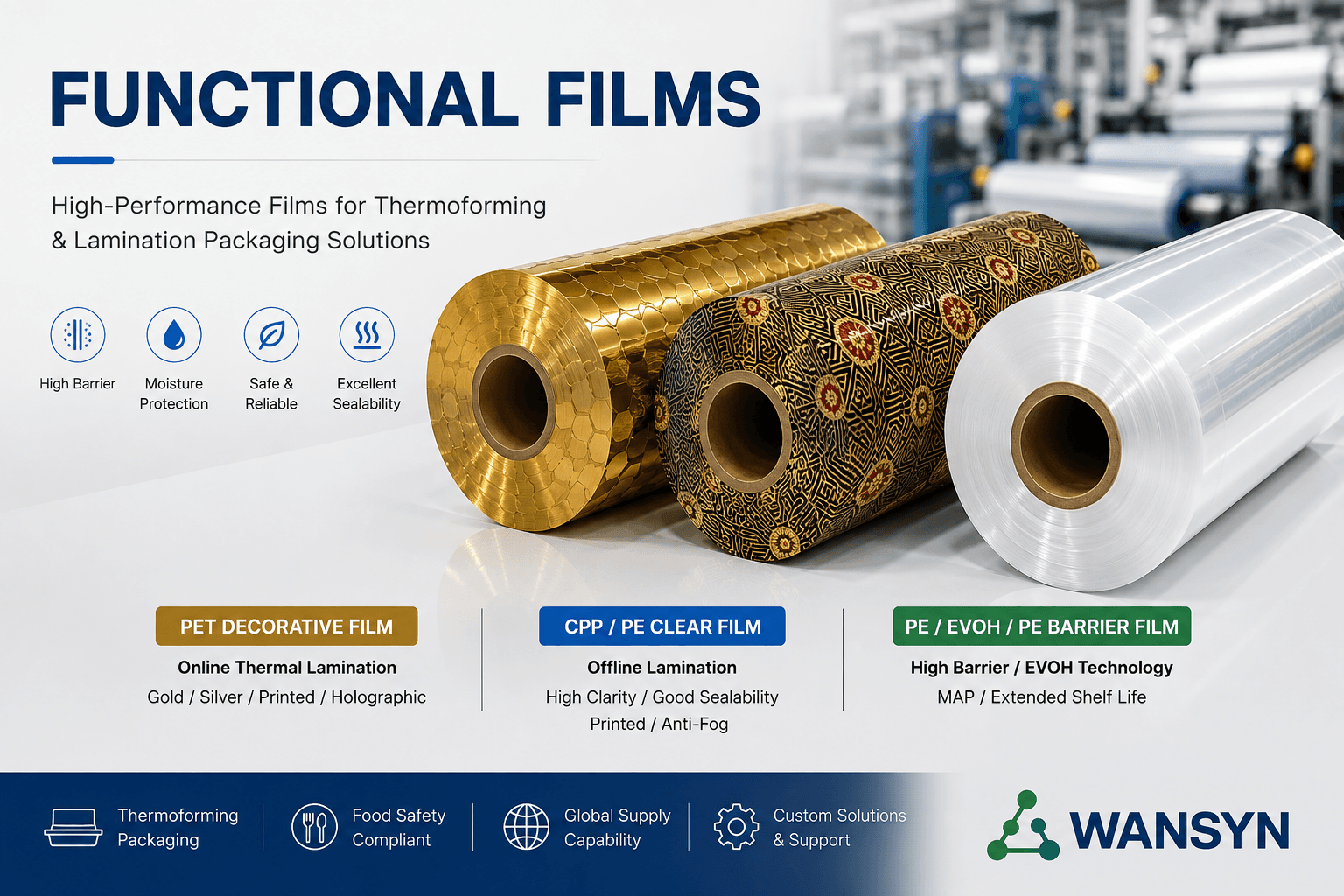

PE/EVOH/PE High Barrier Film for Online Thermal Lamination to PET Sheet
From Conventional Offline Lamination to In-Line High Barrier PET Thermoforming Sheet Production
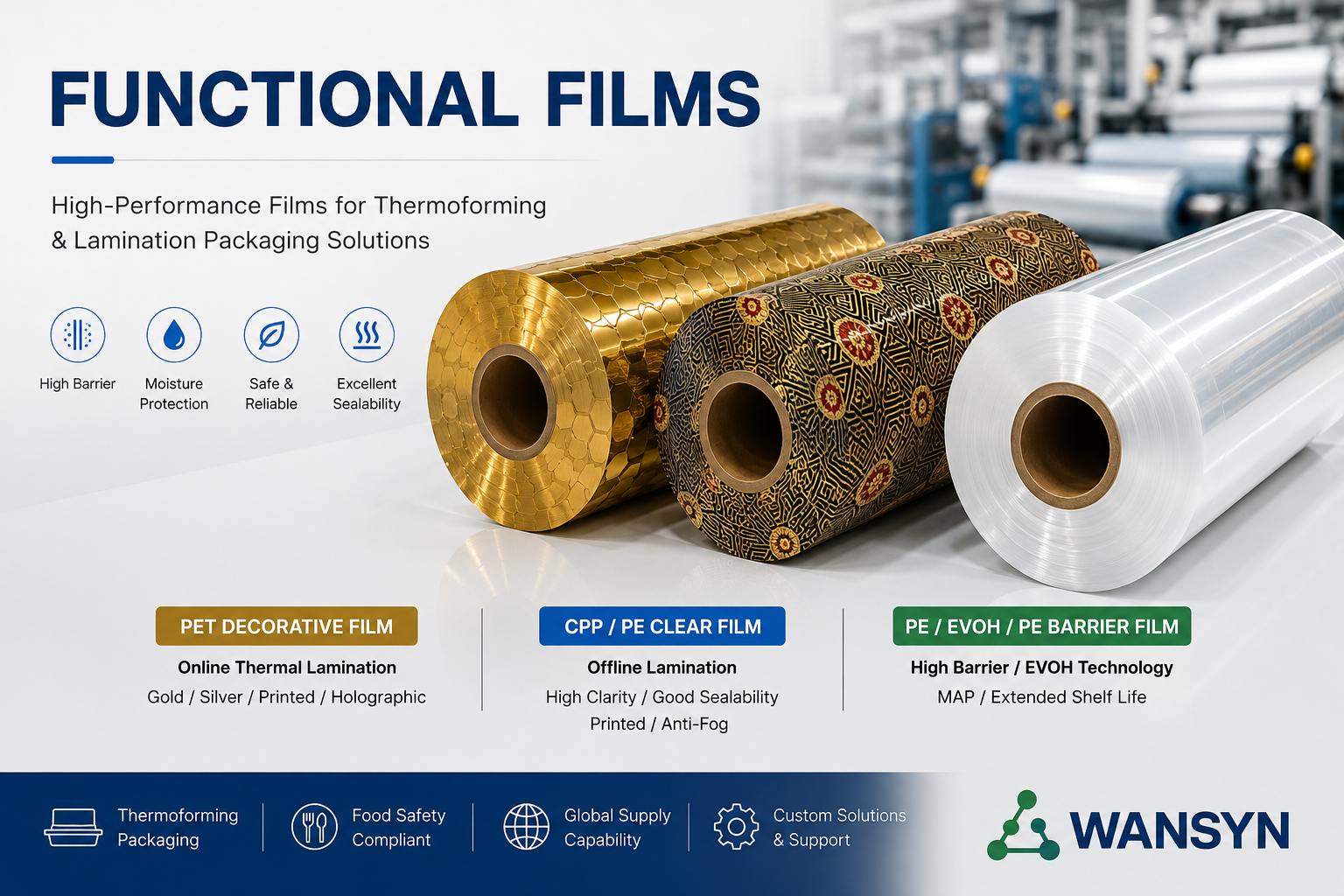
PE/EVOH/PE film is widely used in high-barrier food packaging because the EVOH layer provides strong oxygen barrier performance, while the PE layers protect the barrier layer and can provide sealing and processing functions.
Traditionally, PE/EVOH/PE barrier film is commonly laminated onto PET sheet in a separate offline lamination process.
WANSYN offers a different solution:
A specially designed PE/EVOH/PE high barrier film can be directly thermally laminated onto PET sheet during PET sheet production.
The resulting structure is:
PET / PE / EVOH / PE
This allows PET sheet manufacturers and thermoforming packaging producers to integrate high-barrier functionality directly into the PET sheet production process, reducing the need for a separate offline lamination step.
The final PET/PE/EVOH/PE sheet can be used for thermoformed food trays for meat, seafood, ready meals, cheese, MAP packaging and other shelf-life-sensitive food applications.
Quick Answer: What Is PE/EVOH/PE Film for Online Thermal Lamination?
PE/EVOH/PE film for online thermal lamination is a multilayer high-barrier film specifically designed to be laminated onto PET sheet during the PET sheet extrusion process.
Conventional Process
PET Sheet Extrusion
↓
PET sheet winding and handling
↓
PE/EVOH/PE barrier film
↓
Offline lamination
↓
PET/PE/EVOH/PE high barrier sheet
Online Thermal Lamination Process
PET Sheet Extrusion + PE/EVOH/PE Barrier Film
↓
Online Thermal Lamination
↓
PET/PE/EVOH/PE High Barrier Thermoforming Sheet
The key difference is that the barrier film is integrated during PET sheet production instead of being added through a separate offline lamination process.
Why Is This Different from Conventional PE/EVOH/PE Lamination?
PE/EVOH/PE barrier films are commonly used in offline laminated structures because PET and PE belong to different polymer families and the interface must be properly designed for reliable bonding.
For online thermal lamination, a standard PE/EVOH/PE film should not automatically be assumed to work.
The film must be specifically matched for:
- PET contact surface
- Thermal lamination temperature
- Lamination pressure
- Film tension
- Line speed
- Dimensional stability
- Interlayer bonding
- Downstream thermoforming
This is the main technical difference.
Not every PE/EVOH/PE barrier film is suitable for online thermal lamination to PET sheet.
WANSYN evaluates the barrier film together with the PET sheet production process to achieve a stable online laminated structure.
Understanding the PET / PE / EVOH / PE Structure
A typical finished structure can be represented as:
PET Base Sheet
PET provides the main structural properties of the thermoforming sheet, including:
- Sheet stiffness
- Transparency
- Dimensional stability
- Thermoforming support
- Tray structural strength
PE Functional Layer
The PE layer can provide or support:
- Lamination interface
- Flexibility
- Protection of the EVOH layer
- Sealing-related performance
The exact function depends on the film formulation and layer design.
EVOH Barrier Layer
EVOH is primarily used as the oxygen and gas barrier layer.
It can help reduce oxygen transmission into the package and therefore support food quality and shelf-life requirements.
PE Surface Layer
The outer PE layer can be designed according to the final packaging system for functions such as:
- Food-contact surface
- Heat sealing
- Lidding-film compatibility
- Easy-peel evaluation
- Anti-fog functional integration
The final layer design should always be matched to the actual package.
Why Is EVOH Used in High-Barrier Food Packaging?
EVOH is widely used in multilayer food packaging because of its very high oxygen barrier performance.
For oxygen-sensitive foods, controlling oxygen transmission can help reduce:
- Oxidation
- Color change
- Aroma loss
- Flavor deterioration
- Quality degradation
Typical applications include:
- Fresh meat
- Processed meat
- Seafood
- Fish
- Cheese
- Deli products
- Ready meals
- MAP food packaging
However, EVOH is sensitive to moisture.
This is one of the reasons why it is commonly placed inside a multilayer structure such as:
PE / EVOH / PE
The PE layers help protect EVOH from moisture while also providing processing and sealing functions.
What Are the Main Advantages of Online Thermal Lamination?
1. Reduce a Separate Offline Lamination Step
In a conventional process, PET sheet is produced first and then transferred to another lamination process.
Online thermal lamination integrates the barrier-film lamination directly into PET sheet production.
This can reduce:
- Intermediate winding
- Material handling
- Transfer between production processes
- Separate offline lamination scheduling
For stable specifications and continuous-volume projects, this can simplify the manufacturing flow.
2. Produce Functional PET Sheet Directly from the Production Line
The output is already a functional multilayer sheet:
PET/PE/EVOH/PE High Barrier Sheet Roll
It can then proceed to:
- Thermoforming
- Vacuum forming
- Tray production
- Food packaging conversion
This is especially relevant for PET sheet manufacturers looking to add high-barrier sheet products without treating barrier lamination as a completely separate downstream step.
3. Combine PET Rigidity with EVOH Barrier and PE Sealing Functions
The structure combines several material advantages:
PET
→ rigidity and thermoforming base
EVOH
→ oxygen barrier
PE
→ barrier protection, flexibility and sealing-related functions
This makes PET/PE/EVOH/PE particularly suitable for functional food tray applications.
4. Suitable for High-Value Thermoforming Sheet Products
Instead of supplying standard PET sheet only, sheet manufacturers can develop higher-value products such as:
- High barrier PET sheet
- MAP tray sheet
- Meat tray material
- Seafood tray material
- Ready meal tray sheet
- EVOH barrier thermoforming sheet
This is particularly attractive for thermoforming converters and packaging manufacturers that require more than basic PET performance.
Where Is PET/PE/EVOH/PE High Barrier Sheet Used?
Fresh Meat Packaging
PET/PE/EVOH/PE sheet can be evaluated for fresh beef, pork, poultry and processed meat trays where oxygen barrier and sealing performance are important.
Typical packaging systems include:
- MAP meat trays
- Sealed meat trays
- Chilled meat packaging
Seafood and Fish Packaging
Seafood is highly sensitive to packaging and storage conditions.
High-barrier thermoforming sheets can be used for:
- Fish trays
- Seafood trays
- Shrimp packaging
- Chilled seafood
- Processed seafood
Ready Meal Packaging
Ready meals may require a combination of:
- Barrier
- Sealing
- Shelf-life support
- Product visibility
- Tray rigidity
PET/PE/EVOH/PE can therefore be evaluated according to the actual filling, storage and sealing conditions.
Cheese and Deli Packaging
Cheese and processed deli products are common applications for EVOH-based barrier packaging because oxygen control can be important for product quality and shelf life.
MAP — Modified Atmosphere Packaging
PET/PE/EVOH/PE is particularly relevant for MAP packaging.
A typical MAP system must consider:
High Barrier Bottom Tray
High Barrier Lidding Film
Reliable Seal Integrity
Correct Gas Composition
The bottom tray alone does not determine the final shelf life.
What Buyers Should Really Check: Not Just EVOH Percentage
One of the most common questions is:
“What percentage of EVOH is in the structure?”
EVOH content is useful information, but it should not be the only purchasing criterion.
Two structures with similar EVOH percentages can still deliver different final packaging performance.
Professional buyers should evaluate:
OTR
Oxygen Transmission Rate
A lower OTR generally means stronger oxygen barrier performance.
But every OTR value should be accompanied by its test conditions, especially temperature and relative humidity.
WVTR
Water Vapor Transmission Rate
WVTR describes water-vapor transmission through the complete structure.
Because EVOH itself is moisture-sensitive, the final WVTR performance depends heavily on the complete multilayer construction, including the PE layers.
EVOH Layer Thickness and Grade
Barrier performance depends not only on “EVOH percentage” but also on:
- EVOH grade
- EVOH layer thickness
- Ethylene content
- Complete film structure
- Humidity
- Processing history
Thermoforming Depth
Deep-draw thermoforming changes the local thickness distribution of the sheet.
Corners and sidewalls may become substantially thinner than the original flat sheet.
This can directly influence final package barrier performance.
Flat-Sheet OTR Is Not the Same as Final Tray Performance
This is one of the most important points in high-barrier thermoforming packaging.
A supplier may provide an excellent OTR value for the original PE/EVOH/PE film or flat laminated sheet.
But after thermoforming, material distribution changes.
The highest stretching usually occurs around:
- Tray corners
- Sidewalls
- Deep-draw zones
- Radius areas
Therefore, a professional barrier evaluation should follow the actual production sequence:
PE/EVOH/PE Barrier Film
↓
Online Laminated PET/PE/EVOH/PE Sheet
↓
Thermoforming
↓
Finished Tray
↓
Final Barrier Evaluation
For demanding MAP or extended-shelf-life projects, the performance of the formed package is more meaningful than the barrier value of the original flat film alone.
Barrier Is Only One Part of Shelf-Life Performance
A high-barrier tray does not automatically guarantee long shelf life.
The complete packaging system also includes:
- Lidding-film barrier
- Heat-sealing compatibility
- Seal integrity
- Microleak control
- Tray flange quality
- Easy-peel layer
- Filling conditions
- MAP gas composition
- Storage temperature
- Cold-chain conditions
For example, an excellent EVOH barrier layer cannot compensate for a leaking seal.
Therefore, WANSYN recommends evaluating the complete packaging system, not only the EVOH layer.
Can Easy-Peel, Anti-Fog or Other Functions Be Added?
Yes, these functions can be evaluated according to the final package.
Easy-Peel
For trays that need convenient consumer opening, the PE-side structure can be designed or matched with an easy-peel sealing system.
The final peel performance should be tested together with:
- Lidding film
- Tray sealing layer
- Sealing temperature
- Pressure
- Dwell time
- Target peel strength
Anti-Fog
For chilled meat, seafood and ready meal packaging, anti-fog performance can help improve product visibility.
Anti-fog can be evaluated through the appropriate functional layer or packaging structure.
Printing
Printed structures can be evaluated when branding, product information or decorative effects are required.
VSP / Skin Pack
For VSP and Skin Pack packaging, the bottom sheet must be matched with the top skin film, sealing surface, machine and product geometry.
A high-barrier bottom sheet alone does not determine skin-pack performance.
Online Thermal Lamination vs Offline Lamination
| Factor | Online Thermal Lamination | Conventional Offline Lamination |
|---|---|---|
| PET + PE/EVOH/PE | Specially matched film required | Common production route |
| Lamination stage | During PET sheet production | After PET sheet production |
| Separate lamination process | Reduced | Required |
| Continuous production | Strong advantage | Possible but separate |
| Structure flexibility | Project-specific | Very flexible |
| High-barrier function | Yes | Yes |
| Easy-peel / anti-fog | Can be designed | Can be designed |
| Best suited for | Stable specifications and continuous production | Multiple structures and frequent product changes |
Neither process is universally better.
The right solution depends on:
Structure + Barrier Target + Volume + Equipment + End Application
Who Should Consider This Solution?
This online thermal lamination solution is especially relevant to:
PET Sheet Manufacturers
Companies that already operate PET sheet extrusion lines and want to expand into:
- PET/PE/EVOH/PE sheet
- High barrier PET sheet
- EVOH thermoforming sheet
- MAP tray material
Thermoforming Packaging Manufacturers
Companies producing:
- Meat trays
- Seafood trays
- Ready meal trays
- MAP trays
- High-barrier food trays
Food Packaging Converters
Converters looking for ready-to-thermoform high-barrier sheet rather than arranging a separate lamination process.
Packaging Material Distributors
Distributors looking to add high-barrier thermoforming sheet and barrier-film products to their portfolio.
RFQ Checklist: What Information Should You Send Us?
For a faster technical evaluation and quotation, please provide:
Application
Meat / seafood / fish / cheese / ready meal / MAP / VSP / other
Current Structure
PET / PET-PE / PET-EVOH-PE / other
PET Sheet Thickness
___ mm
Sheet Width
___ mm
PE/EVOH/PE Film Thickness
___ μm
EVOH Layer or Content
___ / Not sure
Final Sheet Thickness
___ mm
Thermoforming Depth
___ mm
Tray Dimensions
___ × ___ × ___ mm
Required OTR
___ cc/m²/day
Test condition: ___
Required WVTR
___ g/m²/day
Test condition: ___
Storage Condition
Ambient / chilled / frozen
Shelf-Life Target
___ days
Lidding Film Structure
Easy-Peel Required
Yes / No
Anti-Fog Required
Yes / No
Food Contact Market
EU / USA / Japan / other
Sample Requirement
Barrier film / laminated sheet / trial roll
Target Quantity
___ kg / tons
How Can WANSYN Support Your Project?
WANSYN can support customers with:
- PE/EVOH/PE high barrier film
- PE/EVOH/PE film for online thermal lamination
- PET/PE/EVOH/PE high barrier sheet
- High barrier PET thermoforming sheet rolls
- MAP tray sheet materials
- Meat and seafood tray materials
- Ready meal high-barrier sheet
- Online thermal lamination process matching
- Thermoforming trial evaluation
- OTR / WVTR structure evaluation
- Easy-peel structure evaluation
- Anti-fog function evaluation
- High-barrier food packaging solutions
If you currently use:
PET Sheet + Offline Laminated PE/EVOH/PE Film
and want to evaluate:
PET Sheet + Online Thermal Laminated PE/EVOH/PE Film
send us your current structure, PET thickness, PE/EVOH/PE film specification, forming depth and barrier target.
WANSYN can help evaluate whether online thermal lamination is suitable for your existing PET sheet production or thermoforming packaging project.
FAQ
Q1: Can PE/EVOH/PE film be thermally laminated directly onto PET sheet online?
Yes, when the PE/EVOH/PE film is specifically designed and matched for the PET sheet production process. A standard barrier film should not automatically be assumed to be suitable. Surface design, temperature, pressure, tension, bonding and thermoforming performance must be evaluated.
Q2: What is the final structure?
A typical structure is:
PET / PE / EVOH / PE
Exact layer design depends on barrier, sealing, forming and food packaging requirements.
Q3: How is this different from conventional PET/PE/EVOH/PE sheet?
The final material structure may be similar, but the manufacturing process is different. Conventional production commonly laminates the barrier film after PET sheet production. Online thermal lamination integrates this step into PET sheet production.
Q4: Is PET/PE/EVOH/PE suitable for MAP trays?
It can be used for MAP packaging projects, especially meat, seafood, cheese and ready meals. However, bottom-web barrier, lidding-film barrier, sealing integrity and actual shelf-life requirements should be evaluated together.
Q5: Is higher EVOH content always better?
No. EVOH content alone does not determine final packaging performance. EVOH grade, layer thickness, humidity, forming depth, total structure and target OTR should all be considered.
Q6: Should OTR be tested after thermoforming?
For demanding high-barrier applications, yes. Thermoforming changes material thickness distribution, so formed-tray barrier performance is more relevant than flat-film data alone.
Q7: Can the structure include easy-peel or anti-fog functions?
Yes, these functions can be evaluated through appropriate layer and sealing-system design. They should be tested with the actual tray, lidding film and packaging conditions.
Q8: Is PET/PE/EVOH/PE recyclable?
PET/PE/EVOH/PE is a multi-material structure. Its recyclability depends on the final composition, material ratios, local recycling regulations and available recycling infrastructure. Recycling claims should therefore be evaluated for the specific target market.
Q9: Who is this solution mainly designed for?
It is particularly suitable for PET sheet manufacturers, thermoforming food packaging manufacturers, MAP tray producers and converters looking to develop high-barrier PET sheet products.
Conclusion
PE/EVOH/PE barrier film is traditionally used in offline lamination with PET sheet.
WANSYN offers a different production route:
PE/EVOH/PE High Barrier Film
↓
Online Thermal Lamination During PET Sheet Production
↓
PET/PE/EVOH/PE High Barrier Thermoforming Sheet
The value of this technology is not simply the addition of an EVOH layer.
Its real advantage is the integration of barrier-film lamination directly into PET sheet production, offering PET sheet manufacturers and thermoforming converters another way to produce high-value barrier sheets for meat, seafood, ready meals and MAP packaging.
For a successful project, the key evaluation points are:
Online Lamination Compatibility + EVOH Barrier Design + Thermoforming Performance + Sealing System + Final Package Barrier
If you are currently using offline-laminated PET/PE/EVOH/PE sheet or are developing a new high-barrier PET thermoforming project, contact WANSYN with your current structure, forming depth, OTR/WVTR target and packaging application.
We can help evaluate whether online thermal lamination is suitable for your project.