
PE/EVOH/PE High-Barrier Film for Online Thermal Lamination to PP Sheet
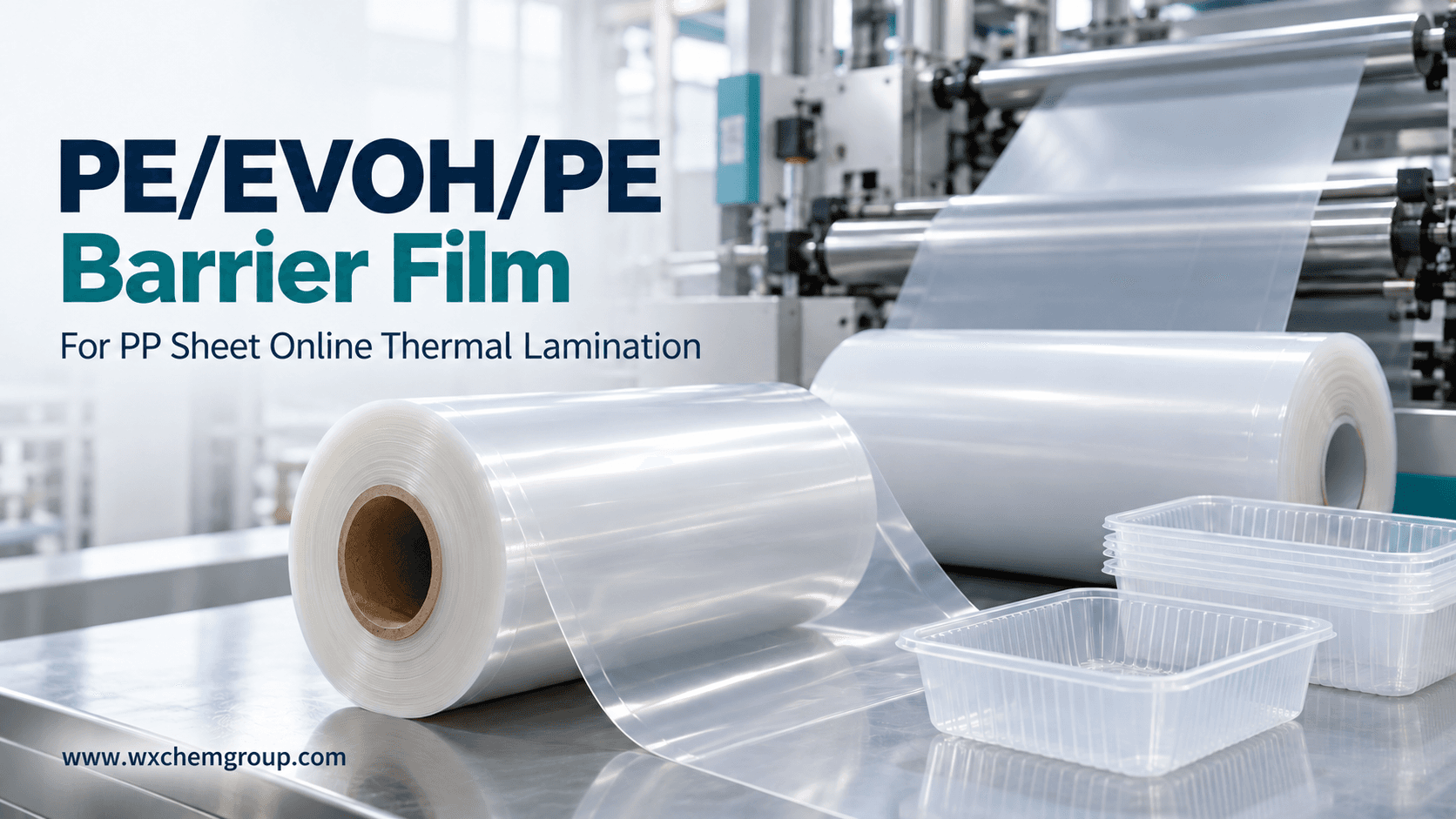
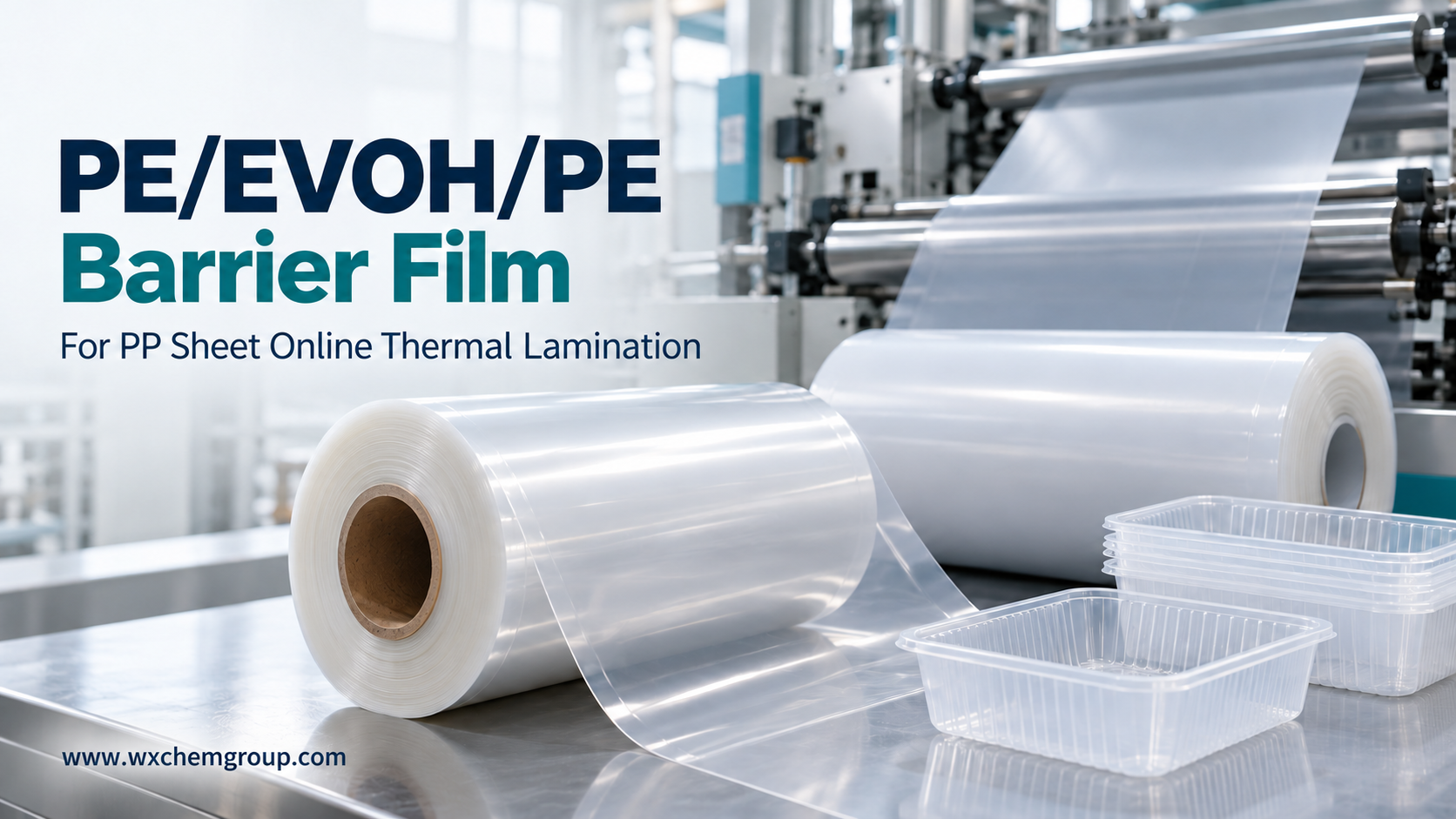
WANSYN supplies PE/EVOH/PE barrier film specially developed for online thermal lamination to PP sheet. This PP-line grade is designed to add an EVOH oxygen-barrier function and a PE sealing face during polypropylene sheet production, supporting the development of PP-based barrier thermoforming sheets for modified atmosphere packaging (MAP).
For PP sheet producers with a suitable inline lamination station, this route can integrate barrier-film lamination into sheet production and reduce the need for a separate offline lamination operation. Film selection and production trials are required to confirm the complete process window.
Quick Answer: What Is the PP-Line Barrier Film?
It is a multilayer PE/EVOH/PE barrier film with a lamination-contact surface specifically matched to PP sheet. Controlled heat, pressure, contact time and film tension are used to bond the film to the PP substrate during sheet production. The EVOH core provides oxygen barrier, while the exposed PE face is selected for the intended sealing system.
Simplified finished structure: PP sheet / PP-compatible lamination interface / PE/EVOH/PE barrier film.
Commercial layer names are simplified descriptions and may omit tie layers or modified interface materials. The full construction, film orientation and exposed sealing face must be confirmed for each project.
Typical Product Parameters
| Item | Specification / selection basis |
|---|---|
| Product | PE/EVOH/PE high-barrier film, PP inline-lamination grade |
| Supply form | Transparent roll film |
| Base sheet | PP sheet; exact PP grade and surface condition reviewed before trials |
| Typical film thickness | 50 μm as a starting specification; other thicknesses evaluated by project |
| EVOH proportion | Selected according to oxygen-barrier target, test conditions and forming design |
| Width and roll length | Customized to the production line, unwinder and required finished-sheet width |
| Core and winding direction | Confirmed according to customer equipment and required lamination/seal-face orientation |
| Lamination route | Heat-and-pressure inline lamination without adding conventional solvent-based adhesive at the lamination station |
| Performance focus | Oxygen barrier, PP-interface bonding, thermoforming compatibility and heat-sealing compatibility |
| Optional functions | Easy-peel or anti-fog requirements subject to separate grade selection and validation |
| Applications | PP-based MAP trays for meat, seafood, cheese, prepared foods and chilled foods |
The barrier film is the supplied product. It is distinct from finished PP barrier sheet, formed trays and lidding film. Availability and final specifications are confirmed for the individual project.
Why PP Requires a Specifically Matched Film
The same PE/EVOH/PE description does not make PP-line and PET-line films interchangeable. PP grade, surface condition, melt and cooling behavior, line configuration and lamination temperature all influence bonding and dimensional stability. WANSYN offers separate film selection for PP and PET sheet production.
A standard PE/EVOH/PE film intended for adhesive lamination should not automatically be assumed suitable for PP inline thermal lamination. The contact-side formulation, film orientation and operating conditions must work together.
- Check bond strength at the PP-to-film interface before and after forming.
- Match film tension and thermal behavior to avoid wrinkles, stretching and curl.
- Confirm the lamination position, available surface temperature, nip pressure and contact time.
- Review cooling, winding and blocking behavior at the intended line speed.
- Confirm which face contacts the PP and which face remains available for sealing.
How Online Thermal Lamination Works on a PP Sheet Line
- Produce the PP base sheet. Establish stable extrusion, thickness and surface conditions using the selected PP formulation.
- Unwind the matched barrier film. Align the correct contact face with the PP surface and control web tension.
- Laminate through the qualified station. Adjust heat, nip pressure, contact time and speed within the trial-approved window.
- Cool and handle the laminate. Evaluate winding or direct transfer to inline thermoforming, according to the line layout.
- Form and seal the final package. Test the tray, lid and sealing system together before commercial release.
There is no universal lamination temperature suitable for every PP line. Trial conditions should be recorded against the actual film grade, PP grade, gauge, speed and equipment configuration.
Key Advantages for PP Sheet Manufacturers
Integrated barrier-sheet production
PE/EVOH/PE barrier film can introduce a functional layer during PP sheet production, allowing converters to evaluate an alternative to a separate offline lamination route. Actual productivity and cost depend on line capability, trial losses and accepted output.
EVOH oxygen-barrier function
The EVOH core helps reduce oxygen transmission in suitable packaging structures. Final performance depends on EVOH grade and thickness, humidity, temperature, forming strain, lid barrier and seal integrity.
PE sealing-face selection
The exposed PE side can be matched to suitable lidding materials and sealing conditions. A film that laminates successfully to PP is not automatically a universal lidding film or easy-peel solution.
Customized roll specifications
Film thickness, width, roll length, core size and winding direction can be reviewed to suit the unwinder and production process. Optional functions require specific evaluation.
Typical Packaging Applications
- Fresh and processed meat MAP trays
- Fish and seafood packaging
- Cheese and selected dairy-product trays
- Prepared-food and chilled ready-meal packaging
- Other oxygen-sensitive foods using qualified PP-based barrier trays
Hot-fill, microwave, retort and frozen-use suitability must be assessed separately for the complete laminate and final package. These properties cannot be inferred from the PP substrate alone.
Validate Barrier Performance After Thermoforming
A flat-film oxygen transmission rate is not a guaranteed finished-tray result. Thermoforming redistributes and thins the layers, especially at deep corners and high-draw areas. Humidity and temperature can also change EVOH barrier performance.
Agree the OTR and, where relevant, WVTR target with the test method, temperature, relative humidity, specimen condition and reporting units. Test the actual PP laminate and formed package rather than transferring a result from another film grade or PET-based structure.
| Qualification check | Purpose |
|---|---|
| Bond strength before/after forming | Verify PP-interface adhesion and resistance to separation |
| Gauge and forming distribution | Identify thinning at walls, corners and flange areas |
| OTR / WVTR under agreed conditions | Confirm barrier performance for the intended specification |
| Heat-seal curve and seal strength | Match the exposed PE face with the actual lidding film |
| Leak testing and shelf-life trials | Validate the finished packaging system with the packed food |
PP-Line Grade or PET-Line Grade?
Choose the barrier film according to the base-sheet production line. The PP-line grade on this page is intended for PP sheet interface matching. Our PET-line PE/EVOH/PE barrier film addresses PET sheet production. A successful trial on one substrate does not qualify the film for the other.
For the wider film range, see Film for Online Thermal Lamination. For finished sheet requirements, browse High Barrier & MAP Sheets.
Information Required for Samples and Quotation
- PP grade, formulation and current sheet structure
- Base-sheet thickness and finished-sheet width
- Required barrier-film thickness, width and quantity
- Line model, unwinder limits, speed and lamination position
- Available surface temperature, nip pressure, cooling and tension controls
- Tray drawing, forming depth, corner radius and process layout
- Food type, storage conditions and target shelf life
- OTR/WVTR target with test conditions
- Lidding-film structure, seal strength and easy-peel requirements
- Core size, maximum roll diameter/weight and winding orientation
- Food-contact documentation required for the intended destination and use
FAQ
Can the PET-line film be used directly on PP sheet?
Do not assume so. PP and PET require different interface and process evaluation. Select the PP-line grade and validate it on the intended PP production line.
Does this process need solvent-based lamination adhesive?
The proposed route uses heat, pressure and a compatible film contact surface without adding conventional solvent-based adhesive at the lamination station. Confirm the complete material construction and process with WANSYN.
Is 50 μm the only available thickness?
50 μm is a starting specification for technical evaluation. Other thicknesses and EVOH proportions are reviewed according to barrier, forming and equipment requirements.
Can the laminated PP sheet be heat sealed?
The exposed PE face is selected for a compatible sealing system. Validate it with the actual lidding film, temperature, pressure and dwell time. Easy peel is a separate requirement.
Does EVOH content alone determine shelf life?
No. Film design, humidity, forming thickness distribution, tray geometry, lid barrier, residual oxygen, leakage, food type and storage conditions all matter. Confirm shelf life through finished-pack trials.
Can I request a trial roll?
Yes. Send the PP line conditions, sheet specification and application requirements so WANSYN can propose a suitable PE/EVOH/PE barrier film trial specification and confirm sample quantity and timing.
Request a PP-Line Barrier Film Trial
Contact WANSYN with your current PP sheet, lamination setup and target packaging performance. We can review a PP-specific PE/EVOH/PE barrier film proposal, roll specifications and trial acceptance criteria for your production line.