
Quick Answer
The right PVC stabilizer for calendered sheet or film cannot be selected from the words “PVC film” alone. A useful recommendation must first distinguish rigid, semi-rigid or flexible PVC; transparent, white or opaque appearance; plasticizer and filler level; the actual heat history of the line; downstream printing, laminating or embossing; and the buyer's document requirements.
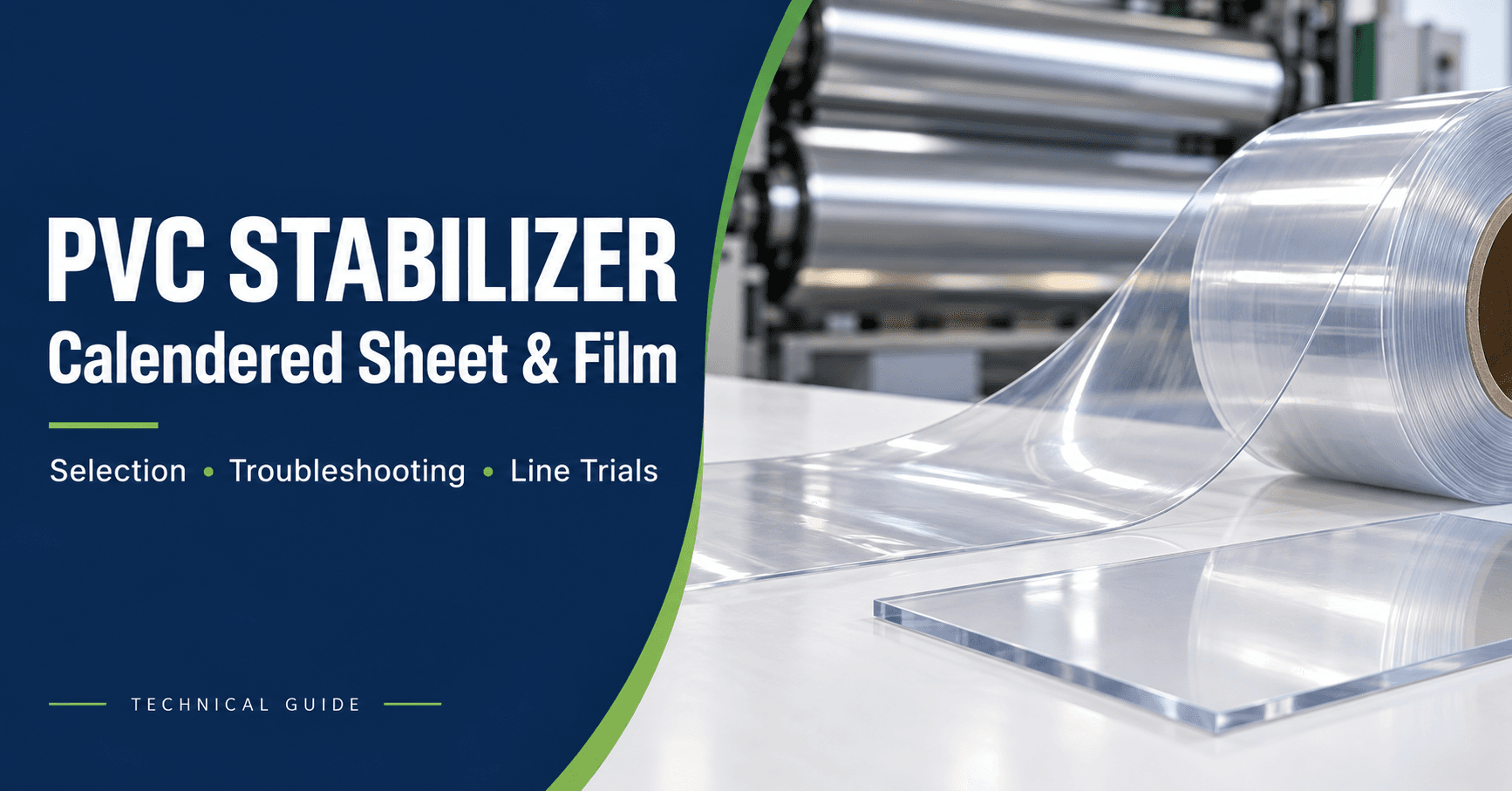
For clear rigid sheet or film, a methyl tin system is often evaluated when optical clarity and heat stability are priority requirements. Application-specific calcium-zinc systems can also be considered for rigid calendering and are widely used in many semi-rigid, flexible, white and opaque products. However, the stabilizer chemistry is only one part of the result. Lubrication, additive compatibility, dispersion, residence time and roll temperatures can change color, haze, release and deposit behavior.
The safest selection method is therefore conditional: define the product, diagnose the defect, shortlist the chemistry and grade, and compare candidates in a controlled lab and production trial.
Why Calendering Is a Demanding Stabilizer Application
PVC needs stabilization because heat and shear can initiate dehydrochlorination. As degradation progresses, color may shift from its initial state toward yellow, brown or darker tones, while processing and final properties can also deteriorate.
Calendering adds several practical complications:
- the compound experiences heat and mechanical work during mixing, plasticization and passage through the roll stack;
- material may remain in hot zones during start-up, speed changes or short stops;
- the film or sheet repeatedly contacts polished rolls, so deposits and surface defects become immediately visible;
- transparent products reveal small changes in haze, color and contamination that an opaque product may hide;
- downstream printing, lamination, embossing or thermoforming may expose compatibility or migration problems that were not obvious at the calender.
This is why a result from a static heat-stability test is useful but not sufficient. A stabilizer must be evaluated as part of the complete formulation and process window.
Define the Sheet or Film Before Choosing the Chemistry
Before comparing suppliers, classify the project in five dimensions.
1. Rigidity and plasticizer level
Rigid, semi-rigid and flexible PVC do not impose the same requirements on fusion, lubrication, compatibility and optical appearance. A grade that performs well in a rigid calendered sheet should not automatically be transferred to a soft film formula.
2. Appearance
Is the target crystal-clear, transparent with an accepted haze limit, translucent, white, printed, filled or fully opaque? For clear products, record both initial color and haze. For white products, record whiteness or an agreed color value. Visual descriptions alone are difficult to compare between trials.
3. Process route
Record the mixer, plasticizing equipment, roll-stack arrangement, production speed, roll temperatures, melt or stock temperature where measured, thickness range, recycled-content level and normal stop/start pattern. The same nominal formulation can receive a different heat history on another line.
4. Downstream conversion
Confirm whether the sheet or film will be printed, laminated, embossed, welded, thermoformed or coated. A stabilizer package that looks acceptable immediately after calendering may still affect surface energy, odor, blocking, adhesion or ageing. These effects are formulation-dependent and must be tested on the finished construction.
5. Market and document requirements
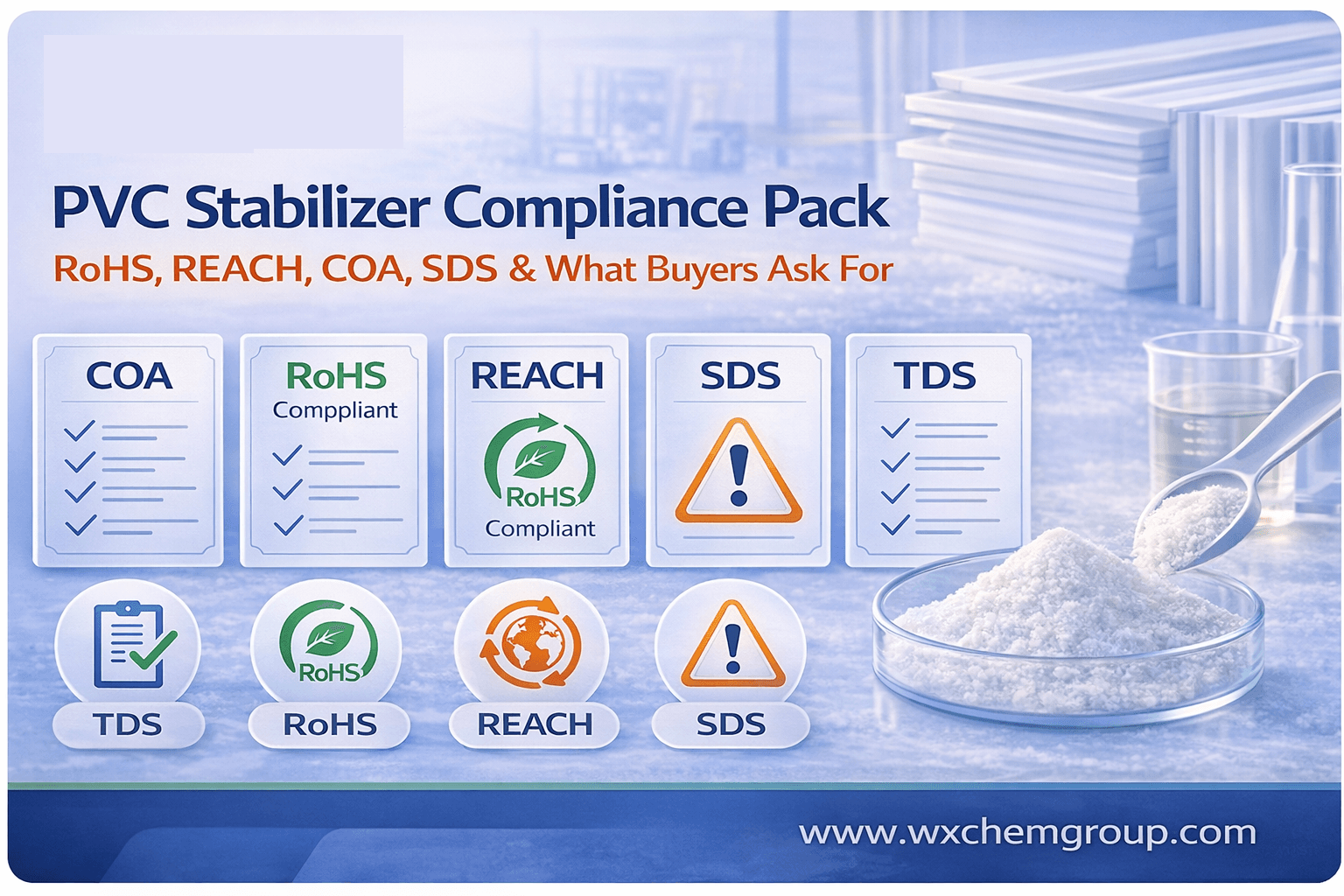
“Lead-free,” RoHS, REACH, food-contact, toy, medical and other requirements are not interchangeable. Do not infer suitability from stabilizer chemistry or a general product description. Define the destination market and required document or test for the exact grade and application before approval.
For supplier qualification, see WANSYN's PVC Stabilizer Compliance Pack guide.
Ca-Zn or Methyl Tin: A Conditional Selection
Calcium-zinc stabilizer systems
Commercial Ca-Zn products are normally formulated systems rather than a simple two-component mixture. Their behavior depends on the stabilizer components, co-stabilizers, lubricants and the rest of the PVC formulation. Calcium-based systems are available in multiple physical forms and have been introduced into both rigid calendering and flexible applications, but they remain application-specific.
For calendered sheet and film, a matched Ca-Zn system may be evaluated when the project requires a lead-free route, when the product is white or opaque, or when a supplier has a grade designed for the relevant rigidity and appearance. Transparent Ca-Zn grades also exist, but the line trial must confirm haze, color hold, plate-out and downstream compatibility.
Methyl tin stabilizers
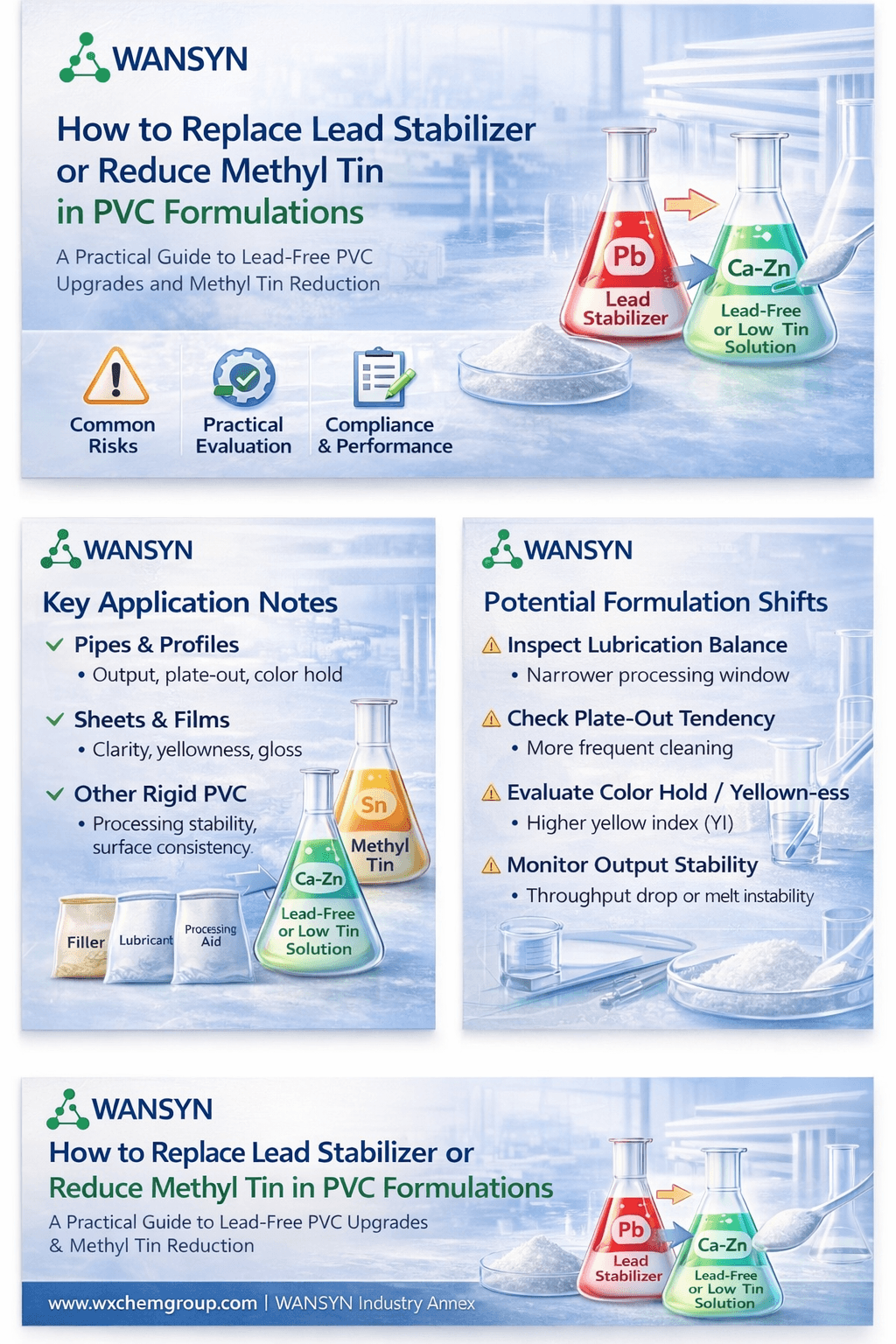
Methyl tin stabilizers are commonly considered for rigid transparent PVC where strong processing heat stability and clarity are important. They are not a complete answer by themselves: the external and internal lubrication balance, formulation compatibility, odor target, regulatory review and cost-in-use still require validation.
Do not assume that a methyl tin grade approved in one rigid clear formula will behave identically with another resin, impact modifier, lubricant package or recycled-content level.
Practical decision rule
- Clear rigid sheet/film: compare an appropriate methyl tin route with a transparent-grade Ca-Zn option if the project allows both; use measured YI, haze, deposits and long-run behavior.
- Transparent semi-rigid or flexible sheet/film: begin with a system specifically designed for that flexibility and optical target; do not copy the rigid-clear formulation.
- White or opaque flexible film: prioritize heat stability, dispersion, color consistency, roll cleanliness and downstream processing rather than paying for clarity that is not required.
- Rigid calendered non-clear sheet: evaluate a rigid-calendering Ca-Zn one-pack against the actual filler, impact modifier and lubrication system.
For the broader chemistry comparison, read How to Choose PVC Heat Stabilizers: Ca-Zn vs Methyl Tin.
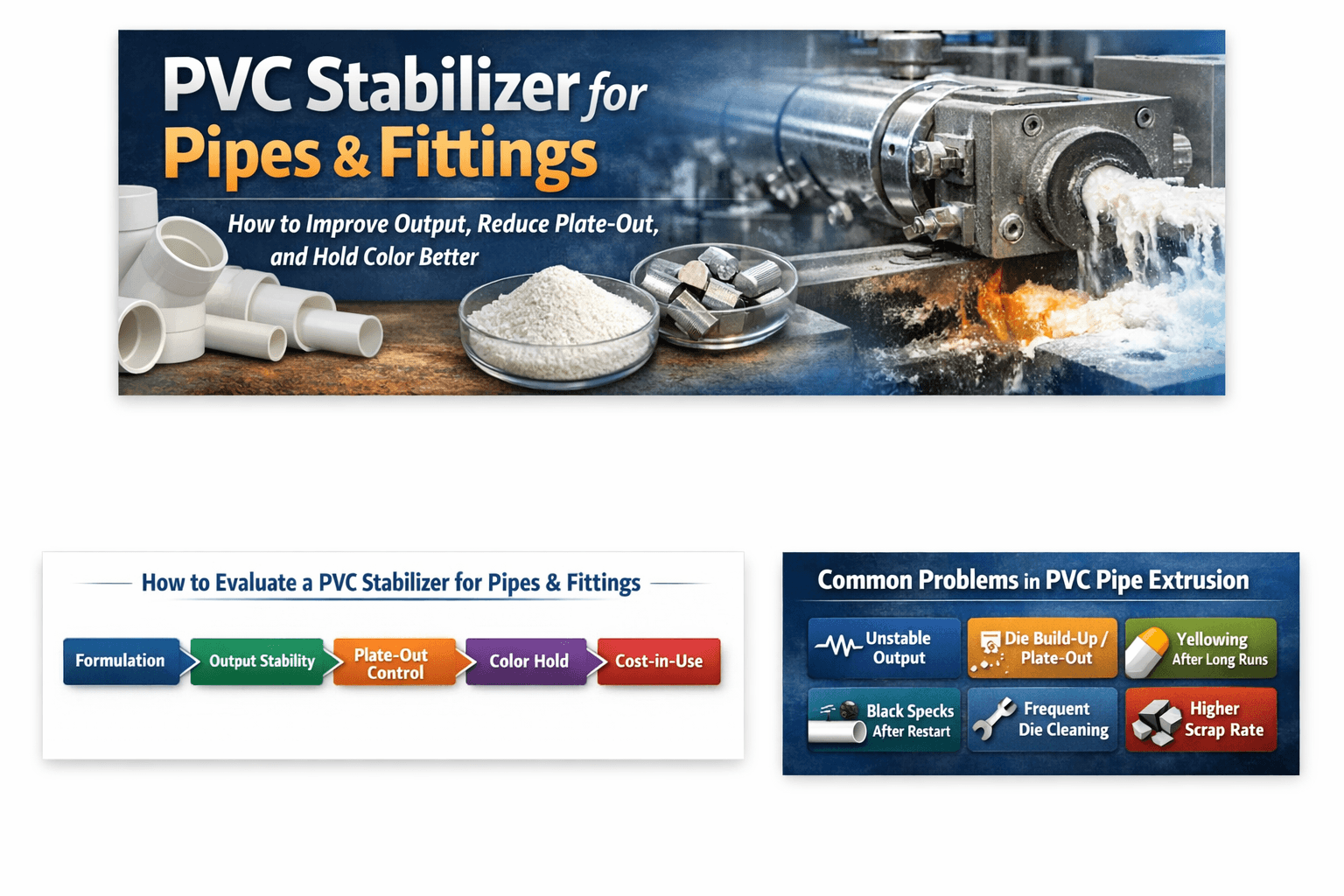
PVC Film Yellowing, Haze and Calender Roll Deposits
Yellowing during start-up or after a short stop
Stabilizer-related possibilities: Insufficient early color or heat-stability reserve for the real heat history
Other causes to check before changing grade: Hot spots, excessive residence time, contaminated dead zones, abnormal roll or stock temperature
Useful comparison: Color/YI at start-up, steady state and after a controlled stop
Gradual color drift during a long run
Stabilizer-related possibilities: Dynamic stability is inadequate or the full formulation is consuming the available stability window
Other causes to check before changing grade: Rising temperature, output drift, recycled-material variability, pigment or filler interaction
Useful comparison: Time-series color, temperature and output records
Haze in transparent film
Stabilizer-related possibilities: Poor dispersion or incompatibility within the additive package; grade not matched to the optical target
Other causes to check before changing grade: Resin and plasticizer compatibility, contamination, moisture, surface texture, gauge variation
Useful comparison: Haze/transmittance on conditioned specimens plus microscopy or dispersion inspection where available
Roll deposits or plate-out
Stabilizer-related possibilities: Stabilizer/lubricant incompatibility or an unsuitable one-pack balance
Other causes to check before changing grade: Excess external lubricant, wax mismatch, filler coating, pigment, processing temperature and roll surface condition
Useful comparison: Deposit weight or photo score at fixed production time; cleaning interval
Sticking or poor roll release
Stabilizer-related possibilities: Lubrication balance may be too internal or insufficiently external for the line
Other causes to check before changing grade: Roll temperature, surface condition, stock temperature and speed
Useful comparison: Release behavior at controlled temperatures and output
Black specks or dark streaks
Stabilizer-related possibilities: Severe local degradation can contaminate later material
Other causes to check before changing grade: Burnt residue, dead zones, screen or equipment contamination, foreign material
Useful comparison: Clean-down inspection and location-based temperature/residence-time review
Surface marks or inconsistent gloss
Stabilizer-related possibilities: Deposits, poor dispersion or unstable fusion may contribute
Other causes to check before changing grade: Roll finish, vibration, temperature uniformity, gauge control and downstream handling
Useful comparison: Surface inspection mapped against roll position and time
These symptoms are not proof that the stabilizer is the root cause. Change one controlled factor at a time. If yellowing disappears only after lowering residence time, for example, increasing stabilizer dosage without addressing the hot zone may hide rather than solve the process problem.
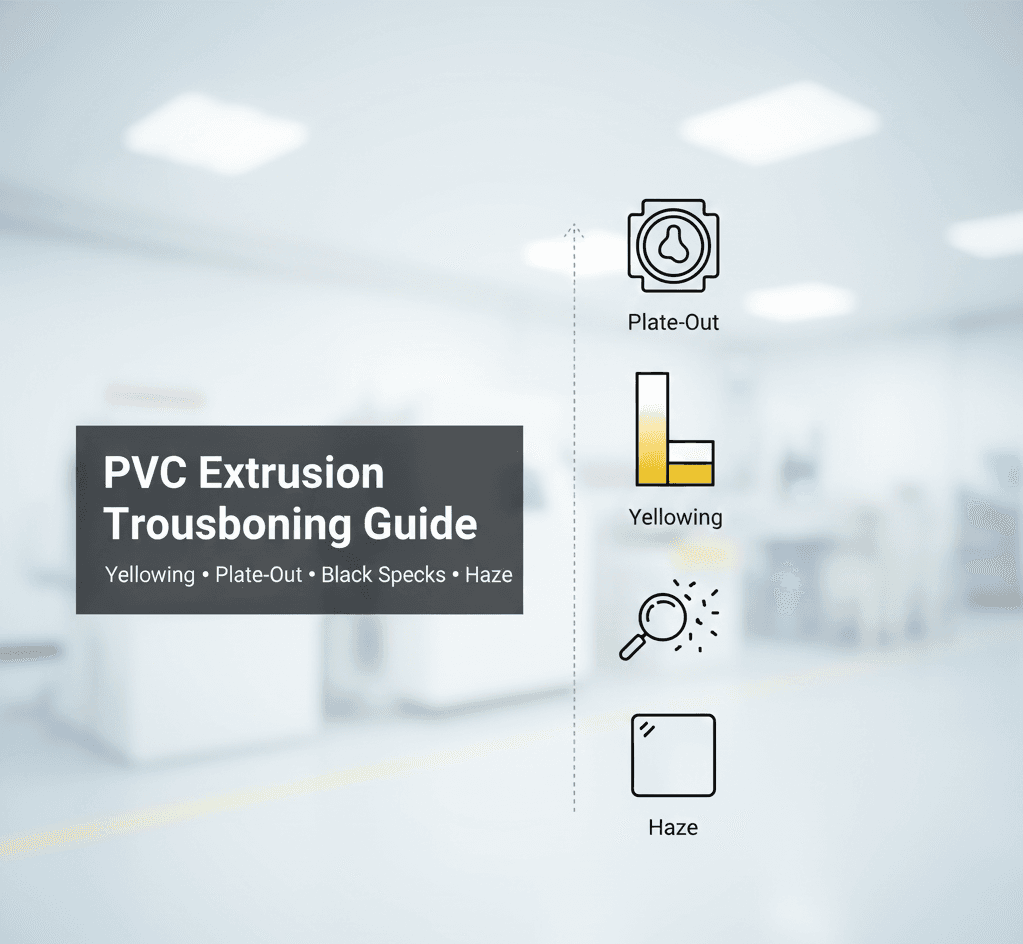
For a wider fault tree, use WANSYN's PVC extrusion troubleshooting guide.
How to Compare a PVC Stabilizer for Calendered Film
Step 1: Freeze the baseline
Use the same PVC resin lot where practical and hold the plasticizer, filler, pigment, impact modifier, processing aid and lubricant package constant. If the candidate is a true one-pack that requires a different lubricant balance, document the supplier's complete recommended change instead of calling the trial a simple one-for-one replacement.
Step 2: Define pass/fail criteria before the trial
Select only metrics that matter to the product. Examples include initial color, color hold, haze or transmittance, roll-deposit score, cleaning interval, output stability, release behavior, surface quality, odor target and downstream print or lamination performance. Use the customer's agreed methods and limits; WANSYN should not invent universal pass/fail values.
Step 3: Use complementary lab tests
A static oven discoloration test tracks the color change of PVC specimens during heating. It is different from the Congo red method in ISO 182-1, which uses indicator-paper color change to assess acidic degradation products released by a heated compound. The ISO method is not recommended for dry blends. Record the specimen form, temperature, preparation and endpoint; do not treat oven color-hold time and Congo red stability time as interchangeable.
A torque rheometer provides a separate comparison of fusion behavior and dynamic response. Check pressed or calendered specimens for color and, where relevant, haze/transmittance using an agreed method such as ASTM D1003. Neither thermal screening nor a haze result establishes downstream print adhesion.
These tests screen candidates; they do not reproduce every roll contact, residence-time pattern or downstream operation of the production line.
Step 4: Run a time-based line trial
Record the formulation, batch, dosing method, output, speed, temperatures, amperage or torque where available, thickness, color, haze, deposit observations and stops. Evaluate deposits at the same elapsed time or tonnage for every candidate. A short clean run may miss plate-out that develops later.
Step 5: Test the converted product
If the film is printed, laminated, embossed, welded or thermoformed, test that operation. Also compare retained samples after the relevant conditioning or ageing period. Immediate line appearance alone is not a complete qualification.
WANSYN's PVC heat stabilizer testing checklist explains how Congo red, torque, color and plate-out observations can be combined.
Initial WANSYN Model Screening for Sheet and Film Projects
The following is an initial application screen, not a final recommendation. Product specifications and the current TDS must be checked before a quotation or trial.
Rigid calendered or extruded PVC sheet
Initial WANSYN grade to discuss: Y-181
Why it enters the shortlist: Current product positioning includes rigid calendering and extrusion
What must still be confirmed: Transparency/opacity, filler and impact modifier, lubrication package, processing window and required documents
Calendered sheet/film, extrusion or blown-film project
Initial WANSYN grade to discuss: Y-550
Why it enters the shortlist: Current product positioning covers these process/application families
What must still be confirmed: Rigidity, appearance, plasticizer level, exact line route and whether a more specific grade is required
Transparent semi-rigid or flexible sheet/film
Initial WANSYN grade to discuss: N-450
Why it enters the shortlist: Current product positioning targets transparent semi-rigid and flexible sheet/film
What must still be confirmed: Haze and color target, plasticizer system, migration/plate-out, downstream conversion and market requirements
Soft opaque or white film, leather or blown film
Initial WANSYN grade to discuss: FR-300
Why it enters the shortlist: Current product positioning targets soft opaque/white film and related applications
What must still be confirmed: Pigment/filler package, odor/VOC target if any, print/lamination route and trial criteria
Clear rigid PVC with demanding optical and heat-stability targets
Initial WANSYN grade to discuss: Liquid methyl tin series
Why it enters the shortlist: Methyl tin is a common evaluation route for rigid clear PVC
What must still be confirmed: Exact grade, tin chemistry, dosage window, lubrication, regulatory suitability and finished-product testing
See the current Powdered Ca-Zn Stabilizer Series, Liquid Stabilizer Series and the main PVC Stabilizers category.
What to Send for an Accurate Stabilizer Recommendation
A useful inquiry should include:
- Finished product: sheet or film, and its end use.
- Rigid, semi-rigid or flexible PVC.
- Transparent, translucent, white, colored or opaque appearance.
- Calendering line type and any upstream extrusion or internal-mixing step.
- PVC resin type or K-value where available.
- Current stabilizer chemistry and grade, without disclosing confidential information you cannot share.
- Plasticizer, filler, pigment, impact modifier, processing aid and lubricant information relevant to the problem.
- Thickness range, production speed, temperature profile and normal run length.
- Main defect: yellowing, haze, deposits, sticking, specks, odor, print/lamination problem or another issue.
- Current test data and photographs, including when the defect begins.
- Destination market and the exact documents or limits the buyer requires.
- Trial quantity and expected purchasing volume after qualification.
With this information, WANSYN can identify a more relevant starting grade and propose a comparison plan. A final dosage or performance claim should follow formulation review and testing rather than be fixed in a general article.
Frequently Asked Questions
What is the best PVC stabilizer for calendered film?
There is no universal best grade. The answer depends on rigidity, transparency, plasticizer and filler level, heat history, lubrication, downstream conversion and compliance requirements. Clear rigid film and soft opaque film should not be treated as the same application.
Can a Ca-Zn stabilizer be used for transparent calendered PVC?
Yes, transparent-grade Ca-Zn systems can be evaluated, but transparency cannot be assumed from the words “Ca-Zn.” Compare haze, color hold, deposits, migration or surface behavior and the converted product under the customer's actual formulation and process.
Is methyl tin always better for clear PVC sheet?
Methyl tin is widely considered for rigid clear PVC because of its heat-stability and clarity performance, but “always better” is too broad. Lubrication, cost-in-use, odor, documents, downstream processing and market requirements may change the decision.
Why does PVC film yellow only after the line has run for some time?
Possible causes include inadequate dynamic stability, temperature or residence-time drift, recycled-material variation, formulation interactions or deposits and degraded material accumulating in hot zones. Track color, temperatures, output and stops as a time series before assigning the cause.
Will adding more stabilizer eliminate roll deposits?
Not necessarily. Deposits can result from incompatibility or an unbalanced lubricant, wax, filler or pigment package. Increasing one component may worsen release, fusion, haze or cost. Use a controlled formulation and line comparison.
Which tests should be used to approve a new stabilizer?
Combine relevant static and dynamic lab screening with a time-based line trial. For transparent products, include agreed color and haze methods. For all products, include deposit/cleaning observations and any downstream print, laminate, weld, emboss or thermoform test that matters to the final product.
Can one stabilizer grade cover rigid, semi-rigid and flexible film?
Do not assume so. A supplier may offer a broad product family, but the stabilizer and lubrication balance must match the rigidity, plasticizer content, appearance and process. Qualify each materially different formulation.
How can I ask WANSYN to match a grade?
Send the product, formulation outline, line conditions, current chemistry, defect evidence, target tests and destination-market document requirements. Contact WANSYN through the project inquiry page or email info@wxchemgroup.com.
Request a PVC Stabilizer for Calendered Film Trial
If you are qualifying a new PVC stabilizer supplier or troubleshooting a calendered sheet or film line, share the application and trial information listed above. WANSYN can help screen the relevant Ca-Zn or methyl tin route and discuss models such as Y-181, Y-550, N-450 or FR-300 where their current product positioning fits.
Recommendations remain subject to the exact formulation, process, test conditions and required documentation. No general article can guarantee a fixed dosage, deposit-free run time, optical result or regulatory suitability.
Dana Chen — WANSYN Industry
Email: info@wxchemgroup.com
WhatsApp: +86 159 5847 3100
Contact WANSYN
Technical References
- ISO 182-1:1990: Congo red method for thermal-stability tendency in vinyl-chloride compounds/products; method scope and limitations should be followed.
- ASTM D1003-21: haze and luminous transmittance of transparent plastics, subject to the relevant material specification and specimen conditions.