Quick answer
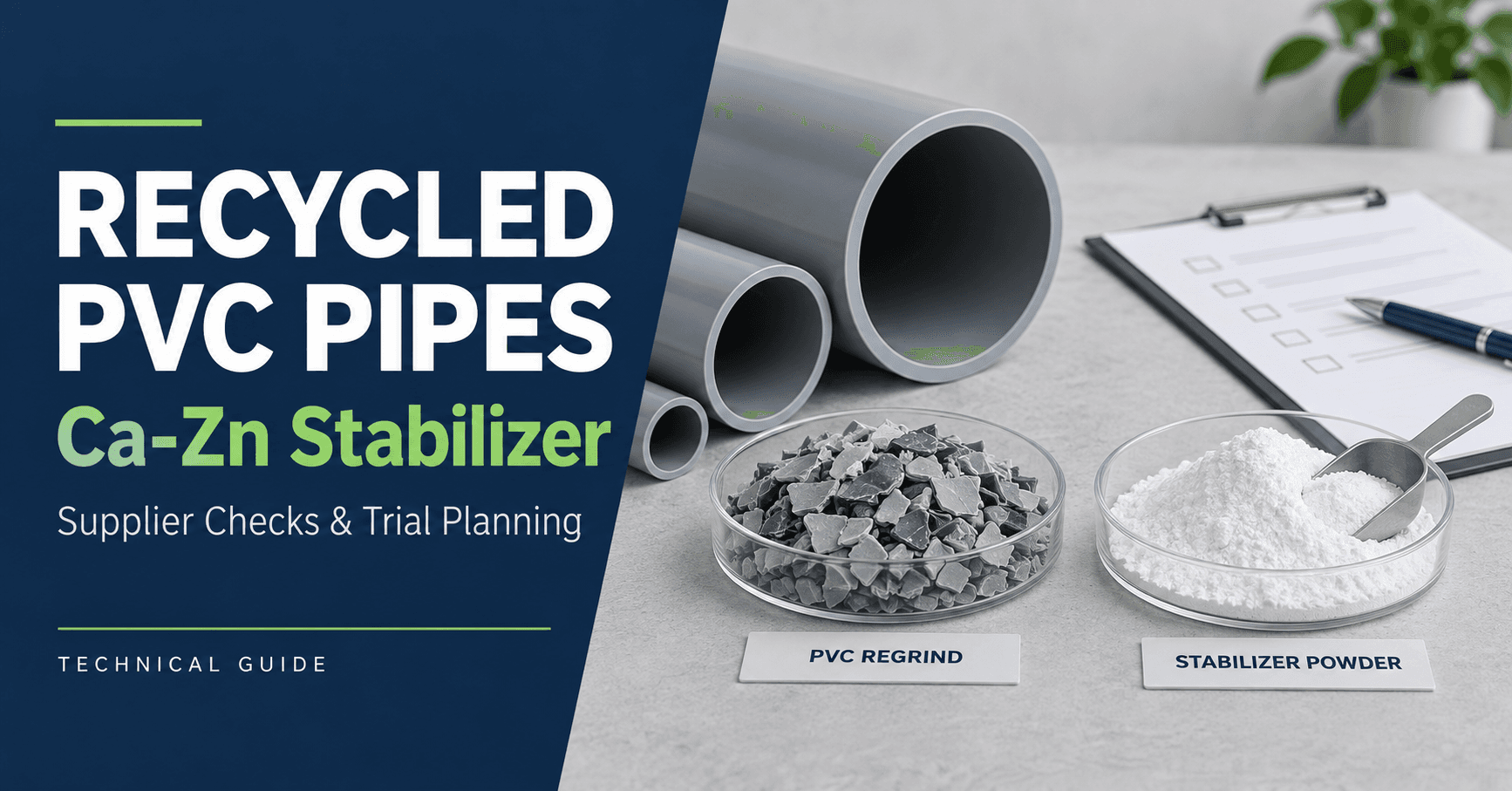
To qualify a calcium zinc stabilizer for recycled PVC pipes, first confirm that the intended product specification permits the proposed recycled material. Then define the feedstock, required stabilizer form and dosage basis. Compare candidates on the same feedstock lot before repeating the evaluation across representative lots. Select a grade only after processing and finished-product requirements are met.
This guide concerns formulation qualification, not blanket approval of recycled PVC for pressure pipe, drinking-water service or another regulated application.
1. Start with the recycled material, not a promised dosage
“Recycled PVC” is not a complete raw-material specification. A controlled production regrind and mixed-source post-consumer material should not automatically be covered by the same approval. Rigid PVC is also described as PVC-U or uPVC; use these terms only when they accurately describe the feedstock and intended pipe formulation.
Ask the material supplier what is known about origin, previous application, formulation and processing history. Record what remains unknown instead of replacing missing information with assumptions.
Build a feedstock record covering:
- Source and batch traceability, including whether material is internally generated or externally purchased.
- Rigid or flexible origin and any evidence of mixed polymers or other contamination.
- Recycled-material fraction, with its calculation basis stated.
- Known filler, pigment, lubricant and stabilizer history.
- Incoming checks agreed with the laboratory and the purchasing specification.
Distinguish PVC polymer from already compounded recyclate. A mass of recycled compound can include filler and other ingredients; it is not necessarily the same mass of PVC resin.
If origin or composition changes outside the approved purchasing specification, treat that as a reason to review qualification. Do not assume a successful run with one lot proves suitability for every future lot.
2. Define the application boundary before discussing chemistry
Write down the pipe type, layer construction, destination market and exact finished-product specification. Where a multilayer structure is involved, identify the layer containing recycled material.
Do not assume that acceptance of recycled material in one construction permits its use in another. Confirm the applicable requirements with the customer and a qualified testing or compliance specialist before selecting material.
Within that boundary, a calcium-zinc formulation can be considered for a controlled processing evaluation. The chemistry name alone does not establish compatibility with an unknown recycled compound, define the lubrication balance or guarantee pipe performance.
For the broader application-selection discussion, use the WANSYN PVC pipe and fitting stabilizer guide. This checklist focuses on the extra qualification questions introduced by recycled feedstock.
3. PVC stabilizer powder vs granules: specify the additive form
A request for “granules” is ambiguous. Does it describe the recycled PVC feedstock, the heat-stabilizer additive, or a ready-to-process compound? State these separately in the RFQ.
If the additive must be supplied as granules, make that a documented acceptance requirement before reviewing a powder grade. Confirm the actual product form, handling requirements and feeding arrangement with the supplier.
Do not infer equal feeding or dispersion behavior from the shared label “Ca-Zn.” For the proposed delivery form, agree which checks are relevant: feeder repeatability, segregation during handling, mixing sequence and distribution in the processed material.
Keep this specification separate from thermal-performance claims. A preferred physical form is not proof of a better finished pipe, and a successful laboratory result does not establish compatibility with the production feeder.
4. Define the PVC stabilizer dosage basis
A statement such as “use the same percentage” is not enough for a supplier comparison. Ask what the percentage is based on.
For a resin-based expression, phr means parts by mass per 100 parts of resin. With recycled compound, agree how the PVC resin contribution is determined; do not silently treat the full recycled-compound mass as pure resin.
If that resin contribution is not known reliably, report the weighed recipe on an explicitly stated compound or batch basis. Do not label it resin-based phr without justification.
The trial sheet should identify:
- The stabilizer mass added and the denominator used.
- Virgin resin and recycled-compound masses separately.
- Other separately added ingredients.
- Any known additives already carried by the recycled feedstock.
A one-pack change may also change the ingredients supplied with the stabilizer. Request guidance on which separately added lubricants or other components must be reviewed. Do not assume that replacing equal masses of two commercial packages creates equivalent formulations.
5. Plan a recycled PVC stabilizer trial in two stages
The following is a proposed comparison framework, not a report of WANSYN test results or a universal standard procedure.
Stage A: compare candidates on one traceable feedstock lot
Use the same feedstock lot for the baseline and candidate runs. Document the complete recipe, weighing basis, mixing conditions, equipment settings, sampling points and acceptance criteria.
Where the current formulation is a valid control, retain it as the baseline. Record deliberate changes rather than quietly adjusting several ingredients until the candidate looks better.
Use a test plan that separates endpoints:
- Color comparison: prepare samples consistently and record exposure conditions, thickness and measurement settings. Compare initial appearance and subsequent change separately.
- Acid-evolution screening: if the laboratory selects ISO 182-1, follow its applicable sample preparation and method. The published scope says the method is not recommended for dry blends. Its indicator endpoint is not a measurement of finished-product whiteness. See the official ISO 182-1 description.
- Processing behavior: record relevant fusion or torque data under a defined laboratory procedure, then check production load, melt pressure and output on the actual line.
- Deposits and surface: use consistent inspection locations, photographs and an agreed trial duration. Record deposits and visible defects rather than promising a cleaning interval.
- Finished-pipe acceptance: use the tests required for the intended product and construction. A stabilizer screening result does not replace these tests.
For additional method-selection questions, see the PVC stabilizer testing guide.
Stage B: challenge the candidate across representative lots
After a candidate passes the initial comparison, repeat the relevant evaluation with additional traceable feedstock lots selected to represent the purchasing specification.
Agree the number and selection of lots with the technical and quality teams. There is no universal sample count that proves all recycled PVC is covered.
Document the approved material range and the changes that trigger requalification. A result that is acceptable only with one unusually favorable lot is not yet evidence of a robust sourcing decision.
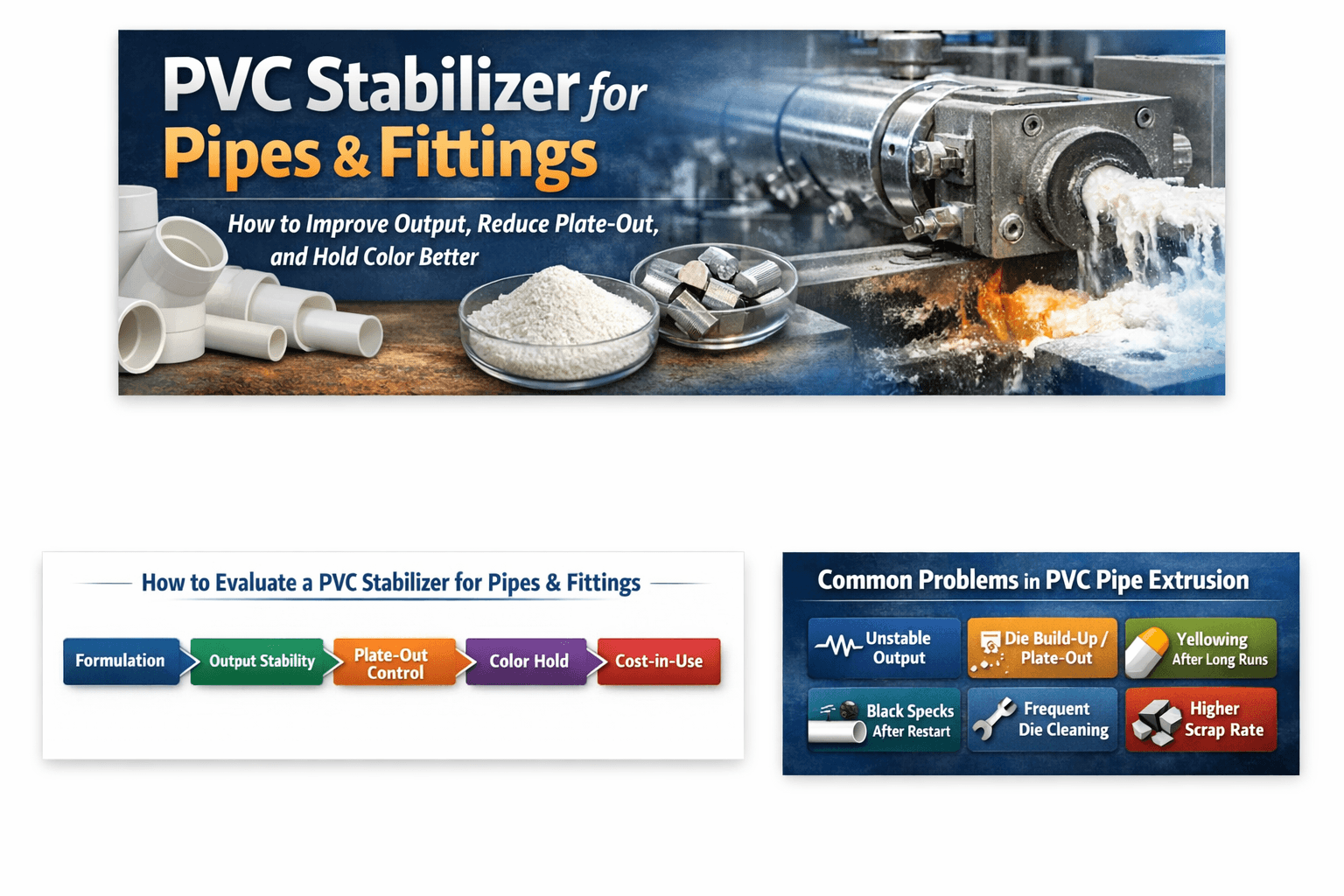
6. Investigate failures without blaming the stabilizer first
Color changes after a feedstock-lot change. Compare retained incoming material and processed samples. Review the lot identity, recipe and recorded processing history before increasing additive addition. The observation identifies a correlation, not a confirmed cause.
Deposits appear while a laboratory heat test looks acceptable. Review lubrication, mixing, contamination and production conditions as separate hypotheses. Passing one thermal endpoint does not resolve a deposit problem.
Pressure or load becomes less consistent. Check feeding and the actual material being delivered to the extruder. Compare settings and sampling times before attributing the variation to Ca-Zn chemistry.
The surface looks acceptable but the pipe fails an acceptance test. Keep the lot unqualified for that specification. Reassess the material, construction and process; appearance is not a substitute for finished-product performance.
For a longer general fault-finding discussion, refer to the PVC extrusion troubleshooting guide.
7. Keep legacy-additive checks separate from new-stabilizer claims
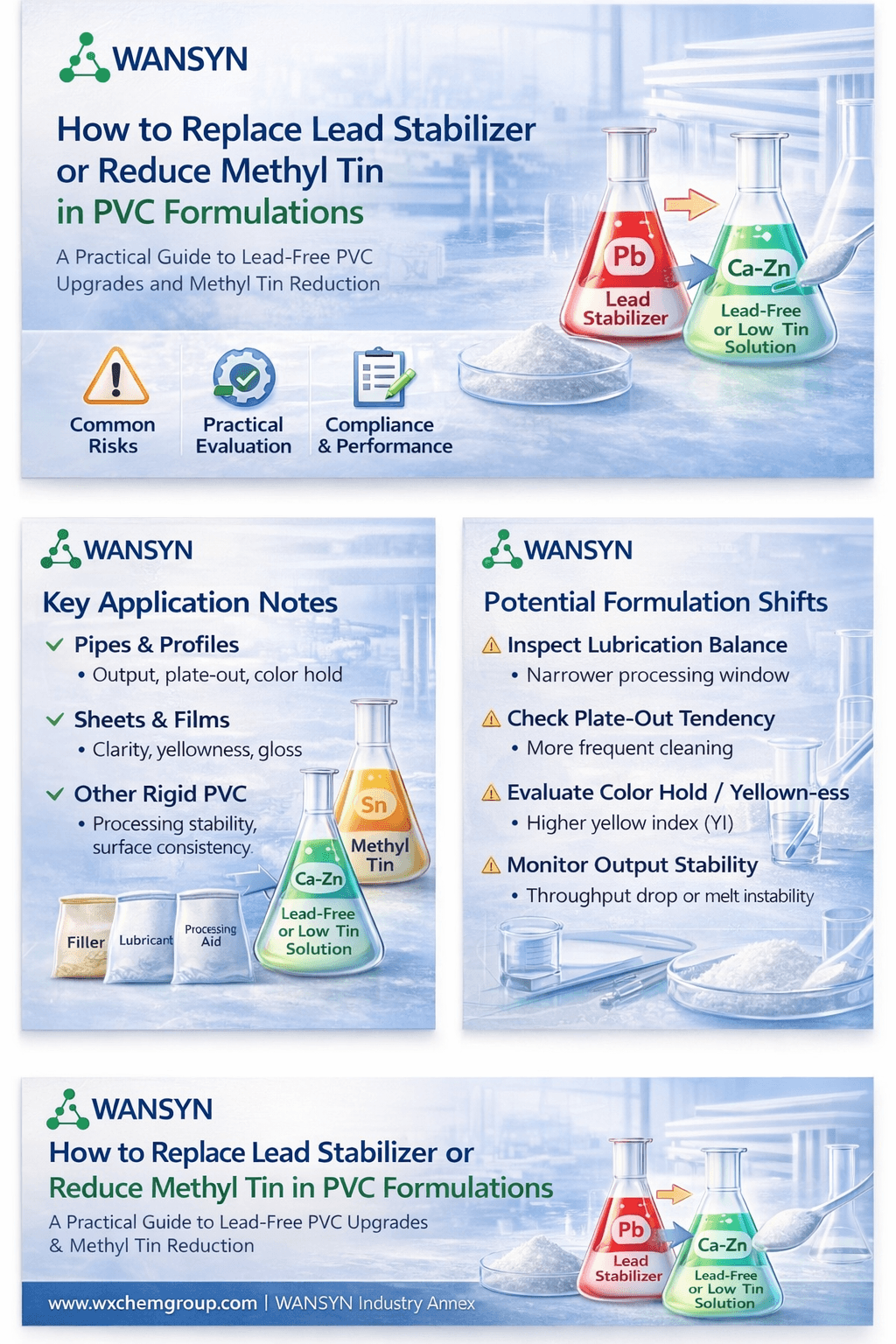
Recovered PVC may carry substances from its earlier formulation. The EU's 2023 regulation addressing lead in PVC discusses legacy lead in recovered material. That source illustrates why feedstock history matters; it is not a declaration that a particular WANSYN formulation meets any market requirement.
Adding a lead-free stabilizer is not a lead-removal operation and does not establish that the resulting recycled compound is lead-free. Verify the incoming material and finished-product requirements separately, using appropriate documents and testing.
A supplier document for an additive does not automatically certify the complete pipe. Use the stabilizer compliance-document checklist to organize the discussion, and obtain application-specific review where necessary.
8. G-80 calcium zinc stabilizer: candidate scope and supplier documents
The WANSYN G-80 product page identifies the product as a powder calcium-zinc one-pack for rigid PVC pipes and fittings.
That makes it a candidate for a formulation review where powder delivery is acceptable. It does not establish qualification for your recycled material, confirm a granulated version, or prove compliance with your finished-pipe specification.
Before agreeing a trial, request the current grade documentation and discuss the recycled feedstock, proposed recipe, processing conditions and acceptance criteria. Grade selection remains conditional on that review and the results.
For Ca-Zn stabilizer supplier qualification, request:
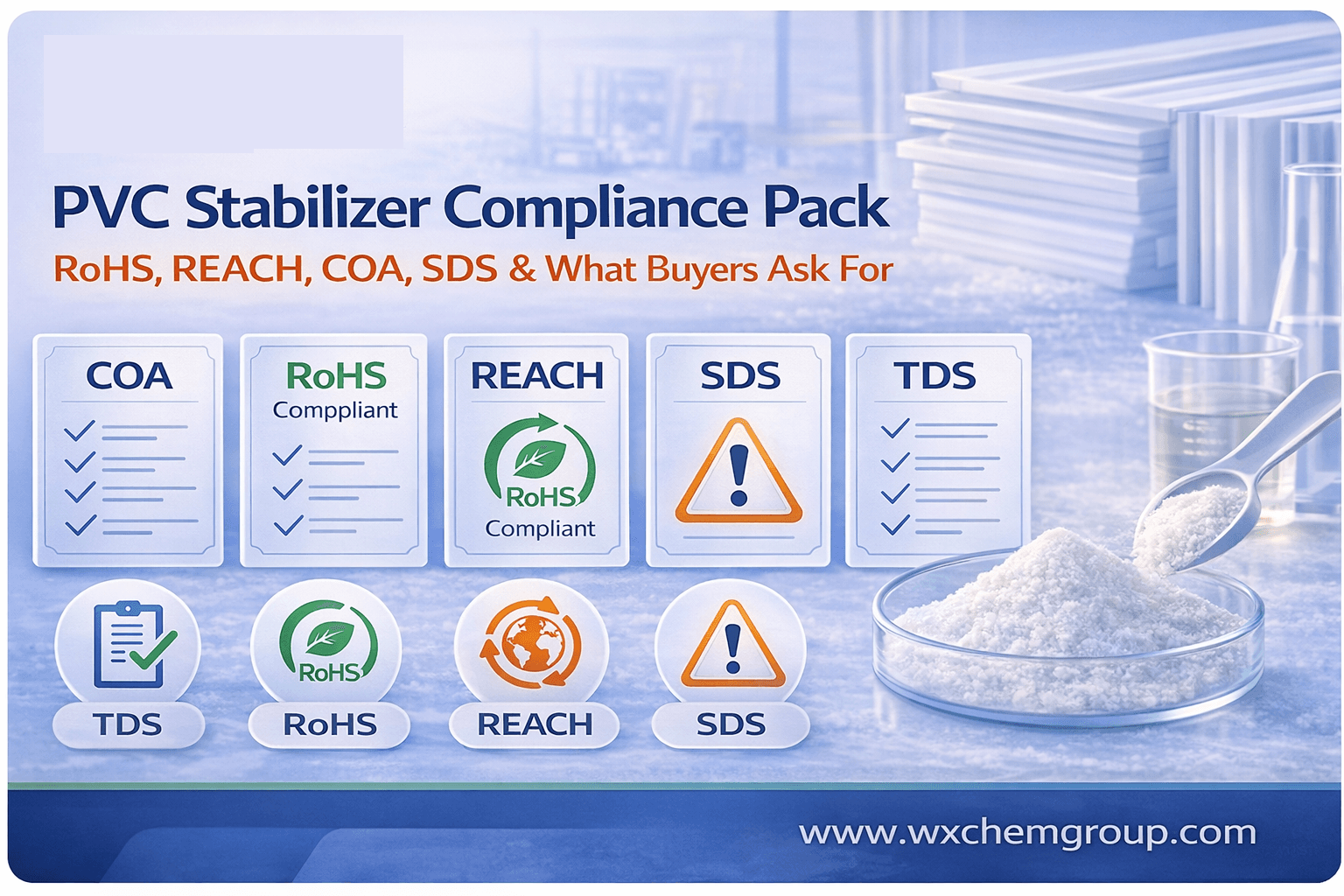
- The current technical data sheet (TDS) identifying the grade and physical form.
- The safety data sheet (SDS) for handling and storage information.
- A batch certificate of analysis (COA), with the agreed measured properties and test methods.
- Traceable trial-sample and production-batch identification.
- Relevant grade-specific reports, including their test scope and limitations.
Agree how product or specification changes will be communicated. These documents support supplier review; they do not replace validation of the finished pipe.
Other chemistry options can be explored through the WANSYN PVC stabilizer portfolio, without assuming that every listed grade applies to this use.
Frequently asked questions
Can I keep the same stabilizer addition when the recycled fraction changes?
Do not assume equivalence. State the addition basis and review the material change. A revised recycled fraction or source may require a new trial within the agreed qualification procedure.
Are stabilizer granules interchangeable with powder?
Not automatically. Confirm the exact grade, composition information relevant to the trial, feeding arrangement and physical-form requirement. G-80's public description is powder, not a confirmed granulated offering.
Does a longer Congo red result mean a whiter pipe?
No direct equivalence should be assumed. Acid-evolution timing and color assessment are different endpoints. Compare each under its own documented conditions and retain production and finished-product checks.
Does a lead-free stabilizer make recycled PVC lead-free?
No. New additive selection does not establish the absence of legacy lead in the feedstock. Material characterization and applicable finished-product requirements must be assessed separately.
Can G-80 be approved from the product page alone?
No. The page identifies a candidate and its public form. Your feedstock, formulation, equipment and required acceptance evidence still need review.
What should I send before asking for a quotation or trial proposal?
Send the application and product specification, feedstock description, complete formulation basis, required additive form, processing conditions and a clearly defined problem. Include the evidence you need for approval and your intended trial scope.
Request a recycled PVC pipe stabilizer review
Use this RFQ checklist to help WANSYN assess the next step:
- Pipe application, construction, destination market and required standard.
- Recycled-material origin, traceability and proportion with its calculation basis.
- Known formulation history and available incoming-material test results.
- Current recipe, stabilizer addition basis and separately added lubricants.
- Required stabilizer form: powder, granules or another explicitly defined form.
- Equipment, processing conditions and the main observed failure.
- Baseline results, proposed trial scope and finished-product acceptance criteria.
- Requested documentation and estimated purchasing requirement.
Contact WANSYN for a formulation and grade review, or email info@wxchemgroup.com. A review can establish what information or testing is needed next; it is not a promise of a fixed dosage, approval, sample dispatch date or production result.
WANSYN Industry | WhatsApp: +86 159 5847 3100