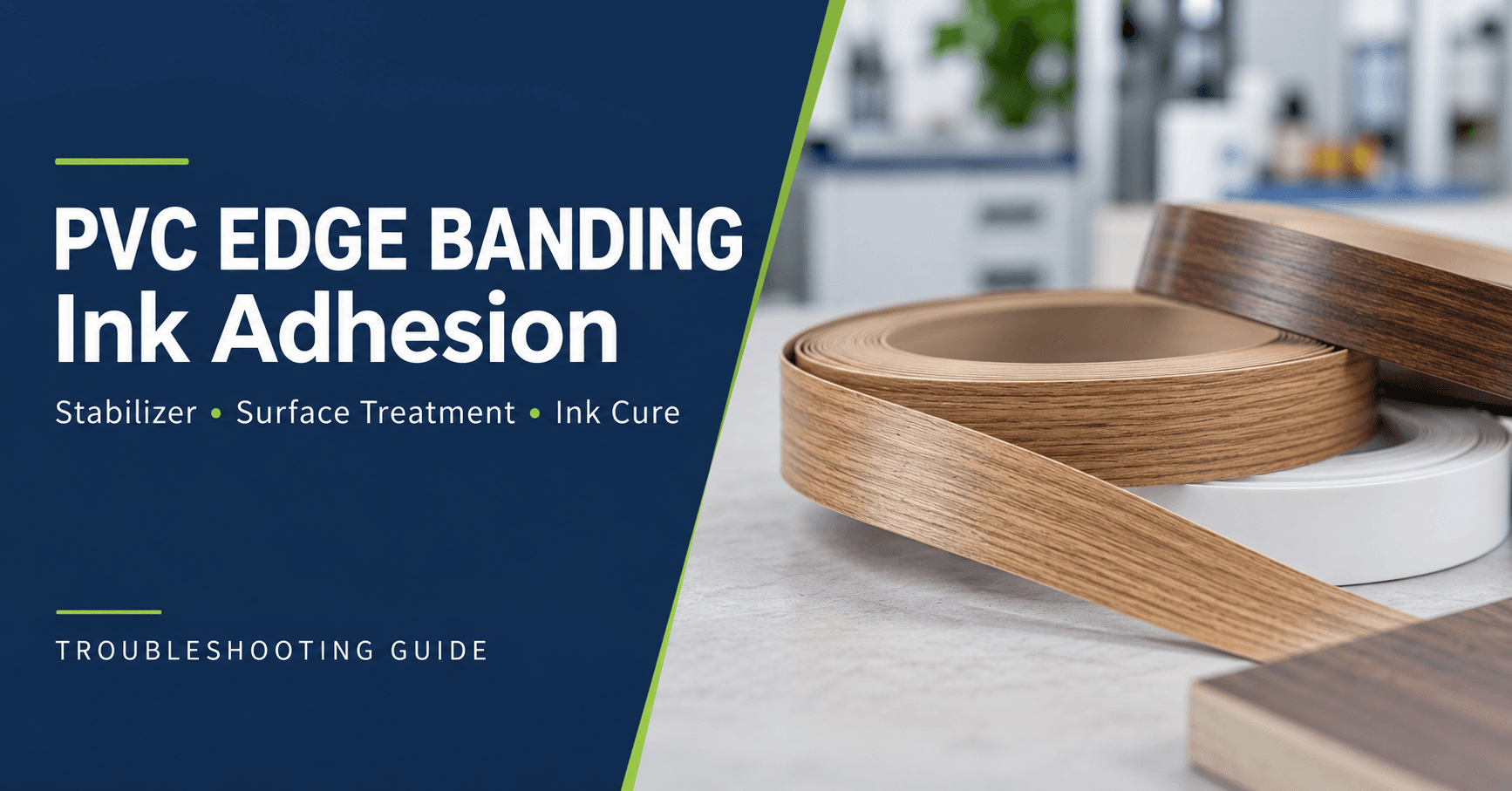

Poor PVC edge banding ink adhesion does not automatically mean the heat stabilizer is wrong. First identify the printed surface, the layer that fails and the conditions under which the defect appears. Then compare the compound, treatment and ink process using a repeatable test. A stabilizer trial becomes useful when the evidence points back to the PVC formulation or processing surface.
This guide focuses on the decorative print face of furniture edge banding. It does not diagnose hot-melt bonding between the reverse side of the strip and the furniture board. Those are different interfaces and need separate tests.
Start with the printed layer, not the product name
Before requesting a new stabilizer, describe the structure. Is the ink printed directly on PVC, on a primer, or on a separate decorative film? Is the strip coextruded, and which compound forms the print-side skin?
If the printed face is a separate film, changing a stabilizer in the PVC core may not address the failed interface. Similarly, a PVC stabilizer recommendation should not be transferred automatically to an ABS print surface.
Keep one unprinted sample and one failed printed sample from the same production section. Mark the print face, machine direction, batch and time. These simple identifiers make later comparisons much more useful than an isolated photograph of removed ink.
What can a Ca-Zn stabilizer change?
Calcium-zinc stabilizers are evaluated as part of a complete PVC formulation. Some one-pack systems also include lubricants and other additives; changing the package can therefore change more than heat stabilization. The supplied package and separately added lubricants should be reviewed together.
For a supplier review, ask whether the proposed package is appropriate for the actual resin, filler, processing route and decorative surface. Avoid interpreting the chemistry name alone as evidence of printability.
WANSYN's FB-100 calcium-zinc stabilizer is positioned for printable PVC furniture edge banding and selected decorative PVC profiles. It is a candidate for evaluation, not a guarantee that ink will adhere. The relevant question is whether the candidate formulation meets both processing and finished-print requirements on the intended line.
For a broader chemistry comparison, see the PVC stabilizer selection guide.
Classify the failure before changing additives
Use the following questions to organize a joint discussion with the compound, ink and treatment suppliers. They are diagnostic prompts, not proof of a particular cause.
Does failure follow a production position?
Mark whether the defect appears across the width, along one edge or at repeating intervals. Retain adjacent acceptable material if available. Ask which production or printing event corresponds to that location.
Does failure follow a batch or storage interval?
Compare resin/compound lots, print dates and the time between extrusion, treatment and printing. Do not compare a newly made candidate strip with an old reference strip without recording their different histories.
Which layer comes away?
Record whether removal exposes the substrate, leaves primer behind, separates one ink layer from another, or tears material within a layer. A photograph alone may not resolve the interface; magnification or laboratory examination may be needed.
Does the unprinted strip also change?
Compare appearance, deposits and processing records with the print result. If the failure occurs only after a change in ink or curing, investigate that change before concluding that a new stabilizer is required. If it repeatedly follows one compound under matched printing conditions, a formulation review becomes more relevant.
Separate treatment from ink cure
Surface activation can improve wetting, but treatment method, uniformity, elapsed time and substrate condition matter. Excess treatment can also damage a surface. A dyne reading is a screening observation, not a direct measurement of cured ink adhesion; do not impose one universal dyne target on every PVC and ink combination. Agree on the measurement procedure and working target with the treatment and ink suppliers. Enercon's surface-activation technical paper discusses wettability measurements, treatment decay and over-treatment.
Ink must also be compatible with the substrate and properly dried or cured before its adhesion is assessed. Follow the selected ink's technical instructions and conditioning requirements rather than judging only whether the surface feels dry. Nazdar's adhesion guidance explains the importance of cure, substrate matching and contamination checks.
For your trial record, identify the ink and primer grades, batch, application settings, drying or curing settings and time before testing. If the ink supplier recommends cleaning, confirm that the procedure is compatible with the strip and plant safety requirements. Do not introduce an unvalidated solvent wipe into production as a universal fix.
Build a small, traceable comparison
The following is a proposed trial design, not WANSYN test data. Agree its details with the plant before running it. Choose operating conditions within the approved safety and processing window.
Stage 1: establish a valid reference
Print the currently accepted substrate with the reference ink process. Confirm that the reference meets the agreed test. If it fails, resolve the reference problem before interpreting a candidate result.
Stage 2: compare formulation and treatment separately
Prepare matched reference and candidate strips. Record each formulation and its supplier-agreed trial dosage. Keep other formulation variables controlled where practical; document unavoidable differences in the one-pack composition. Use the same printing session and comparable storage history.
| Trial sample | Purpose |
|---|---|
| R-A: reference compound, standard treatment | Establish the baseline |
| C-A: candidate compound, standard treatment | Compare compounds under the same treatment route |
| R-B: reference compound, agreed alternate treatment | Check the reference response to treatment |
| C-B: candidate compound, agreed alternate treatment | Check whether the candidate responds differently |
Keep ink, primer, print settings, conditioning and test procedure consistent across the four samples. Repeat comparisons and retain both acceptable and failed specimens. An alternate treatment is a controlled variable, not permission to exceed equipment or substrate limits.
If both compounds improve under treatment B, that result supports reviewing the treatment window. It does not prove the stabilizer caused the original failure. If a candidate improves the repeatable result under both treatment routes, it merits further formulation validation; a small matrix alone does not establish the chemical mechanism.
Stage 3: qualify the complete production result
Do not approve a candidate solely because one tape test looks better. Include process stability, color, deposits, dimensional requirements and the customer's finished-product checks. Record actual output and rejected material before making any cost-saving claim. Review broader process symptoms with the PVC extrusion troubleshooting guide.
Define the PVC edge banding ink adhesion test
Agree the method, specimen conditioning, test face, coating stack, tape or tool, operator procedure and acceptance rule. Keep these constant and photograph the failure location. If ASTM D3359 is specified, confirm its suitability and agreed application to the actual plastic/coating system; it was developed for metallic substrates, and its scope notes limitations for non-metallic substrates. It is a rating method, not an absolute bond-strength measurement. ASTM D3359-23 public scope.
Use the customer's agreed bend, rub, trimming or service-exposure checks where relevant. Report each result separately rather than converting unlike tests into one invented score.
For processing-side measurements, the WANSYN heat-stabilizer test guide provides a broader checklist. Keep heat-stability results separate from print-adhesion results: passing a thermal test is not proof that a printed edge strip will pass the customer's adhesion requirement.
What to send for an FB-100 review
Use this RFQ checklist to connect the fault report with a useful grade discussion:
- Structure: strip thickness and width, core and print-side materials, primer or decorative film, and intended furniture use.
- Formulation: PVC resin, filler and pigments, modifiers, current stabilizer and dosage, separately added lubricants and relevant recycled content.
- Process: extrusion or calendering route, equipment, recorded temperatures, speed, cooling and surface finish.
- Printing: treatment method, measured surface indicator, time to printing, ink/primer identification and drying or curing record.
- Failure evidence: labelled samples, photographs, test procedure, acceptance requirement and the conditions that reproduce the defect.
- Purchasing needs: destination market, required documents, trial quantity, estimated annual volume and quotation terms.
For FB-100, dosage, document availability and sample arrangements must be confirmed for the project. Neither the Ca-Zn chemistry name nor a successful printing trial establishes a blanket certification or food-contact claim. No fixed delivery or sample timing is implied.
Frequently asked questions
Can a PVC heat stabilizer guarantee ink adhesion?
No. It is one part of the compound and processing system. The printed layer, surface condition, treatment, ink and cure also require validation.
Should I increase stabilizer dosage when ink peels off?
Not without a diagnosis. First reproduce and classify the failure. Any dosage comparison should be agreed for the actual formulation and evaluated with processing and printing checks.
If the dyne reading is acceptable, why test adhesion?
A wetting indicator does not measure the integrity of the cured coating system. Keep the surface measurement and finished-print test as separate records.
Is FB-100 the same as an ink adhesion promoter?
No. FB-100 is a PVC heat-stabilizer grade proposed for appropriate edge-banding formulations. It is not a substitute for an ink supplier's primer, adhesion promoter or curing specification.
Does good print adhesion prove good board bonding?
No. Decorative-face printing and reverse-side adhesive bonding are different interfaces. Validate each with the relevant customer requirement.
Can I compare candidates using an unnamed tape test?
Such a comparison is difficult to reproduce. Identify the tape or tool, conditioning and procedure, then agree how the results will be accepted.
Request a PVC edge banding ink adhesion review
Explore the WANSYN PVC stabilizer range or send your project details for an FB-100 suitability review. Please include the failed interface and trial conditions, not only a request for a “better stabilizer.”
Dana Chen | WANSYN Industry
Email: info@wxchemgroup.com
WhatsApp: +86 159 5847 3100