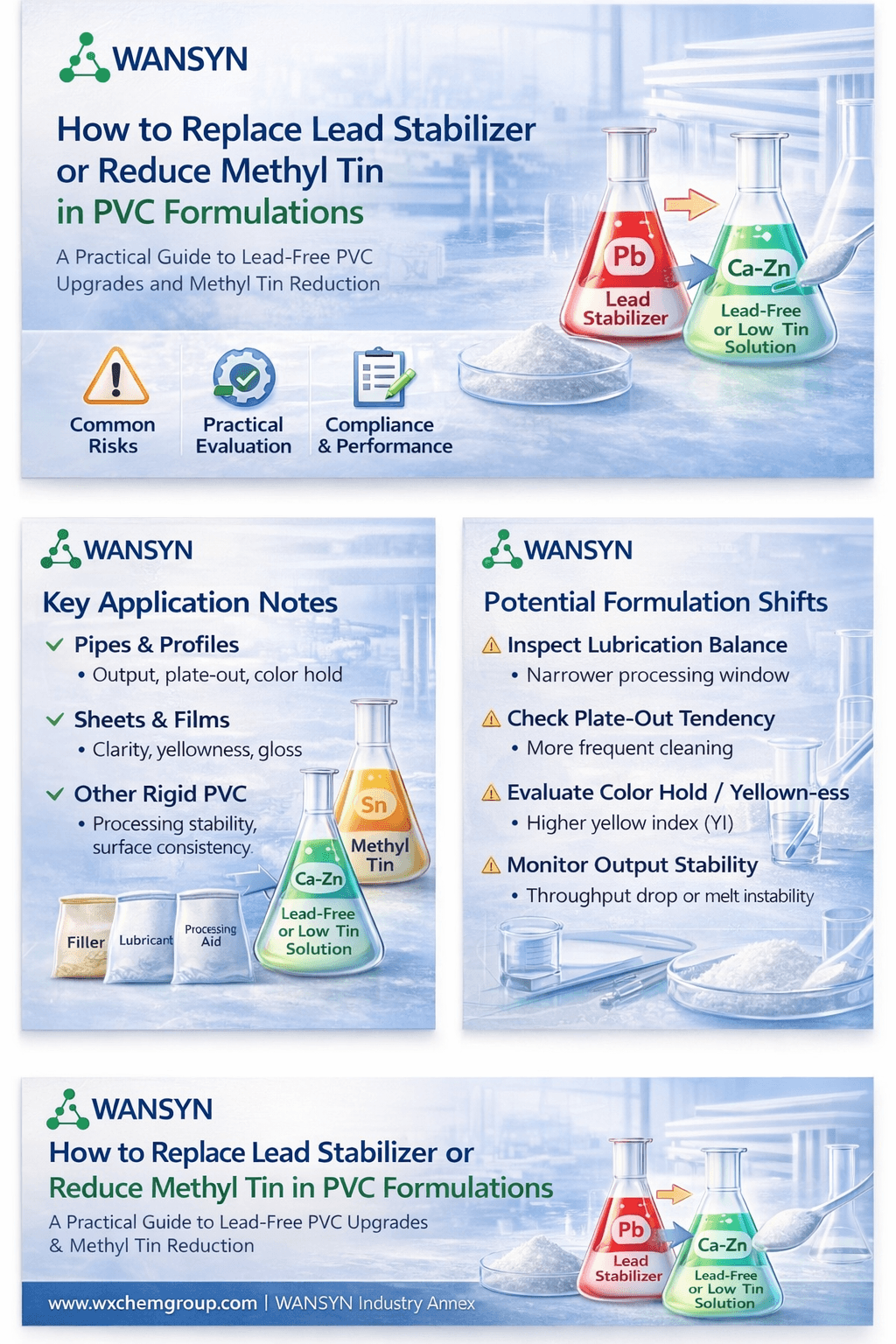

How to Replace Lead Stabilizer or Reduce Methyl Tin in PVC Formulations
In PVC formulation upgrade projects, many processors today are no longer asking only whether a line can keep running.
They are also asking:
- whether the formulation can support lead-free or lower restricted-substance positioning
- whether it can better match RoHS, REACH, or customer audit requirements
- whether the process window, appearance, and output can remain acceptable after an upgrade
- whether there is room to reduce methyl tin in selected applications
- whether the change can be introduced without creating excessive production risk or unstable cost
That is why more and more PVC processors are actively evaluating two questions:
How can lead stabilizers be replaced by a Ca-Zn-based system?
How can methyl tin usage be reduced without losing too much processing stability or product performance?
In practice, however, formulation upgrades are never as simple as switching one stabilizer for another.
Whether the goal is replacing a lead-based system with a Ca-Zn route, or partially reducing methyl tin in selected formulations, the real challenge is always the same:
how to rebuild a workable balance between heat stability, processing stability, plate-out behavior, color hold, gloss, clarity, output, and cost-in-use.
This article explains:
- why more PVC processors are considering lead replacement or tin reduction
- what the most common technical risks are
- what should be checked when evaluating Ca-Zn as a lead-free upgrade route
- what to watch when reducing methyl tin
- what buyers should prepare before trials
- and how to approach a formulation upgrade in a more practical, lower-risk way
Quick Answer: What Do Buyers Really Care About in a Stabilizer Upgrade?
When buyers consider replacing lead stabilizers or reducing methyl tin in PVC formulations, the real question is usually not whether the switch is theoretically possible.
What they really care about is:
- whether the production line can still run stably
- whether yellowing, plate-out, or output instability will increase
- whether gloss, clarity, whiteness, or surface finish will be affected
- whether the existing lubrication package, filler level, and processing aid system can still work
- whether customer audit and compliance pressure can be handled more easily
- whether the total cost becomes more manageable, not just the raw material price
So the real task is not just to “find a greener or cheaper stabilizer.”
It is to:
rebuild a formulation that remains manufacturable, testable, and sustainable under new technical and compliance requirements.
Key Takeaways
- Replacing lead stabilizers or reducing methyl tin is fundamentally a formulation system upgrade, not a simple additive swap.
- The most common risks are usually not total failure, but narrower process windows, more plate-out, weaker color hold, lower clarity, and unstable output.
- Ca-Zn stabilizers can be evaluated as a practical lead-free upgrade route in many rigid PVC applications, but only together with resin, filler, lubrication, processing aid, and equipment conditions.
- If the goal is not full replacement but partial methyl tin reduction, the application and final performance requirements must be reviewed even more carefully.
- The most effective upgrade path is usually not a single major reformulation, but a staged validation process with clear pass/fail criteria.
Why More PVC Processors Are Considering Lead Replacement or Tin Reduction
The push toward formulation change usually comes from several factors at the same time.
1. Regulatory and Customer Audit Pressure
More downstream customers now explicitly ask for:
- lead-free positioning
- easier support for RoHS / REACH
- lower restricted-substance exposure
- better alignment with internal compliance and audit processes
This means that even if an existing formula still runs well, processors may still need to plan an upgrade path.
2. Export and Brand-Customer Requirements
For export projects, international brands, or customers with stricter audit systems, the stabilizer package is no longer judged only on technical performance.
It can also affect:
- supplier approval
- document preparation
- long-term supply confidence
- future audit risk
3. Supply Strategy and Cost Structure
Some processors are not driven only by compliance.
They may also want to explore:
- reduced dependence on one stabilizer route
- partial methyl tin reduction in selected applications
- better overall cost-in-use
- more flexibility in second-source qualification
So formulation upgrading is not always only an environmental move.
It is often also a sourcing and risk-management decision.
What Usually Changes First When Lead Is Replaced or Methyl Tin Is Reduced?
Most upgrade projects do not fail because the new system “cannot work at all.”
They become difficult because some performance areas start to move in the wrong direction.
Typical issues include:
1. Lower Heat-Stability Margin
This may appear as:
- easier yellowing
- shorter tolerance to residence time
- weaker restart behavior
- greater sensitivity in hotter processing zones
2. Narrower Processing Window
Typical signs include:
- the formulation becoming more sensitive to temperature and speed
- lubrication balance becoming harder to control
- more operator intervention needed to keep the line stable
3. More Plate-Out or Die Build-Up
This may lead to:
- more frequent cleaning
- less consistent surface quality
- reduced long-run stability
4. Changes in Appearance
Depending on the application, this may include:
- weaker whiteness
- higher YI
- lower clarity
- reduced gloss
- duller or less uniform surface appearance
5. Output or Plastification Changes
Typical signs include:
- lower throughput
- unstable melt behavior
- head-pressure fluctuation
- more frequent process adjustment
That is why the real question should not be:
“Can this Ca-Zn replace lead?”
or
“Can we reduce methyl tin?”
A more useful question is:
“Under our application, formulation, and equipment conditions, which performance areas are most likely to shift, and what do we need to protect first?”
What Should Be Checked When Evaluating Ca-Zn as a Lead-Free Upgrade Route?
In many rigid PVC applications, Ca-Zn systems are a realistic upgrade direction.
But success depends less on whether substitution is possible in theory, and more on how the evaluation is done in practice.
1. Start with the Application Type
Different applications tolerate formulation change differently.
For example:
- pipes & fittings usually focus on output, plate-out, color hold, and long-run stability
- profiles often focus on weatherability, surface quality, and whiteness
- sheets / rigid films often focus more on clarity, yellowing, gloss, and deposit control
- edge banding or cable-related applications may focus more on process stability and long-term consistency
The replacement logic should not be copied mechanically from one application to another.
2. Recheck Lubrication Balance
Many failed replacement projects are not caused by the Ca-Zn system itself.
They fail because:
- the original lubrication design was built around a lead-based system
- the stabilizer was changed, but the lubrication package was not reviewed
- the result was more plate-out, unstable plastification, or a narrower processing window
In practice, lubrication balance almost always needs to be re-evaluated when moving from lead to Ca-Zn.
3. Re-evaluate Fillers and Processing Aids
Filler loading, processing-aid level, and resin characteristics all influence the new system’s performance.
Key points to review include:
- whether filler loading is already high
- whether processing aid is sufficient for plastification and surface development
- whether the resin and line conditions are already sensitive to narrower stability margins
4. Do Not Rely Only on Static Heat-Stability Data
Static lab heat-stability tests are useful, but they do not decide whether a formulation is production-ready.
What matters in real production is:
- long-run stability
- restart behavior
- output consistency
- plate-out control
- surface appearance
- batch-to-batch stability
Lab data can support evaluation, but it cannot replace actual trials.
What Should Be Considered When the Goal Is to Reduce Methyl Tin, Not Replace It Completely?
For many processors, the goal is not a full stabilizer switch.
It is to reduce methyl tin usage in selected applications without unacceptable performance loss.
This is a very practical direction, especially in:
- applications that are not extremely dependent on the highest clarity
- projects trying to optimize total cost
- customers trying to reduce compliance pressure
- processors looking for more formulation flexibility
But several points matter:
1. Not Every Application Offers the Same Room for Tin Reduction
Applications that are highly sensitive to clarity, gloss, low yellowing, or heat-stability margin may allow less reduction.
2. Tin Reduction Is Not Just a Simple Dosage Cut
In many cases, reducing methyl tin also means reviewing:
- co-stabilizer design
- lubrication
- processing aid
- and sometimes even pigments, fillers, or process settings
3. You Must First Define Which Performance Cannot Be Lost
For example:
- clarity must remain unchanged
- YI must not rise significantly
- throughput must not drop
- plate-out must not increase
Without this priority setting, trials often become inefficient and repetitive.
The 5 Most Common Mistakes in Formulation Upgrade Projects
1. Treating the Change as a One-Ingredient Replacement
In reality, this is usually a system rebalance.
2. Focusing Only on Short Trials
Short success does not guarantee long-run manufacturability.
3. Looking Only at Raw Material Price
If the new system causes more scrap, more downtime, or lower output, total cost may rise.
4. Starting Without Clear Evaluation Standards
If the trial does not define what must be protected, decision-making becomes subjective.
5. Trying to Change Too Much at Once
A step-by-step validation approach is usually much safer than a full reformulation in one move.
A More Practical Way to Run Lead-Replacement or Tin-Reduction Projects
If the goal is to increase the chance of a successful upgrade, a staged approach is usually better.
Step 1: Define the Real Goal
Are you trying to:
- fully replace lead
- partially reduce methyl tin
- prepare for lead-free positioning
- support customer compliance review
- optimize total cost-in-use
Different goals require different trial paths.
Step 2: Define the “Do Not Lose” Parameters
For example:
- output must not drop
- YI must remain acceptable
- plate-out must not increase
- clarity must remain stable
- gloss must be maintained
- cleaning interval must not shorten
Step 3: Organize the Current Formulation Baseline
At minimum, review:
- resin type / K value
- filler loading
- lubrication package
- processing aid
- current stabilizer system
- temperature settings
- equipment type
- current processing problems
Step 4: Run Small, Controlled Trials First
Start with directional validation before making larger formulation shifts.
Step 5: Evaluate Like a Real Production Project
Do not judge only by one sample sheet or one short run.
Look at:
- long-run behavior
- restart behavior
- batch consistency
- output
- scrap
- cleaning interval
- appearance
- total cost-in-use
What Buyers Should Prepare Before Discussing Lead Replacement or Tin Reduction
If you plan to discuss a formulation upgrade with a supplier, it helps to prepare the following:
1. Current Application
- pipes / fittings
- profiles
- sheets / films
- rigid transparent products
- other rigid PVC applications
2. Current Formulation Baseline
- current stabilizer route
- filler level
- lubrication package
- processing aid
- pigment / TiO₂ system
3. The Main Problem or Goal
- compliance-driven lead-free upgrade
- partial tin reduction
- lower audit pressure
- cost optimization with acceptable risk
- second-source preparation
4. Which Properties Must Be Protected
Clear pass/fail thinking makes trials much more efficient.
How Suppliers Should Support This Type of Project
A mature stabilizer supplier should not only say:
“Yes, it can be replaced.”
A more valuable approach is to help the buyer clarify:
- whether the application is suitable for lead replacement or tin reduction
- where the main risks are likely to appear
- which variables should be checked first
- which formulation data should be collected first
- whether a staged validation path is more suitable
- whether the project is better treated as a lead-replacement or a tin-reduction project
That is why the smoothest upgrade projects are usually not simple product sales.
They are application-matching and trial-path design projects.
What Buyers Should Prepare Before Discussing a Formulation Upgrade
If you plan to discuss lead replacement or methyl tin reduction with a supplier, it helps to prepare the following first:
1. Current Application
- pipes / fittings
- profiles
- sheets / films
- rigid transparent products
- other rigid PVC applications
2. Current Formulation Baseline
- current stabilizer route
- filler level
- lubrication package
- processing aid
- pigment / TiO₂ system
3. Main Goal of the Upgrade
- compliance-driven lead-free upgrade
- partial tin reduction
- lower audit pressure
- cost optimization with acceptable risk
- second-source preparation
4. Which Properties Must Be Protected
Clear pass/fail thinking makes trials much more efficient.
How Buyers Can Connect Upgrade Goals with Practical Grade Evaluation
Once a processor moves beyond the general idea of “lead replacement” or “tin reduction,” the next step is usually not to choose a product name first.
The more practical starting point is to define:
- which application is being upgraded
- which performance must be protected
- which risks are most likely to change during the trial
In real projects, different upgrade paths usually lead to different evaluation priorities.
For example:
- pipe and fitting projects often need closer attention to output stability, plate-out behavior, and long-run consistency
- profile applications may focus more on surface quality, color hold, and processing window
- sheet and film applications may pay more attention to clarity, gloss, yellowing, and deposit control
- selected low-tin projects often require a more careful balance between compliance goals and retained appearance or processing performance
From this perspective, stabilizer grades are better understood as application-oriented evaluation options, rather than universal one-to-one replacements.
That is why it is usually more effective to discuss the upgrade path first, and only then move to actual grade trials.
Related Product Directions for Practical Evaluation
Under this type of trial logic, different grade families may be more relevant to different project directions.
For example:
- G-80 may be more relevant in pipe- and fitting-oriented powder Ca-Zn evaluations
- Y-181 / Y-550 may be more relevant in selected projects where processors are evaluating partial methyl tin reduction or low-tin upgrade directions
- other powder Ca-Zn grades may be considered for profiles, sheets, films, or edge banding, depending on formulation goals and processing conditions
For processors moving toward a lead-free direction, or evaluating partial methyl tin reduction in selected applications, a properly matched Ca-Zn stabilizer system is worth practical evaluation based on the current formulation and processing condition.
FAQ
1. Can lead stabilizers always be directly replaced by Ca-Zn in PVC formulations?
They should not be treated as direct one-to-one replacements.
Ca-Zn evaluation usually needs to be combined with application type, lubrication balance, filler level, processing aid, and line conditions.
2. Is reducing methyl tin simply a matter of lowering dosage?
Usually not.
Partial tin reduction often requires review of co-stabilizers, lubrication, processing aid, and process settings to avoid yellowing, plate-out, or clarity loss.
3. What usually changes first during lead replacement or tin reduction?
Common early changes include weaker color hold, more plate-out, narrower processing windows, lower clarity, output fluctuation, and weaker restart behavior.
4. What should be checked most carefully during trials?
The most useful checks are long-run behavior, restart performance, output, plate-out, YI / color, surface appearance, and total cost-in-use — not only short heat-stability results.
5. Which applications are more suitable to evaluate Ca-Zn as an upgrade path?
This depends on the actual application.
Many rigid PVC applications can evaluate Ca-Zn routes, but different applications place different priorities on clarity, whiteness, gloss, weatherability, and processing stability.
6. What should buyers prepare before discussing a formulation upgrade?
It is best to prepare the current application, formulation baseline, main target, and the properties that must be protected during validation.
Conclusion
Whether the project is about replacing lead stabilizers or partially reducing methyl tin, it should not be treated as a simple material switch.
It is a real formulation-upgrade project.
The key is not whether a product claims to be a replacement.
The key is:
- whether the target is clearly defined
- whether the current system is understood
- whether the trial path is realistic
- whether the evaluation criteria are clear
- whether the supplier can support real application matching
For many PVC processors, the real goal is not only to become “greener,” and not only to become “cheaper.”
It is to:
build a formulation system that remains manufacturable, verifiable, and sustainable under new technical and compliance requirements.
Considering lead replacement or methyl tin reduction in your PVC formulation?
If you are evaluating:
- lead-free upgrades
- partial methyl tin reduction
- new supplier qualification
- sample validation and formulation matching
feel free to share your application, current formulation status, and target requirements with us.
WANSYN can help review where a practical evaluation should begin.