PVC Stabilizer Compliance Pack: RoHS, REACH, COA, SDS & What Buyers Usually Ask For
In PVC stabilizer projects, many buyers do not start by asking about price or dosage.
Instead, one of the first questions is often:
“What documents can you provide?”
This is especially common in the following situations:
-
new supplier qualification
-
second-source approval
-
export-oriented projects
-
brand customer audits
-
internal purchasing / quality / regulatory review
-
pre-trial EHS and compliance checks
For many buyers, a PVC stabilizer is not only a technical material that needs to perform well in production. It is also a product that must be able to pass an internal review process before trials can even begin.
If a supplier cannot provide basic documentation in a clear and timely way, many buyers will not move the project forward.
That is why more and more customers now ask for a clear PVC Stabilizer Compliance Pack before deciding whether to proceed with samples.
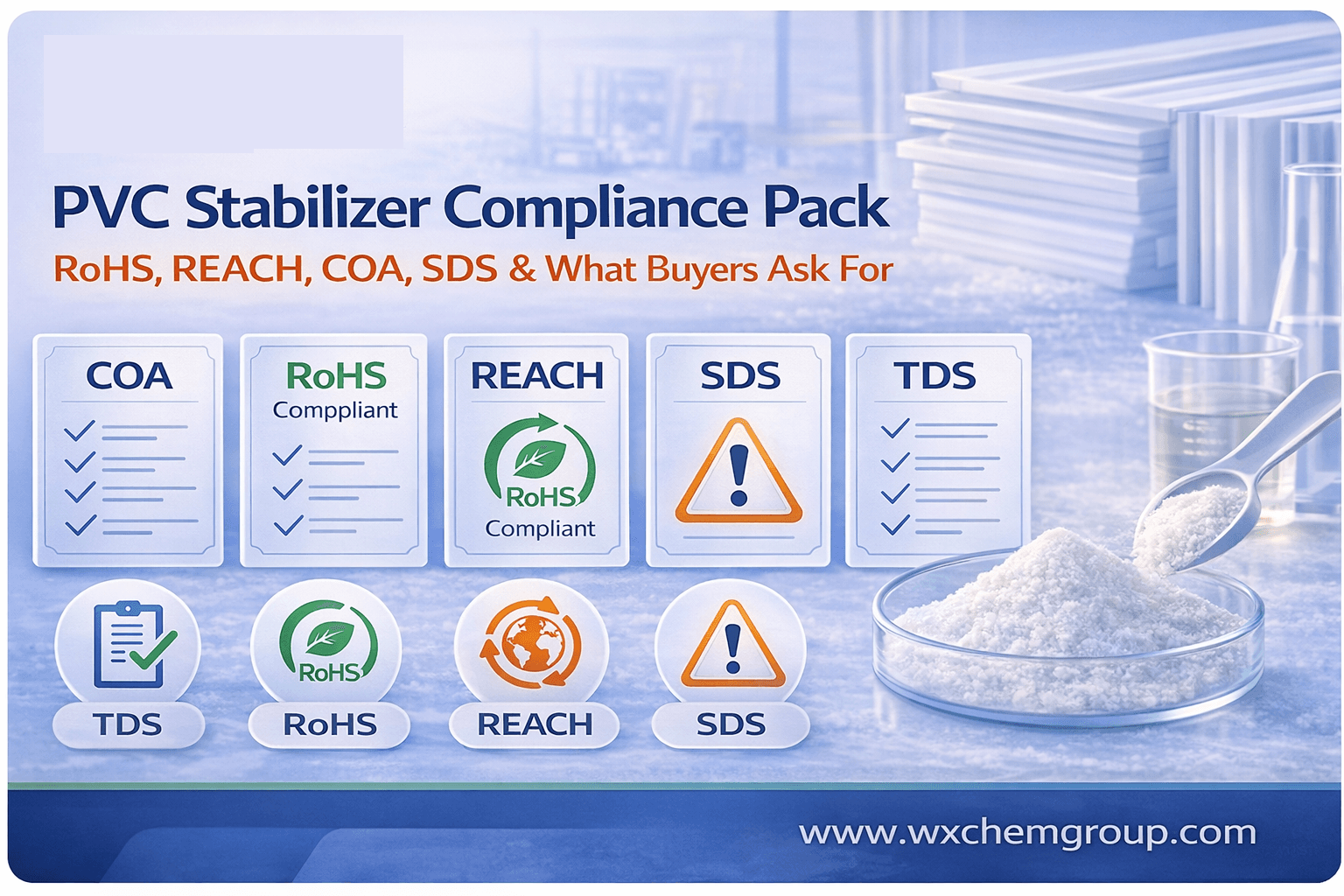
In real sourcing practice, the most commonly requested documents include:
-
TDS
-
SDS / MSDS
-
COA
-
RoHS
-
REACH / SVHC
-
batch traceability information
-
sample-to-production consistency information
-
application-specific or customer-specific supporting documents
This article explains:
-
which documents PVC stabilizer buyers usually request first
-
which files are basic requirements and which depend on market or application
-
how document priorities vary by application
-
how to organize a more practical compliance pack for supplier qualification and second-source approval
-
and why documentation quality often affects project progress more than suppliers expect
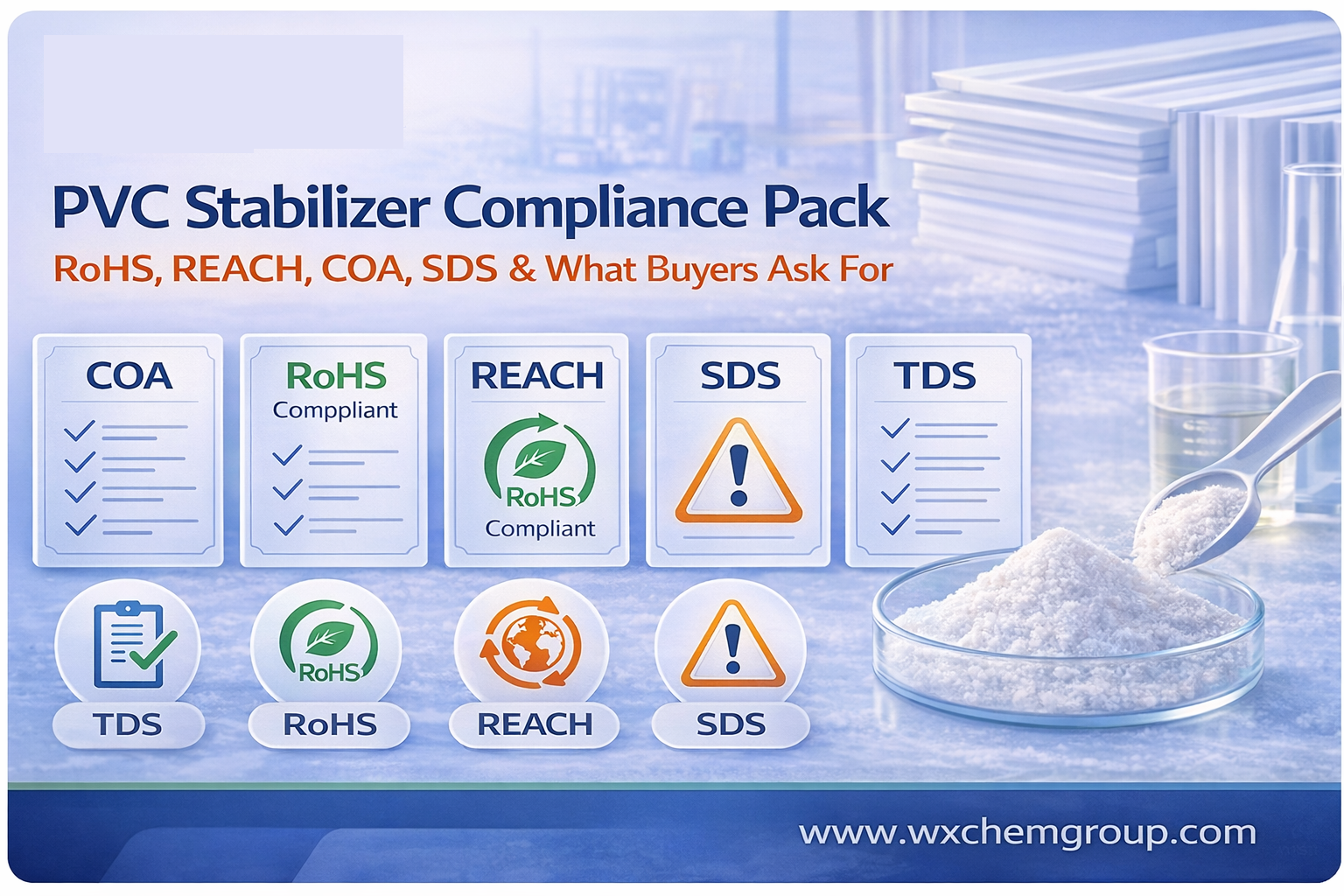
Quick Answer: What Documents Do PVC Stabilizer Buyers Usually Ask For First?
If a buyer is evaluating a PVC stabilizer for sampling or supplier approval, the most commonly requested documents are:
-
TDS (Technical Data Sheet)
-
SDS / MSDS (Safety Data Sheet)
-
COA (Certificate of Analysis)
-
RoHS-related documents
-
REACH / SVHC-related documents
-
and, depending on the project, batch traceability, packing/storage information, sample batch details, and application notes
If these documents are clear, complete, and matched to the actual product, the buyer is much more likely to move the project into trial and review stages.
Key Takeaways
-
In PVC stabilizer sourcing, a compliance pack is not an extra — for many buyers it is the starting point of supplier approval.
-
The most commonly requested documents are TDS, SDS / MSDS, COA, RoHS, and REACH / SVHC.
-
Different buyers focus on different details depending on application; pipes, profiles, sheets, films, and cable compounds do not all review documents in the same way.
-
A good compliance pack is not just “sending files.” It should be product-specific, clearly structured, easy to review, traceable, and suitable for internal circulation.
-
For second-source approval and new supplier development, document quality and response speed strongly affect buyer confidence.
Why Buyers Ask for Compliance Documents Before Trials
Many suppliers assume samples should always come first.
In real industrial purchasing, especially with larger buyers and export projects, the process is often the opposite:
documents first, samples later.
This usually happens for several reasons.
1. Buyers Need to Complete Internal Pre-Screening
Procurement teams often cannot decide on trials alone.
They may first need to submit supplier documents to:
-
purchasing
-
quality
-
R&D
-
regulatory
-
EHS
-
production management
If basic documents are missing, the project may stop before testing starts.
2. Documents Are the Fastest Way to Judge Supplier Discipline
At the early stage, buyers may not deeply study your formulation philosophy.
But they will use documents to judge whether you have:
-
basic quality discipline
-
document control capability
-
batch management
-
familiarity with international buyer processes
-
the ability to support ongoing qualification work
In many cases, documentation quality is part of your professional image.
3. Buyers Want to Avoid Wasting Trial Time
If the basic compliance requirements are not met, buyers often do not want to spend time testing.
Even if the sample performs well, the project may still fail later if the required documents cannot be provided.
4. EHS, Warehouse, and Transport Checks Often Come Early
For chemical additives, many customers want to review at least the following before sample intake:
-
SDS / MSDS
-
storage and handling precautions
-
hazard overview
-
basic packing and labeling information
For well-managed factories, this is routine, not an unusual request.
Which Documents Are Most Commonly Requested for PVC Stabilizers?
Below are the most common and most practical document types in PVC stabilizer sourcing.
1. TDS: Technical Data Sheet
The TDS is often one of the first documents buyers request because it helps them quickly understand:
-
what type of stabilizer it is
-
which PVC applications it is mainly intended for
-
what the key product features are
-
whether it generally fits the project direction
A practical PVC stabilizer TDS usually includes:
-
product name / grade
-
product type (for example powder Ca-Zn, liquid methyl tin, liquid Ca-Zn)
-
recommended applications
-
typical features
-
handling and storage guidance
-
packing information
-
and, when appropriate, a carefully worded starting dosage reference
For buyers, the TDS is not a regulatory file, but it is often the entry document for product selection.
2. SDS / MSDS: Safety Data Sheet
The SDS is one of the most basic documents in chemical sourcing.
It is commonly used for:
-
EHS review
-
warehouse assessment
-
safe handling procedures
-
preliminary transport review
-
internal documentation filing
Through the SDS, buyers usually check:
-
product identification
-
composition information
-
hazard overview
-
first aid measures
-
personal protection guidance
-
spill handling
-
storage and transport information
-
regulatory information
For many customers, without an SDS, a sample may not even enter the factory review system.
3. COA: Certificate of Analysis
The core value of a COA is to show:
whether a specific batch of product meets the supplier’s relevant specification or agreed control standard.
Buyers commonly use COAs to check:
-
whether the file matches the actual product and batch
-
whether key items are controlled consistently
-
whether there is batch traceability
-
whether the supplier has a real release and record system
For PVC stabilizers, buyers usually care less about how many test items appear on the COA than about:
-
whether the COA is real and well-structured
-
whether it matches the actual sample
-
whether it helps show batch consistency
-
whether it supports future batch tracking
4. RoHS-Related Documents
Many customers ask early in the conversation:
“Can you provide RoHS?”
This is usually not just a formality.
It often means they want to confirm:
-
whether the product aligns with their restricted-substance requirements
-
whether it can support export or downstream compliance needs
-
whether the supplier has basic environmental documentation capability
Buyers typically care about:
-
whether a report or declaration is available
-
whether the document matches the actual grade
-
whether the date is reasonably current
-
whether the format and source are credible
5. REACH / SVHC-Related Documents
For Europe-related projects, international brands, or compliance-sensitive customers, REACH / SVHC documents are also commonly requested early.
Buyers often want to know:
-
whether a REACH declaration can be provided
-
whether there is SVHC-related information
-
whether any screening or testing information matches the actual grade
-
whether the document can support internal review or customer filing
Many buyers do not require a highly complex regulatory file at the first step, but they do expect the supplier to show:
-
familiarity with the requirement
-
experience in preparing such documents
-
ability to support follow-up reviews
6. Packing, Storage, and Batch Information
This category is often underestimated, but it matters a lot during supplier qualification.
Buyers may also want to confirm:
-
packing specification
-
storage conditions
-
shelf life / recommended use period
-
batch identification method
-
how the sample batch relates to future production supply
These details help buyers judge:
-
whether the product is manageable in their internal system
-
whether future batches will be traceable
-
whether trial data will be meaningful later
Which Documents Are Basic, and Which Should Be Prepared by Project?
Not every buyer will ask for every file at the same time.
A better approach is to prepare documents in three levels.
A. Basic Standard Pack
These are the most universal and most commonly used documents:
-
TDS
-
SDS / MSDS
-
sample COA
-
packing and storage notes
This should be the standard minimum pack for all main grades.
B. Routine Compliance Pack
These are especially common in export projects and brand-related sourcing:
-
RoHS
-
REACH / SVHC-related documents
-
basic environmental declarations when needed
These files should ideally be organized by grade or product line, not assembled in an ad hoc way every time.
C. Project-Specific Supporting Pack
These are not always needed, but they are very useful in larger or more structured projects:
-
current sample batch details
-
batch traceability information
-
sample-to-production consistency note
-
application-specific notes
-
internal test-item overview
-
customer-specific formats if required
The most efficient approach is not to send “everything every time,” but to:
send the basic pack first, then add the project pack according to buyer needs.
What Different Buyers Usually Check First by Application
Even though all of these buyers are sourcing PVC stabilizers, their priorities are not exactly the same.
1. Pipe & Fitting Buyers
These buyers often care most about:
-
whether the COA is formal and clear
-
whether batch consistency can be understood
-
whether the SDS is complete
-
whether long-term supply support is realistic
-
whether compliance files can support second-source approval
-
whether future problems can be traced back by batch
They are usually focused on one core question:
Can this supplier support stable production and long-term approval?
2. Profile Buyers
Profile customers often pay extra attention to:
-
whether the environmental direction is clear
-
whether documents can be easily circulated internally
-
whether the product suits light-colored or white formula directions
-
whether application communication is reasonably clear
3. Sheet & Film Buyers
When the project involves transparency, low yellowing, or high-gloss requirements, buyers often care more about:
-
whether the TDS clearly states the intended application
-
whether sample batch information is clear
-
whether RoHS / REACH files are easy to pass on to downstream customers
-
whether the technical pack supports internal comparison and approval
4. Cable Compound / Flexible PVC Buyers
These buyers often place more weight on:
-
SDS
-
environmental and regulatory files
-
storage and handling information
-
batch consistency
-
response speed for documentation
This is because ongoing supply coordination and document responsiveness matter a lot in continuous projects.
How Buyers Use These Documents to Screen Suppliers
Buyers do not always read every file line by line.
But they often use document quality to decide whether a supplier is worth moving forward with.
The most common review points are:
1. Are the files complete?
If even basic TDS, SDS, and COA cannot be provided quickly, buyer confidence drops.
2. Do the files match the actual product?
Buyers strongly dislike:
-
wrong grade files
-
outdated files
-
generic documents unrelated to the actual sample
This immediately weakens trust in document control.
3. Is the format professional?
Clear naming, consistent structure, product-specific content, and version clarity all affect buyer perception.
4. Are the files easy to circulate internally?
Buyers often need to forward documents to:
-
purchasing
-
quality
-
R&D
-
regulatory
-
production
If the files are disorganized, project speed slows down.
5. Can the supplier respond quickly and accurately?
In many cases, buyers are not only checking whether the files exist.
They are checking whether the supplier can provide them quickly, correctly, and in a structured way.
That often says more about future cooperation than the files themselves.
How to Organize a More Practical PVC Stabilizer Compliance Pack
If you want to improve project efficiency, it is better not to wait for buyers to ask one file at a time.
Instead, prepare a ready-to-send compliance pack in advance.
A practical structure can look like this:
1. Basic Pack
Include:
-
Product TDS
-
SDS / MSDS
-
sample COA
-
packing and storage note
This is suitable for early inquiry, sampling, and supplier pre-screening.
2. Compliance Pack
Include:
-
RoHS-related documents
-
REACH / SVHC-related documents
-
additional environmental declarations if needed
This is useful for export projects, brand customers, and more formal internal reviews.
3. Sample / Project Pack
Add by project:
-
current sample batch information
-
corresponding grade note
-
application note
-
batch traceability information
-
sample-to-production consistency statement when needed
This is especially useful for second-source approval and structured customer review processes.
4. Professional Naming and Delivery Also Matter
It helps to name files consistently, for example:
-
ProductName_TDS_EN.pdf
-
ProductName_SDS_EN.pdf
-
ProductName_COA_Sample.pdf
-
ProductName_RoHS.pdf
-
ProductName_REACH_SVHC.pdf
If you can send them as one clearly structured compressed pack or folder, buyer experience improves significantly.
Why Compliance Packs Matter Even More in Second-Source Qualification
For many factories, adding or changing a PVC stabilizer supplier is not simple.
They usually need to confirm at the same time:
-
whether documents are complete
-
whether the sample is traceable
-
whether later production batches will remain consistent
-
whether internal compliance review can be passed
-
whether the supplier looks capable of long-term support
So in second-source qualification, a compliance pack is not just about proving that “documents exist.”
It shows the buyer that:
-
you understand industrial sourcing flow
-
you know how their internal review works
-
you have a more mature support system
-
you are not only able to send samples, but also able to support qualification properly
That strongly affects buyer trust.
What Buyers Usually Ask After Reviewing the Documents
Once buyers start reviewing your files seriously, their next questions are often:
-
Which PVC applications is this grade mainly designed for?
-
Do you have relevant application experience?
-
What is the typical starting dosage range?
-
Can you support trial adjustment?
-
How do you keep sample and production batches consistent?
-
Can you support second-source qualification flow?
-
If the end customer later requests updated documents, can you still support them?
These questions usually mean the project is moving beyond simple inquiry and into real supplier evaluation.
FAQ
1. What documents do PVC stabilizer buyers usually ask for?
Usually: TDS, SDS / MSDS, COA, RoHS, REACH / SVHC-related files, and depending on the project, batch and traceability information.
2. What is the difference between TDS, SDS, and COA?
TDS explains product positioning, features, and recommended applications.
SDS covers safety, handling, storage, and regulatory basics.
COA shows test results for a specific batch and supports consistency and traceability.
3. Why do buyers ask for RoHS, REACH, and SDS before trials?
Because many buyers need to complete purchasing, quality, regulatory, or EHS review before the sample can officially enter the testing process.
4. Does every project require both RoHS and REACH?
Not every project requires both at the same time, but they are very common in export projects, brand customers, compliance-sensitive markets, and second-source approval.
5. Do different application buyers care about different documents?
Yes. Pipes, profiles, sheets, films, and cable compounds often focus on different details, although the basic files are usually necessary for all.
6. What makes a good PVC stabilizer compliance pack?
The most important points are: complete documents, correct match to the actual product, clear structure, easy internal review, traceability, and support for communication from sample to production.
Conclusion
In PVC stabilizer projects, a compliance pack is not an extra — it is part of the purchasing process.
For buyers, it helps them move faster through:
-
supplier pre-screening
-
internal review
-
sample approval
-
second-source qualification
-
pre-production confirmation
For suppliers, a well-prepared, clearly named, and quickly delivered documentation pack improves professionalism and makes it much easier to move the project from “asking for files” to “requesting samples, testing, and discussing real business.”
If you want to improve conversion in PVC stabilizer projects, organizing your TDS, SDS / MSDS, COA, RoHS, and REACH / SVHC into a buyer-friendly PVC Stabilizer Compliance Pack is one of the most practical things you can do.
Looking for PVC stabilizers and want to confirm compliance documents first?
WANSYN can support basic documentation packs for different stabilizer types and application directions, including:
-
TDS
-
SDS / MSDS
-
COA
-
RoHS / REACH-related documents (available by project)
-
application and sample communication support
If you are preparing for new supplier review, second-source qualification, or sample testing, feel free to share your application and document requirements with us so we can support more efficiently.