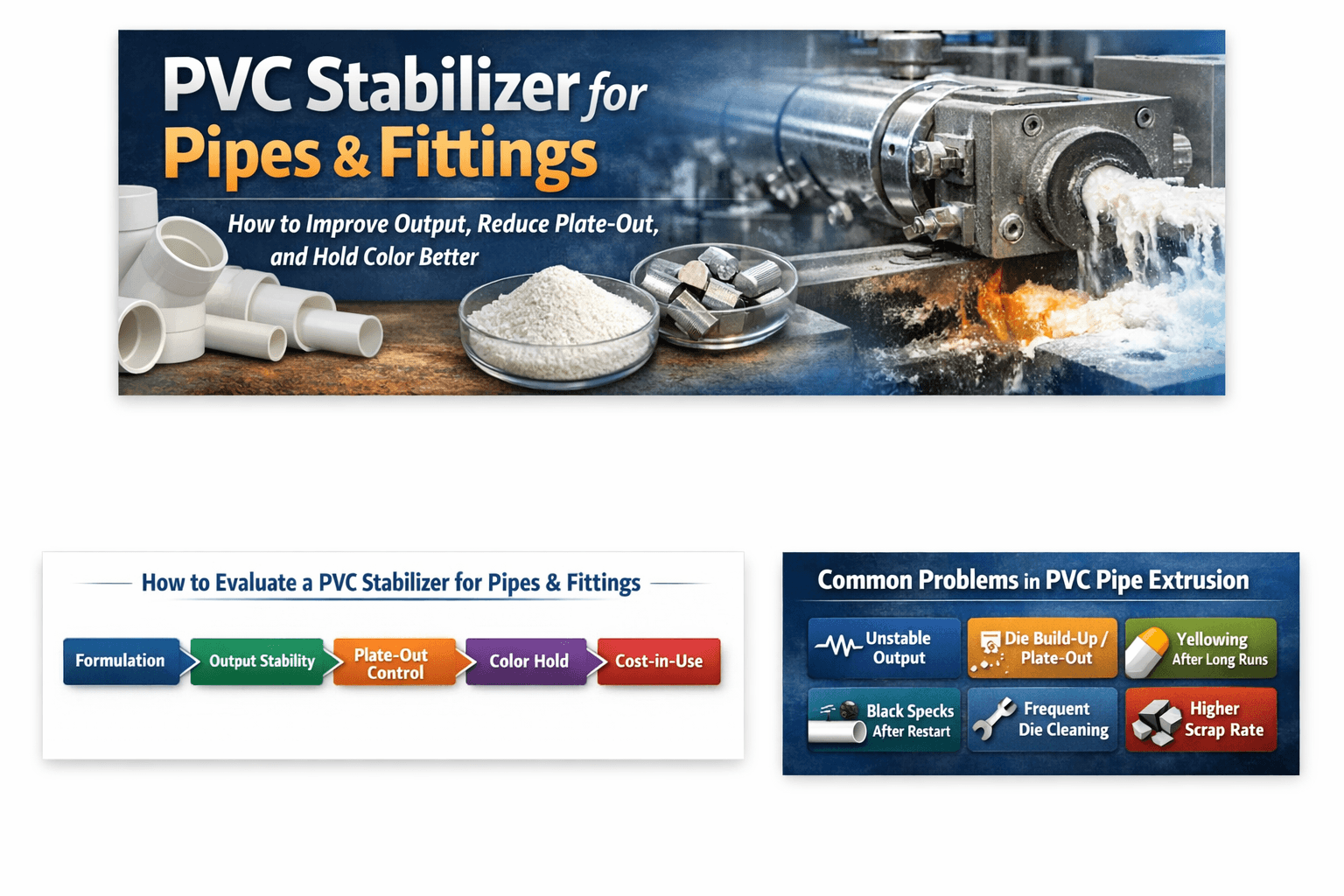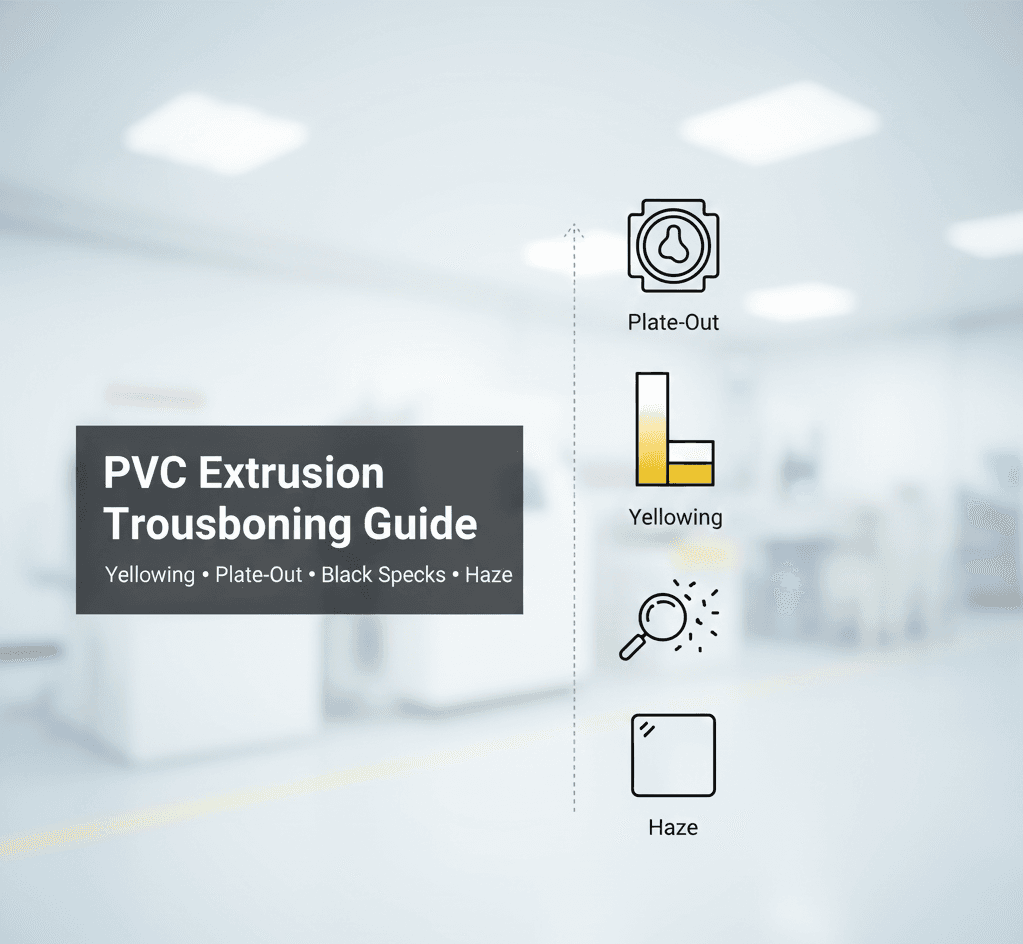

PVC Extrusion Troubleshooting Guide: Fix Yellowing, Plate-Out, Black Specks, Haze & Instability (Stabilizer-Focused)
Intro
PVC extrusion issues—yellowing, plate-out (die build-up), black specks, haze, and unstable pressure/torque—are often blamed on the machine. In practice, they are frequently caused by a mismatch between stabilizer system, lubrication balance, and heat history (temperature + residence time + start/stop events).
This guide is symptom-first: symptom → likely causes → quick checks → fix directions, with a stabilizer-focused lens.
Recommended Reading:
Key Takeaways
-
Separate root causes into three buckets: thermal degradation, lubrication/compatibility, and contamination/dead zones.
-
Always check heat history before changing materials: melt temperature, residence time, and start/stop behavior.
-
Plate-out and haze are often lubrication + compatibility problems—not “stabilizer quality” alone.
-
Validate fixes using quick KPIs: YI/color trend, cleaning interval, pressure fluctuation range, scrap rate, long-run stability.
60-Second Diagnostic Flow
-
Yellowing / discoloration? → Thermal stability + heat history
-
Plate-out / die lip build-up? → Lubrication balance + wax package + compatibility
-
Black specks / burnt particles? → Overheating, dead zones, contamination, degraded regrind
-
Haze / poor clarity (clear PVC)? → Additive interactions + moisture + clarity package
-
Pressure/torque fluctuations? → Fusion stability + lubrication drift + temperature profile
Quick Troubleshooting Table
| Symptom | Most likely causes | First fix direction |
|---|---|---|
| Yellowing / browning | Thermal degradation, high melt temp, long residence, weak stabilization synergy | Strengthen stabilization + reduce heat history, confirm with YI |
| Plate-out / die build-up | Lubrication imbalance, wax mismatch, additive incompatibility | Rebalance lube + optimize wax, track cleaning interval |
| Black specks | Hot spots, dead zones, contamination, degraded regrind | Remove hotspots + clean/filtration + control regrind |
| Haze / poor clarity | Incompatible additives, moisture, non-clarity package | Optimize clarity package + reduce haze contributors |
| Pressure/torque instability | Fusion instability, lubrication drift, temp mismatch | Stabilize fusion + tune lube + re-check temperature profile |
1) Yellowing / Discoloration
Likely causes (stabilizer-related)
-
Insufficient thermal stability under your real heat history
-
Long residence time, high melt temperature, or frequent hot start/stop
-
Weak co-stabilizer synergy (not just “dosage”)
-
Pigment/filler interactions increasing heat stress
Quick checks
-
Compare color at steady state, 60 minutes, and end of run
-
Track Yellowness Index (YI) if possible
-
Identify hot zones: adaptor, screen pack area, die entry
Fix directions
-
Choose system by application (clear rigid often needs stronger clarity + stability package)
-
Improve synergy (co-stabilizers) instead of only adding dosage
-
Reduce heat history: adjust temperature profile, lower residence time, manage downtime hot hold
-
Validate with YI trend + long-run color hold + scrap rate
2) Plate-Out / Die Build-Up (Die Lip Build-Up)
Likely causes
-
External lubricant too strong / wrong wax blend → deposits at die lip
-
Stabilizer–lubricant incompatibility
-
Excess wax/process aid migration
-
Temperature profile causing partial melt + re-solidification near die
Quick checks
-
Where is deposit? die lip / calibrator / roll
-
Texture: waxy/oily vs hard crust
-
Does build-up worsen when output increases or external wax increases?
Fix directions
-
Rebalance internal vs external lubricants (first step)
-
Optimize wax package to reduce deposit-forming components
-
Consider a “cleaner processing” stabilizer package designed for lower plate-out
-
Validate with cleaning interval + deposit score + fewer surface streaks
3) Black Specks / Burnt Particles
Likely causes
-
Local overheating or dead zones releasing carbonized residue
-
Contaminated raw materials or degraded regrind
-
Insufficient filtration/screen pack
Quick checks
-
Random vs periodic specks (periodic often = dead zone release)
-
Inspect screen pack and die corners for carbonized deposits
-
Temporarily reduce regrind % to confirm root cause
Fix directions
-
Reduce hotspots + shorten residence time
-
Improve cleaning schedule and filtration
-
Strengthen stabilization against heat spikes (especially start/stop)
-
Validate with speck count + scrap rate + stability after downtime
4) Haze / Poor Clarity (Clear PVC Sheet/Film)
Likely causes
-
Additive interactions (lubricants/process aids) reducing optical clarity
-
Moisture/contamination
-
Stabilizer system not optimized for clarity + color hold
Quick checks
-
Compare haze/clarity under identical lighting (or haze meter)
-
Dry resin/additives and compare
-
Check whether haze worsens over time (migration/plate-out related)
Fix directions
-
Use a clarity-oriented system (often tin-based for rigid clear, or optimized Ca-Zn)
-
Reduce haze contributors (incompatible wax/aid)
-
Validate with haze + YI + surface quality
5) Unstable Pressure / Torque / Output Fluctuations
Likely causes
-
Fusion instability (under-fusion or over-lubrication)
-
Lubrication balance drifting as the line heats
-
Temperature profile mismatch causing inconsistent gelation
Quick checks
-
Worse after warm-up?
-
Any lab torque curve data to compare?
-
Do small lube changes cause big instability?
Fix directions
-
Stabilize fusion by tuning internal/external lube ratio and processing aid
-
Improve thermal stability so viscosity doesn’t drift
-
Validate with pressure stability range + consistent output + stable torque plateau
Minimal A/B Trial Plan
Record:
-
Color/YI at start + 60 min + end
-
Cleaning interval and deposit score
-
Pressure fluctuation range
-
Scrap rate (especially after downtime)
-
Photos of deposits and surface
CTA
Send us:
-
Application (pipe/profile/clear sheet/cable/compound)
-
Process (extrusion/calendering)
-
Symptom(s)
-
Current stabilizer type (if known)
-
Key formulation notes (wax/filler/pigment/regrind %)
-
Output rate & temperature profile
FAQ
Q1: What causes PVC yellowing during extrusion?
A: Yellowing is most commonly caused by thermal degradation—high melt temperature, long residence time, hot start/stop events, or insufficient stabilization synergy. Track color/YI over time (steady state → 60 min → end of run) and adjust heat history and stabilizer/co-stabilizer balance.
Q2: How do I reduce plate-out and die lip build-up in PVC extrusion?
A: Plate-out is often driven by lubrication imbalance and wax package mismatch. Start by rebalancing internal vs external lubricants, then optimize wax components and compatibility. Confirm improvement by longer cleaning intervals and lower deposit scores.
Q3: Why do black specks appear in PVC extrusion?
A: Black specks typically come from overheating or dead zones releasing carbonized deposits, contaminated inputs, or degraded regrind. Inspect die/screen pack, reduce hotspots, improve filtration, and temporarily reduce regrind to verify the root cause.
Q4: What causes haze in clear PVC sheet and film?
A: Haze often results from additive interactions (lubricants/process aids), moisture, contamination, or a non-optimized clarity package. Compare haze under consistent conditions, try drying inputs, and adjust the package for clarity + color hold.
Q5: How do stabilizers affect pressure and torque stability?
A: Stabilizers influence melt stability and viscosity drift under heat history. Instability can also reflect fusion and lubrication behavior. Combine stabilizer optimization with lubrication tuning and a verified temperature profile, then track pressure fluctuation ranges.
Q6: What KPIs should I record during troubleshooting trials?
A: At minimum record: YI/color trend, cleaning interval/deposit score, pressure fluctuation range, scrap rate (especially after downtime), and photos of deposits and surface quality.