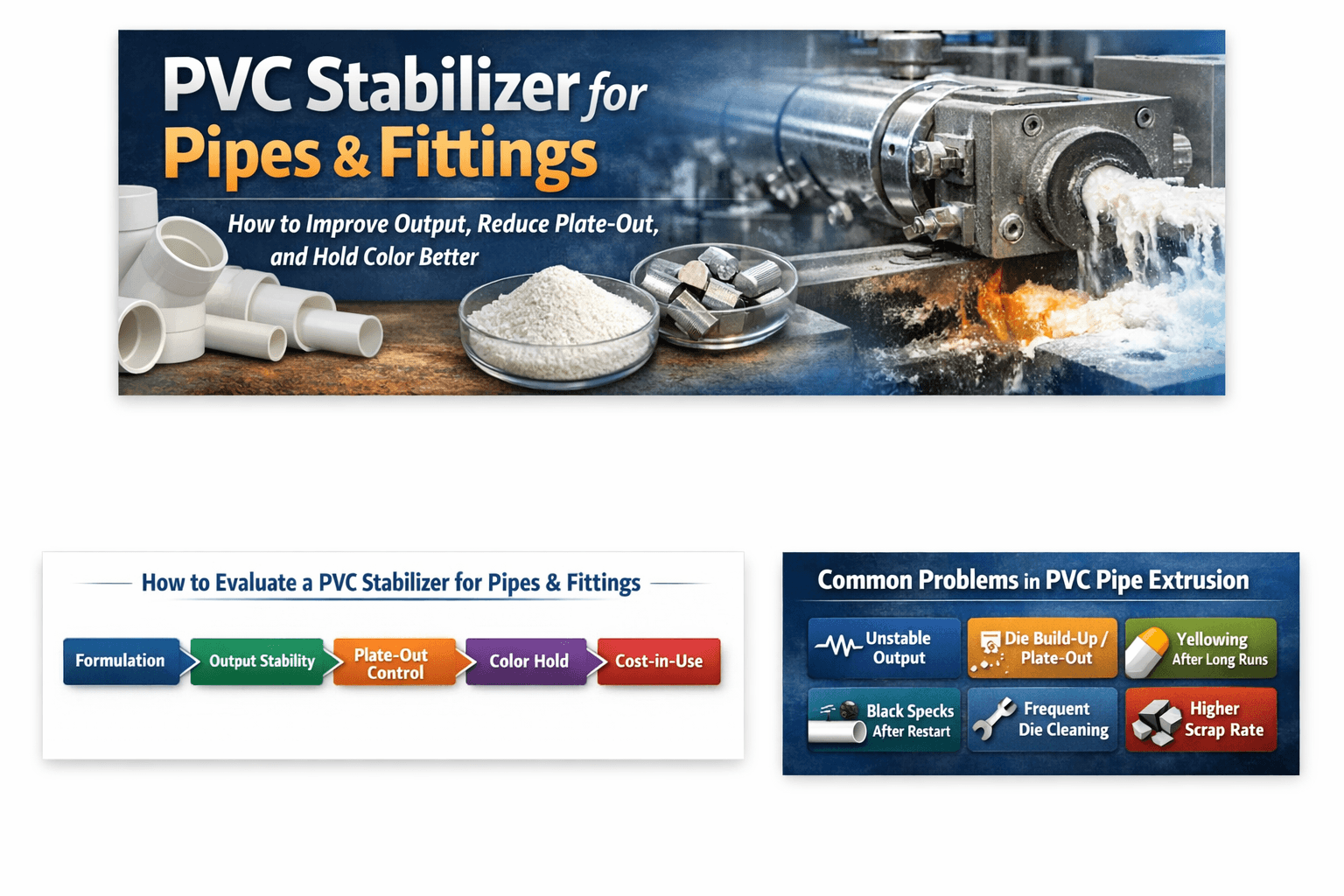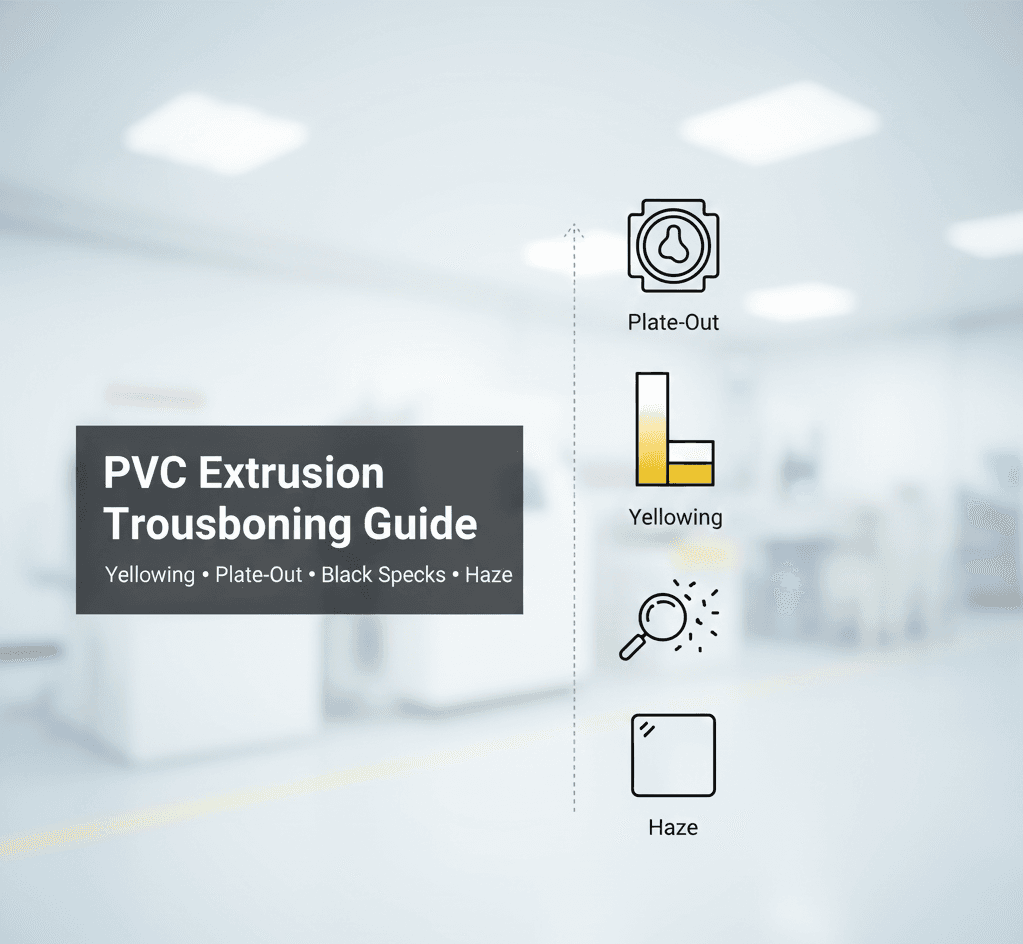

How to Test PVC Heat Stabilizers: Congo Red, Torque Rheometer, YI & Plate-Out (Practical Checklist)
PVC heat stabilizer trials shouldn’t be “taste tests.” If you evaluate stabilizers with the right KPIs and simple lab/line checks, you can reduce yellowing, plate-out (die build-up), scrap, and downtime—while improving stability and cost-in-use.
This article gives you a practical testing checklist used by many PVC processors to validate Ca-Zn and methyl tin stabilizer options—by application (pipe, profile, clear sheet/film, cable compounds, flexible PVC).
Recommended Reading (Selection Guide):
-
How to Choose PVC Heat Stabilizers: Ca-Zn vs Methyl Tin (By Application) → https://www.wxchemgroup.com/blog/pvc-stabilizer-selection-ca-zn-vs-methyl-tin
Key Takeaways
-
Use 10 pass/fail KPIs to compare stabilizers fairly (not just $/kg).
-
Combine static stability (Congo Red/oven) with dynamic stability (torque rheometer + line behavior).
-
Always include a plate-out/die build-up check during extrusion trials.
-
For clear rigid PVC, track Yellowness Index (YI) and haze/clarity at multiple time points.
-
Compare stabilizers by cost-in-use: dosage window + scrap + cleaning interval + output stability.
Why Testing Matters More Than “Price per kg”
Two stabilizers with the same price can perform very differently in production:
-
One may run clean for 8–12 hours; another forces cleaning every 2–4 hours.
-
One keeps stable color during start/stop; another turns yellow during downtime.
-
One allows higher throughput; another narrows your processing window.
That’s why the goal is not “best TDS numbers.” The goal is the lowest total cost per ton of finished product—with consistent quality.
Step 1 — Define Your Trial KPIs (10 must-have metrics)
Before you run any test, define pass/fail targets. These 10 KPIs cover most PVC stabilizer evaluations:
-
Initial Color / Whiteness
-
Lab* (or visual reference) at steady-state production.
-
-
Yellowness Index (YI) / Color Hold (especially for clear rigid PVC)
-
Track YI at multiple points: start, 30–60 min, after long run, after heat aging.
-
-
Static Thermal Stability (Congo Red / oven test)
-
Measures “how long the material resists degradation” under controlled heating.
-
-
Dynamic Thermal Stability (Torque Rheometer curve / fusion behavior)
-
Indicates processing stability under shear and heat.
-
-
Plate-Out / Die Build-Up Tendency
-
Cleaning interval, die lip deposits, calibrator build-up, roll deposits (if calendering).
-
-
Processing Window
-
Stable temperature range without discoloration, rough surface, or melt fracture issues.
-
-
Output Stability
-
Throughput at constant quality; no sudden pressure fluctuations.
-
-
Melt Pressure / Torque Stability
-
Stable pressure/torque means stable fusion and lubrication balance.
-
-
Start/Stop Scrap Rate
-
How much off-grade product during start-up and after downtime.
-
-
Odor / Emissions Perception (as needed)
-
Particularly relevant for indoor applications, flexible PVC, and cable compounds.
Step 2 — Build a Fair Comparison Setup (so data is meaningful)
To compare stabilizers fairly:
-
Keep the base formulation constant (PVC resin, fillers, TiO₂, impact modifier, processing aid).
-
Keep lubricants constant at first, then optimize lubrication only after you understand baseline behavior.
-
Use the same line settings during the first pass: temperature profile, screw speed, output rate.
-
Run each candidate long enough to observe plate-out (a short run can hide problems).
Practical Tip: If you’re switching stabilizer families (e.g., tin → Ca-Zn), expect to adjust lubrication in the optimization phase. Don’t judge the stabilizer only from the first run if lubrication balance obviously mismatches.
Step 3 — Test Methods (What to do, what to record)
3.1 Congo Red Test (Static Thermal Stability)
What it tells you: resistance to thermal degradation under static heating.
How to run it (practical):
-
Use consistent sample size and temperature conditions.
-
Record time to endpoint (color change indicator).
What to record:
-
Endpoint time (minutes)
-
Visual notes: uniform color change vs spots
How to use it:
-
Good for ranking “baseline stability,” but it cannot fully predict real extrusion behavior.
-
Always pair with a dynamic/shear test.
3.2 Torque Rheometer (Dynamic Thermal Stability + Fusion Behavior)
What it tells you: fusion time, stability under shear, lubrication balance, and melt behavior.
Key torque curve points to compare:
-
Fusion time: how quickly the compound fuses
-
Stability plateau: how stable torque remains after fusion
-
Torque drop / rise: signals lubrication imbalance or degradation onset
What to record:
-
Fusion time
-
Peak torque and plateau torque
-
Stability time until torque change (or discoloration)
-
Notes on curve shape (stable vs drifting)
How to interpret quickly:
-
A stable plateau often indicates a more forgiving processing window.
-
Curves that drift upward/downward can indicate lubrication issues or thermal stability limits.
3.3 Yellowness Index (YI) + Color Hold (Rigid & Clear PVC)
What it tells you: how color changes across processing and heat history.
Recommended checkpoints:
-
At steady state (baseline)
-
After 30–60 min run
-
After extended run (e.g., end of shift)
-
After controlled heat aging (if you do it)
What to record:
-
YI value at each checkpoint
-
Visual appearance: haze, specks, yellowing gradient
Practical tip for clear sheet/film:
-
Color can look “OK” initially, but shift under long residence or downtime. That’s why multi-point tracking matters.
3.4 Plate-Out / Die Build-Up Evaluation (Line-Based)
What it tells you: real-world cleanliness and downtime risk.
Simple scoring approach (1–5 scale):
-
1 = clean (minimal deposits, long cleaning interval)
-
3 = moderate (manageable build-up)
-
5 = heavy (frequent cleaning required)
What to record:
-
Cleaning interval (hours)
-
Deposit location: die lip / calibrator / rolls
-
Deposit texture: oily / waxy / hard
-
Impact on product: surface streaks, gloss loss, specks
Why it matters:
Plate-out is one of the biggest hidden costs. A stabilizer that reduces die build-up often wins on cost-in-use even at a higher $/kg.
3.5 Haze / Clarity Checks (Clear Sheet & Film)
If you produce clear rigid PVC, include clarity checks:
-
Haze measurement (if available)
-
Visual clarity under consistent lighting
-
Surface defects: micro-streaks, specks
Record: haze value + photo reference + processing conditions.
Step 4 — What to Prioritize by Application (Quick Decision Table)
uPVC Pipe & Fittings
Most important KPIs:
-
Process window, pressure stability, start/stop scrap
-
Plate-out control and cleaning interval
-
Long-run stability under seasonal temperature changes
PVC Profiles (Window / Technical)
Most important KPIs:
-
Surface quality (streaks/lines), color hold
-
Plate-out on die/calibrator
-
Stable fusion and torque behavior
Clear Rigid PVC Sheet / Film (Extrusion / Calendering)
Most important KPIs:
-
YI and color hold over time
-
Haze/clarity + surface quality
-
Long residence stability + downtime recovery
Wire & Cable PVC Compounds
Most important KPIs:
-
Dynamic stability (torque curve), aging behavior
-
Compatibility with plasticizers (if applicable)
-
Odor/emissions perception (as required)
Flexible / Semi-Rigid PVC
Most important KPIs:
-
Compatibility, stability, migration perception
-
Odor/emissions perception as required
-
Process stability and consistent output
Step 5 — Compare Stabilizers by Cost-in-Use (Not Just Price)
Use this simple checklist when comparing two options:
-
Dosage: does one require higher loading to pass your KPIs?
-
Scrap: which one produces less off-grade during start/stop?
-
Cleaning: which one extends cleaning interval?
-
Output: which one allows higher throughput at stable quality?
-
Consistency: which one shows smaller batch-to-batch variation?
If you track these 5 items, your decision becomes much clearer.
Common Mistakes (Avoid These During Trials)
-
Testing too short (plate-out and long-run yellowing won’t appear)
-
Changing multiple variables at once (you won’t know what caused improvement)
-
Skipping start/stop tests (real production pain often shows there)
-
Comparing data without defining pass/fail targets
-
Ignoring lubrication balance when switching stabilizer family
-
No photo/record discipline (hard to justify decisions internally)
-
Only trusting lab tests without line validation (or vice versa)
Want a Trial Checklist for Your Line?
If you share these 6 details, we can suggest a Ca-Zn or methyl tin direction and a short trial plan:
-
Application (pipe/profile/clear sheet/cable/compound)
-
Process (extrusion/calendering/injection)
-
Target issue (yellowing/plate-out/haze/instability)
-
Current stabilizer system (if known)
-
Key formulation notes (filler/pigment/plasticizer/regrind %)
-
Output rate & typical processing temperature
FAQ
Q1: What is the Congo Red test for PVC heat stabilizers?
A: The Congo Red test is a static thermal stability method. It measures how long a PVC compound can resist degradation under controlled heating. It’s useful for baseline comparison, but should be used together with dynamic tests and line trials.
Q2: How do you read a torque rheometer curve for PVC stability?
A: Focus on fusion time, peak torque, and the stability of the plateau after fusion. A stable plateau often indicates a wider processing window. Torque drifting up/down may point to lubrication imbalance or approaching thermal stability limits.
Q3: What is Yellowness Index (YI) and how is it used in stabilizer trials?
A: YI quantifies yellowing. Track YI at multiple checkpoints (steady state, mid-run, long-run, and after heat aging if applicable) to evaluate color hold and long-run stability—especially for clear rigid PVC.
Q4: What causes plate-out (die build-up) in PVC extrusion?
A: Plate-out is commonly linked to lubrication balance, wax package selection, temperature profile, residence time, and additive compatibility. A practical approach is to score deposits and track cleaning intervals during trials.
Q5: Which KPIs matter most for pipe vs clear sheet vs profiles?
A:
-
uPVC pipe: processing window, pressure stability, start/stop scrap, and plate-out interval.
-
Clear rigid sheet/film: YI/color hold, haze/clarity, surface quality, and long-run stability.
-
Profiles: surface finish (streaks/lines), color stability, and die/calibrator cleanliness.
Q6: Should stabilizers be compared by price per kg or cost-in-use?
A: Cost-in-use is usually more meaningful. Compare dosage, scrap rate, throughput stability, downtime, and die cleaning frequency. A lower price per kg can be more expensive if it narrows your processing window.
Q7: What information is needed to get a stabilizer trial recommendation?
A: Share: application (pipe/profile/clear sheet/cable/compound), process (extrusion/calendering/injection), target issue (yellowing/plate-out/haze), current stabilizer type, key formulation notes (filler/pigment/plasticizer/regrind %), and output rate/typical processing temperature.
Related Guides (Recommended Reading):