
How to Choose PVC Stabilizer for Pipes & Fittings: Output, Plate-Out, and Color Hold
For uPVC pipe and fitting manufacturers, a stabilizer does far more than simply “prevent PVC from degrading under heat.”
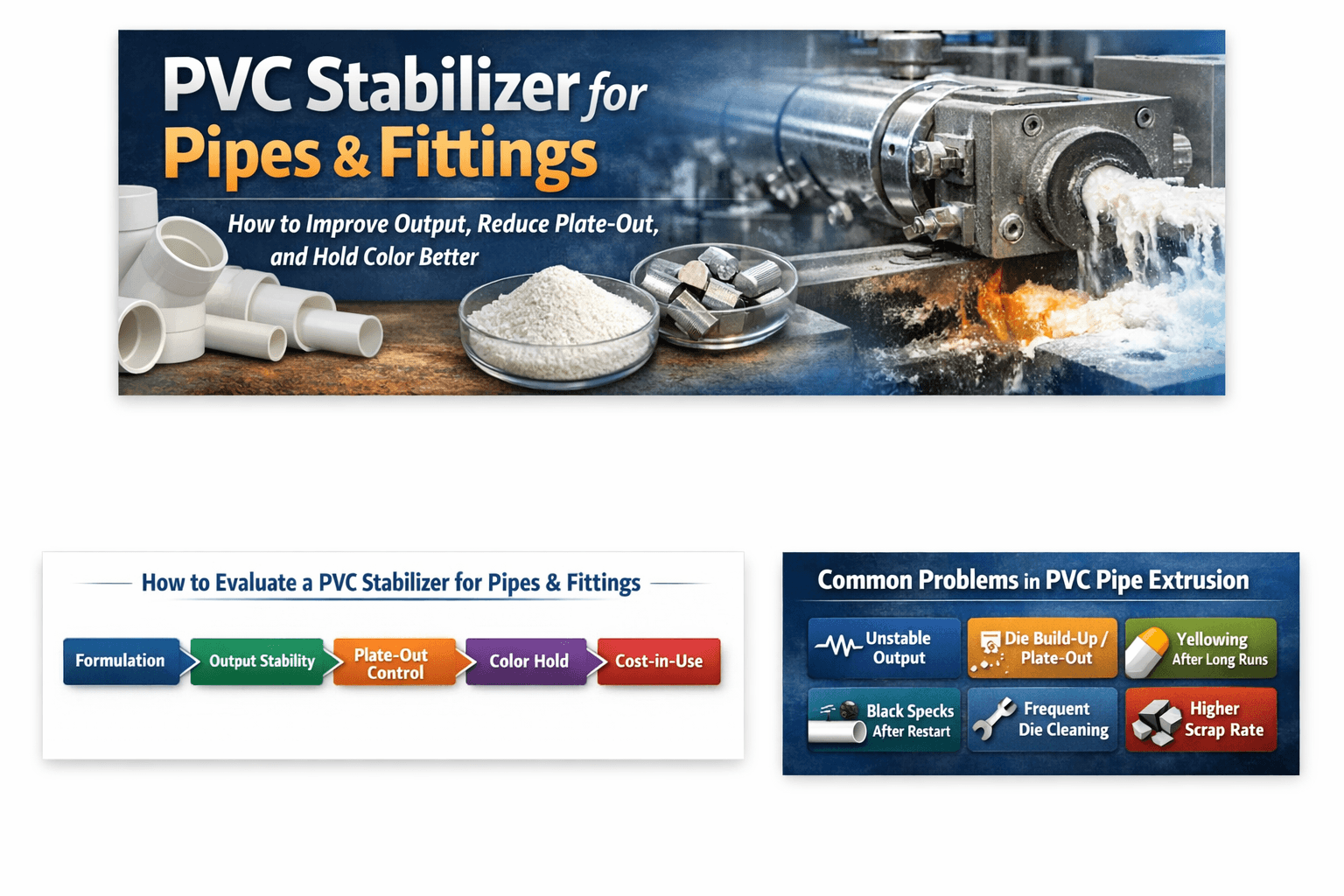
In real production, whether a stabilizer is suitable or not will directly affect the performance of the whole line, including:
-
whether extrusion output stays stable
-
whether die build-up or plate-out becomes a problem
-
whether the product color shifts or yellows during processing
-
whether black specks, burnt material, or surface defects appear after start-stop cycles
-
whether die cleaning frequency increases
-
whether scrap rate rises
-
whether total production cost stays under control
That is why choosing the right PVC stabilizer for pipes & fittings should never be based only on price per kilogram or on a single lab heat-stability result.
It should be evaluated based on overall production performance and real cost-in-use.
For pipe and fitting processors, a truly suitable stabilizer system should help balance several practical goals at the same time:
-
stable output
-
low plate-out
-
better initial color and color hold
-
stronger start-stop tolerance
-
good compatibility with filler, lubrication, and processing-aid systems
-
more competitive overall production economics
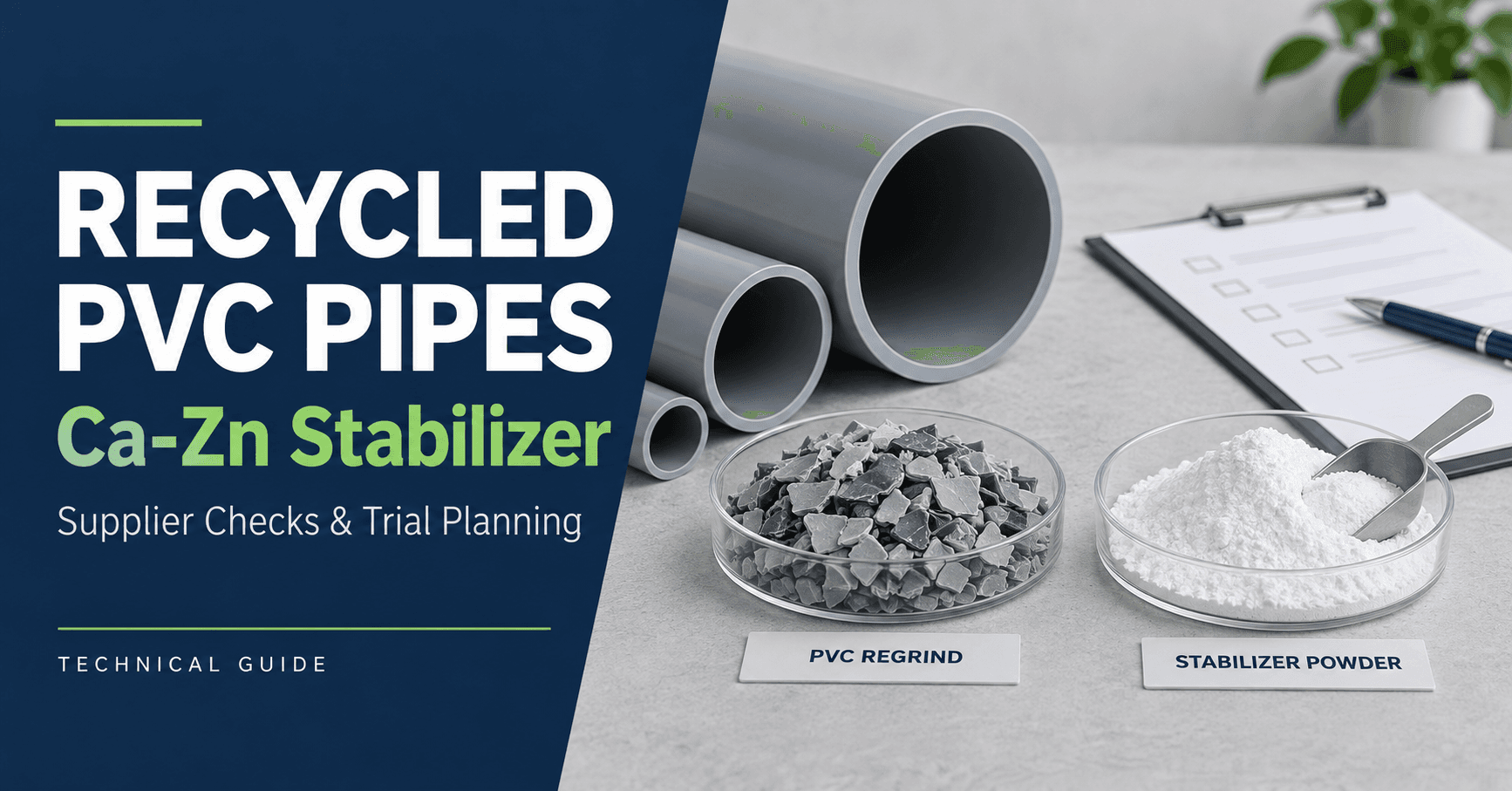
In many PVC pipe and fitting applications, calcium-based systems, especially powder Ca-Zn stabilizers, are widely used because of their practical value in processing stability, formulation flexibility, and balanced cost-in-use.
However, this only works when the stabilizer package is properly matched to the actual formulation, equipment, and process conditions.
This article explains:
-
what pipe processors should really look at when choosing a stabilizer
-
what usually causes plate-out, unstable output, or weak color hold
-
how to evaluate a stabilizer in a way that is closer to real production
-
and why a pipe-oriented powder Ca-Zn grade such as G-80 deserves practical trial evaluation in rigid PVC pipe and fitting applications
Key Takeaways
-
For uPVC pipes and fittings, the right stabilizer should balance output, plate-out control, color hold, and line stability.
-
In pipe extrusion, cost-in-use is often more important than raw material unit price, because downtime, die cleaning, scrap, and lost output quickly expand the difference.
-
A good pipe stabilizer must work together with the lubrication package, filler level, processing aid, screw design, and actual line condition.
-
Ca-Zn stabilizers are widely used in many PVC pipe and fitting applications, but their performance depends heavily on proper formulation and process matching.
-
Pipe trials should not be judged by static lab data alone. Real production behavior matters much more.
Why PVC Pipes & Fittings Require a Higher Standard in Stabilizer Selection
PVC pipes and fittings are rigid PVC applications that place high demands on continuous processing stability.
Compared with some general sheet, film, or profile applications, pipe and fitting production usually focuses much more on:
-
stable long-run extrusion
-
melt stability over extended production cycles
-
clean die behavior
-
surface consistency
-
recovery after line stops and restarts
-
tolerance to process fluctuation
-
dimensional consistency
-
long-term production efficiency
This means that a stabilizer which is “basically workable” in another PVC application may still perform poorly on a pipe line.
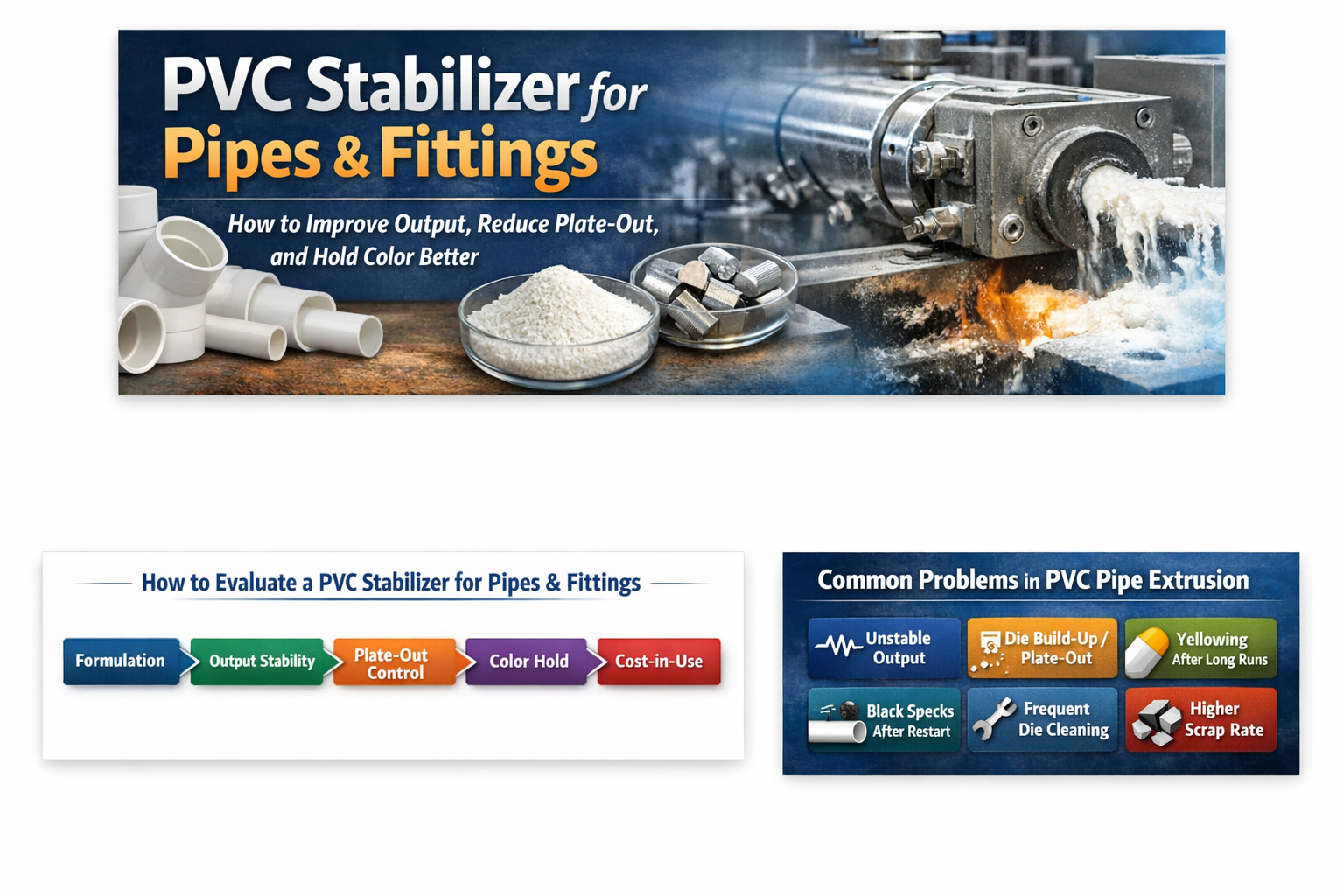
In real production, common problems include:
-
unstable output after start-up
-
increased die build-up over longer runs
-
gradual yellowing
-
high die-cleaning frequency
-
fluctuation in torque, pressure, or plastification behavior
-
dull surfaces or abnormal defects on the pipe
It is important to note that these issues are rarely caused by one raw material alone.
They are usually the result of interaction among:
-
the stabilizer package
-
internal/external lubrication balance
-
filler system
-
processing aid
-
PVC resin characteristics
-
temperature settings
-
screw and die design
-
residence time and process fluctuation
So in pipe extrusion, stabilizer selection is not just about “changing one additive.”
It is fundamentally a question of matching the formulation system and the processing system together.
What Pipe & Fitting Producers Usually Care About Most
For most rigid PVC pipe and fitting plants, stabilizer evaluation usually comes down to several key areas.
1) Stable Output
A stabilizer does not only affect heat stability. It also influences plastification and melt behavior inside the equipment.
When the package is better matched, processors often see:
-
faster stabilization after start-up
-
output staying closer to the target range
-
less process fluctuation
-
fewer operator adjustments
For pipe lines, stable output is usually more valuable than a short-term peak output.
2) Low Plate-Out
Plate-out is one of the most typical efficiency killers in PVC pipe extrusion.
It can lead to:
-
die build-up
-
poorer surface quality
-
more shutdowns for cleaning
-
lower continuous run efficiency
-
weaker product consistency
That is why a pipe stabilizer should not be judged only by heat-stability minutes.
It should also be judged by whether it helps the full formulation maintain lower plate-out tendency in real production.
3) Better Color Hold
Some processors assume that for opaque white pipes, gray pipes, or other non-transparent products, color hold is not very important.
In reality, color stability still matters because it is a visible signal of how robust the formulation is under processing heat history.
In pipe production, color instability often suggests:
-
insufficient thermal-stability margin
-
weak tolerance to longer residence time
-
poor start-stop tolerance
-
imbalance somewhere in the formulation system
So color hold is not just an appearance issue. It is also a process-stability signal.
4) Stronger Start-Stop Tolerance
In real production, pipe lines inevitably experience:
-
temporary stops
-
die changes
-
material changes
-
restart after reheating
-
fluctuations between shifts and seasons
If the formulation is weak under these conditions, the first signs usually appear as:
-
yellowing
-
black specks
-
burnt material
-
unstable surface quality
-
longer recovery time after restart
This makes start-stop tolerance one of the most important, yet often overlooked, criteria in stabilizer evaluation.
5) Practical Cost-in-Use
For pipe processors, a stabilizer should not be judged only by purchase price.
A better evaluation method is to look at the total production result, including:
-
dosage level
-
actual throughput
-
scrap rate
-
die-cleaning frequency
-
downtime loss
-
width of processing window
-
consistency over multiple production days
From this perspective, a stabilizer with a slightly higher unit price but lower plate-out, better output stability, and fewer interruptions may actually be the more economical solution.
Why Ca-Zn Stabilizers Are Widely Used in PVC Pipes & Fittings
In many PVC pipe and fitting applications, calcium-based systems, especially Ca-Zn stabilizers, are widely used because they often offer a balanced combination of:
-
heat stability
-
process adaptability
-
alignment with heavy-metal-free market direction
-
formulation flexibility
-
controllable cost-in-use
However, there is one very important point:
Ca-Zn stabilizers are not universal plug-and-play commodities.
Their actual performance depends heavily on:
-
co-stabilizer package design
-
internal/external lubrication ratio
-
filler loading
-
TiO₂ and pigment system
-
processing aid level
-
resin and equipment condition
-
barrel, screw, and die matching
In other words, whether a Ca-Zn system works well cannot be judged separately from the actual formula.
For pipe and fitting applications, a truly suitable Ca-Zn stabilizer should help processors achieve:
-
smoother extrusion behavior
-
lower plate-out tendency
-
better color hold
-
longer stable running time
-
easier matching with typical pipe formulations
This is why PVC pipe stabilizers must always be evaluated within the whole formulation and equipment system, not as isolated raw materials.
What Usually Causes Plate-Out in PVC Pipe Extrusion
Plate-out is one of the most common problems in PVC pipes and fittings, and also one of the most misunderstood.
Many processors immediately assume the stabilizer itself is the problem.
In practice, however, plate-out is usually caused by a combination of factors such as:
-
excessive external lubrication or poor lubrication balance
-
weak compatibility among additives
-
insufficient high-temperature stability margin
-
interaction between fillers and pigments
-
too long residence time
-
temperature settings that are too high
-
poor matching between the stabilizer and processing aid
-
raw material batch variation affecting the whole system
So when evaluating a stabilizer for pipe production, the question should not simply be:
“Will this stabilizer plate out?”
A better question is:
“How does this stabilizer perform in my resin, filler, lubrication, and equipment system when it comes to plate-out control?”
That is a much more realistic production question.
A pipe-oriented stabilizer should help reduce die build-up tendency, but this must always be verified under the actual formulation, actual line condition, and actual run time.
How to Evaluate Output, Plate-Out, and Color Hold in Real Trials
When comparing different PVC pipe stabilizers, do not rely only on supplier claims, static laboratory heat-stability data, or a very short test run.
A more useful approach is to evaluate the stabilizer in a way that is closer to real production.
A. Evaluate Output
Check whether the line can reach target throughput smoothly and maintain it over time.
Look at:
-
whether amperage or torque remains stable
-
whether melt flow shows abnormal fluctuation
-
whether head pressure stays reasonable
-
whether output remains stable after the line reaches operating temperature
-
whether operators need frequent parameter correction
B. Evaluate Plate-Out
Trial time must be long enough. Short runs often hide the real picture.
Look at:
-
whether the die remains clean
-
whether visible build-up forms
-
whether cleaning intervals become longer
-
whether surface consistency remains stable
-
whether the condition changes clearly over longer runs
C. Evaluate Color Hold
Even when transparency is not the goal, color stability is still worth monitoring because it reflects the formulation’s tolerance to thermal history.
Look at:
-
whether the initial color is clean
-
whether yellowing appears after longer running time
-
whether restart causes noticeable color shift
-
whether different batches remain consistent
D. Evaluate Start-Stop Performance
This is especially important in pipes and fittings.
Look at:
-
whether restart recovery is smooth
-
whether yellowing becomes obvious after restart
-
whether black specks or burnt material appear
-
whether surface quality remains stable after stop-start cycles
E. Evaluate Cost-in-Use
At the same time, track practical data such as:
-
stabilizer dosage
-
actual throughput
-
scrap rate
-
die-cleaning downtime
-
operator intervention frequency
-
line stability over multiple production days
These numbers usually provide much more decision value than purchase price alone.
What Information Should Be Confirmed Before Choosing a PVC Pipe Stabilizer
Before requesting samples or quotations, it is helpful to organize the following information first.
This helps suppliers recommend a more suitable grade and makes trials more efficient.
1) Product Type
-
pressure pipe
-
drainage pipe
-
conduit
-
fittings
-
foam-core pipe
-
solid-wall pipe
2) Current Base Formulation
-
resin type / K value
-
filler loading
-
TiO₂ / pigment level
-
impact modifier
-
processing aid
-
internal/external lubrication package
3) Equipment & Process Conditions
-
screw design
-
temperature settings
-
die design
-
target throughput
-
typical residence time
-
seasonal temperature variation
4) Main Problem to Solve
-
plate-out
-
unstable output
-
yellowing
-
poor surface finish
-
cost reduction
-
wider processing window
5) Trial Evaluation Criteria
Before the trial, define:
-
target throughput
-
acceptable die cleanliness
-
color-hold requirement
-
scrap level
-
die-cleaning interval
-
continuous running time
When these points are clear, the sample recommendation and trial guidance become much more useful.
Where G-80 Fits in PVC Pipe & Fitting Applications
G-80 is intended for rigid PVC pipe and fitting applications where processors need a practical balance of processing stability, color hold, and plate-out control.
-
helps maintain more stable extrusion output
-
helps reduce die build-up tendency
-
improves color consistency
-
supports longer stable production runs
-
is easier to match with common pipe formulations
Final suitability should always be confirmed together with resin, filler, lubrication, processing aid, and equipment conditions. Sample validation on the actual pipe or fitting line is recommended.
Common Mistakes When Choosing a Pipe Stabilizer
Mistake 1: Comparing only price per kilogram
A lower purchase price does not automatically mean lower total cost.
If the grade causes more cleaning, more scrap, and a narrower process window, the total cost may be higher.
Mistake 2: Ignoring lubrication balance
Many plate-out problems are not simply “bad stabilizer” problems.
They are system-balance problems.
Mistake 3: Running trials that are too short
Short trials often fail to show long-run build-up, color-hold issues, and restart problems.
Mistake 4: Using sheet or profile logic to judge a pipe formulation
Pipe and fitting production places stronger demands on continuity, fluctuation tolerance, and long-run stability.
The evaluation logic should be different.
Mistake 5: Having no clear pass/fail criteria
Without defined standards for output, plate-out, color, or cleaning interval, trial results quickly become subjective.
What Buyers Should Ask Before Requesting Samples
If you are sourcing a PVC stabilizer for pipes & fittings, it is useful to clarify the following before asking for samples:
-
Is this grade mainly designed for pipes, fittings, or general rigid PVC?
-
What filler range is it normally matched with?
-
What lubrication balance is usually recommended?
-
How should plate-out be evaluated during the trial?
-
What output range is realistic for this type of line?
-
What documents are available (SDS, compliance files)?
-
What starting dosage range is recommended?
The clearer these questions are, the more efficient the sampling, comparison, and quotation process becomes.
FAQ
1) What is the best PVC stabilizer for pipes & fittings?
The best stabilizer is the one that matches your actual formulation and line condition while balancing output, plate-out, color hold, and cost-in-use.
2) Are Ca-Zn stabilizers suitable for uPVC pipes?
Yes. In many PVC pipe and fitting applications, calcium-based systems, including Ca-Zn stabilizers, are widely used. However, they still need to be well matched to the actual formulation and processing conditions.
3) Why does PVC pipe extrusion often suffer from plate-out?
Plate-out is usually not caused by one factor alone. It is often the combined result of stabilizer package, lubrication balance, fillers and pigments, residence time, temperature profile, and equipment conditions.
4) Why does color hold still matter for opaque pipes?
Because color stability is a visible sign of thermal robustness and processing consistency, especially during long runs and start-stop cycles.
5) What should be compared when evaluating two pipe stabilizers?
The main points should be output, die cleanliness, color hold, start-stop behavior, scrap rate, and cleaning interval, not only purchase price.
6) What information should be provided before asking for a quote?
It is best to provide the pipe/fitting type, base formulation, filler loading, equipment and process condition, main problem to solve, and trial evaluation criteria.
Conclusion
Choosing a PVC stabilizer for pipes & fittings is really about controlling the operating risk of the whole production line.
A suitable grade should do more than simply “stabilize PVC.”
It should help your line:
-
run more steadily
-
run longer
-
suffer less plate-out
-
stop less often
-
maintain better surface and color consistency
-
control total production cost more effectively
For most pipe and fitting manufacturers, the real questions are:
-
Can it hold output steadily?
-
Can it reduce plate-out?
-
Can it maintain better color stability under real processing conditions?
-
Can it lower total cost, not just raw material cost?
If your goal is to make PVC pipe or fitting production more stable, then a powder Ca-Zn stabilizer system such as G-80 is worth evaluating systematically on a real production line.
Looking for a stabilizer for PVC pipes and fittings?
If you are trying to solve output, plate-out, color hold, or start-stop stability problems on your uPVC pipe or fitting line, WANSYN can support sample testing and application matching.
Please share:
-
your pipe or fitting type
-
current base formulation
-
filler loading
-
equipment and processing condition
-
the main problem you want to improve
We can help review whether G-80 is a suitable starting point for your next trial.
G-80 powder Ca-Zn stabilizer for PVC pipes & fittings
Ca-Zn vs Methyl Tin selection guide
PVC stabilizer testing: Congo Red, torque, plate-out, and color