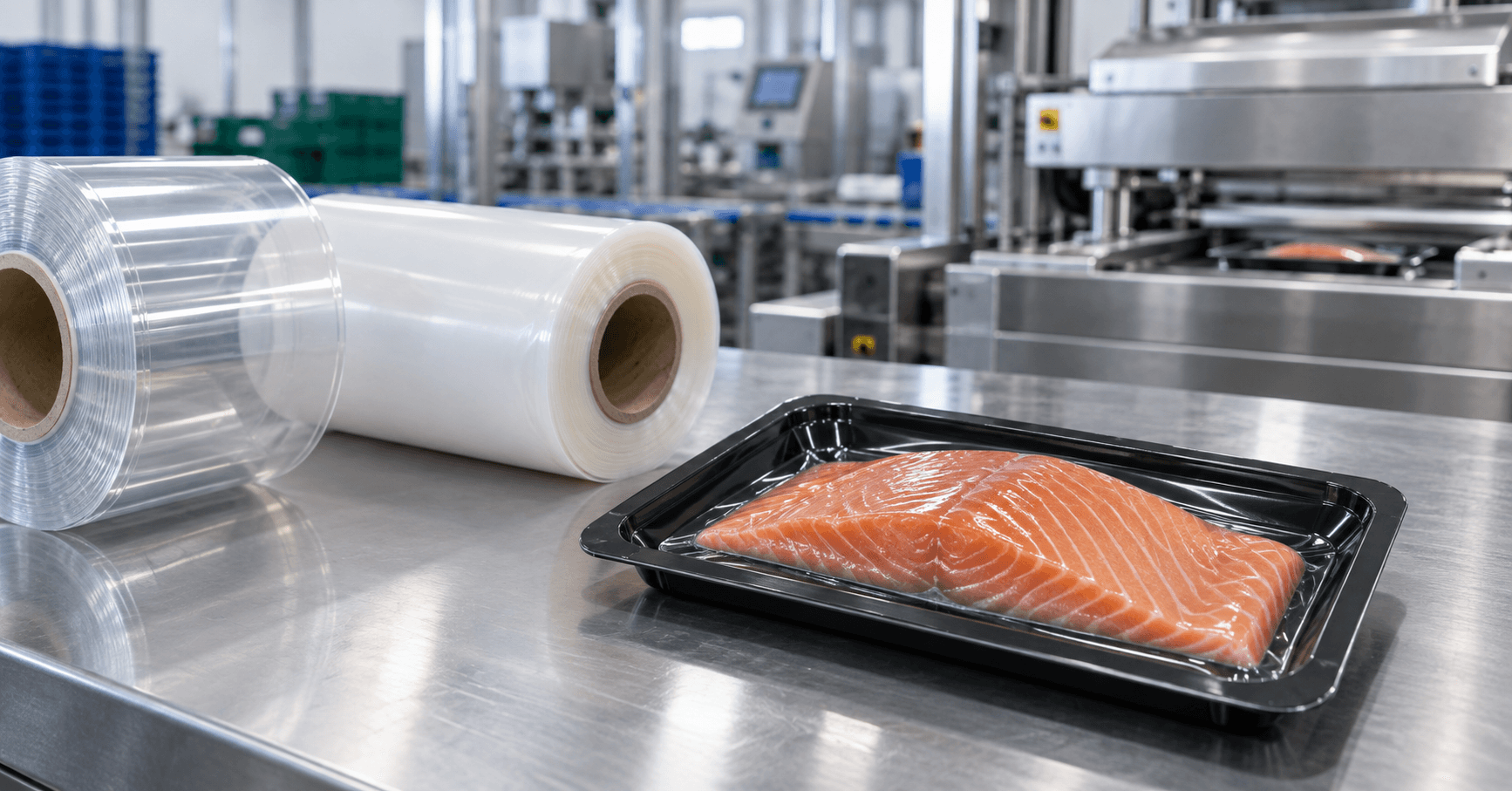

PE Film for Online Thermal Lamination to PET Sheet
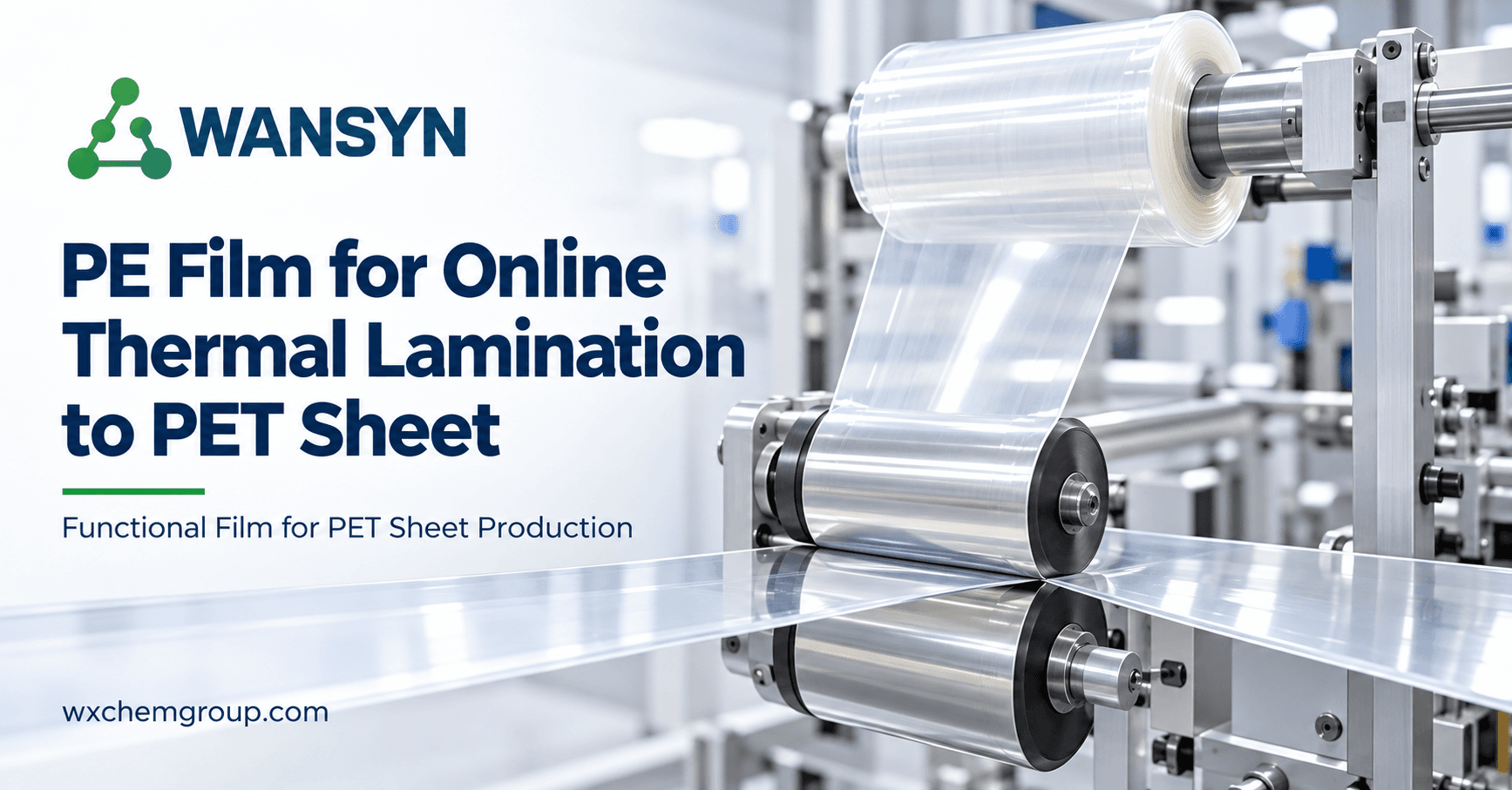
PE film for online thermal lamination helps PET sheet producers add a PE-based functional surface during sheet production. The film is supplied in rolls and matched to the PET substrate, lamination station and downstream thermoforming process.
For manufacturers developing PET/PE sheet, the purchasing decision involves more than film thickness and width. The PET bonding face, exposed PE surface, web handling and laminate performance all need to be specified together.
Quick answer: what is PE online thermal lamination film?
PE film for online thermal lamination is a specially designed PE-based functional film intended for bonding to PET sheet on a suitably equipped production line. A qualified film and process can add the PE surface without a separate liquid-adhesive application at the lamination station. Film formulation and line compatibility are essential: a generic polyethylene film should not be assumed to perform in the same way.
1. What does PE film add to PET sheet?
The PET sheet provides the structural base for the finished material. A PE functional film adds the specified surface properties to that base. Depending on the selected grade and construction, these may include a PE sealing layer, flexibility at the surface and moisture resistance. Each required function should be stated and evaluated for the actual application.
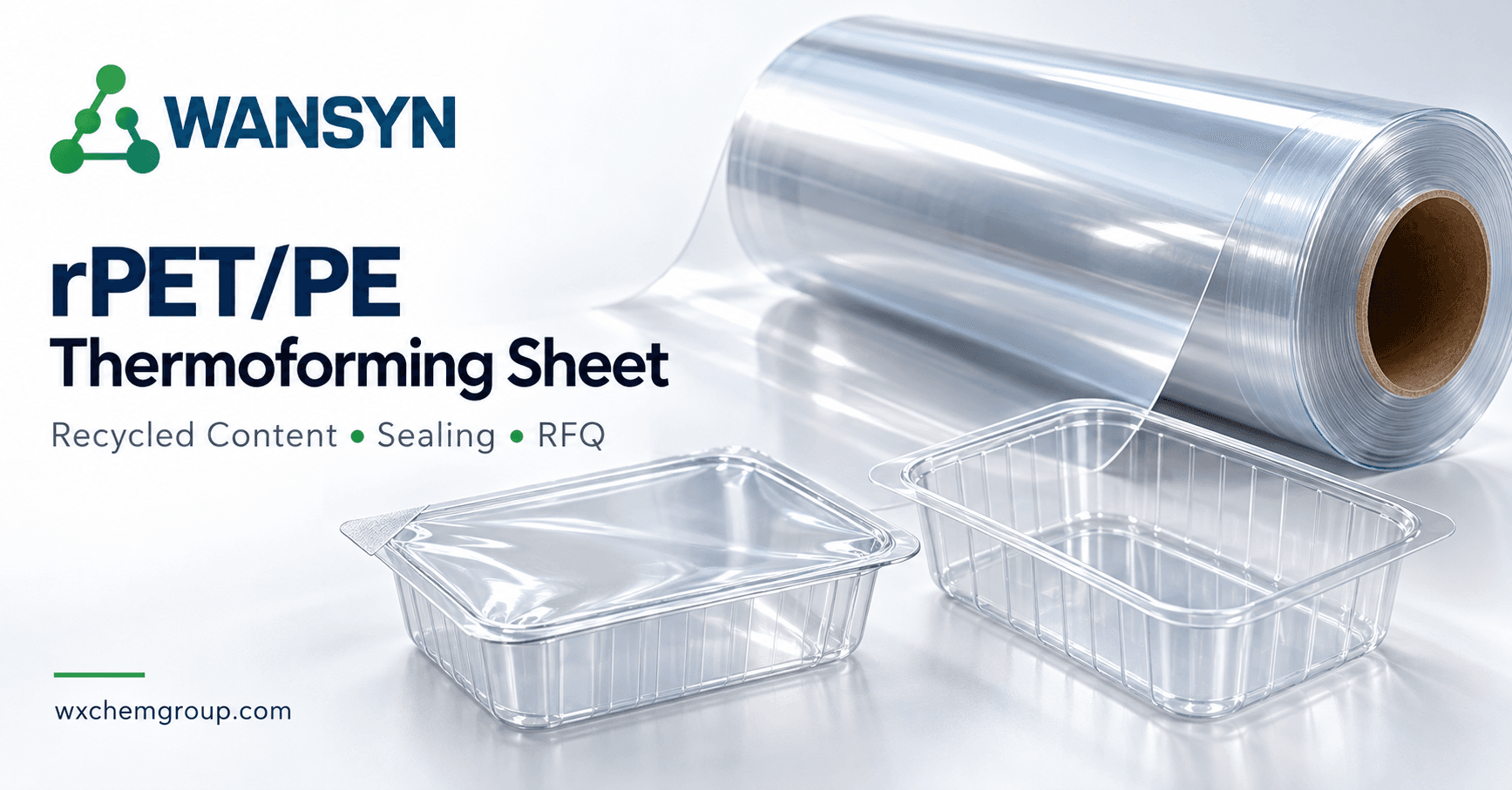
The resulting material is commonly described as PET/PE sheet. This is a commercial abbreviation rather than a complete cross-section. The specification should identify any additional functional bonding layers or coatings that are relevant to production and end use.
This article focuses on PE film for PET sheet lamination. Customers seeking an oxygen-barrier construction can refer to the separate PE/EVOH/PE online thermal lamination film guide.
2. How does online PET sheet lamination work?
A premanufactured film roll feeds into a lamination station integrated with the PET sheet extrusion line. The selected film meets the PET substrate under controlled heat and nip pressure. The laminated sheet then passes through the cooling and winding arrangement specified for the equipment.
The practical production sequence is:
- Produce the PET base sheet. Establish the specified sheet grade, thickness, width and surface condition.
- Unwind the PE film. Present the designated bonding face to the PET, following the approved roll-direction drawing.
- Apply the qualified thermal lamination process. Control heat, nip conditions, line speed and film tension for the selected material pair.
- Cool and wind the laminate. Check flatness, appearance, winding quality and release criteria.
- Thermoform the approved sheet. Verify that the laminate meets the requirements of the intended part.
This premanufactured-film route differs from feeding PE resin into a coextrusion system or applying molten polymer by extrusion coating. “Online” and “inline” describe integration with the sheet line; the actual equipment and material route must still be identified.
3. Why consider PE film for inline thermal lamination?
Integrating film lamination with PET sheet production can give a manufacturer another route to functional sheet products. Its practical value depends on the production mix, available equipment and accepted output.
- Add a functional surface during sheet production. A qualified line produces the proposed PET/PE construction as part of the sheet-making flow.
- Reduce a separate lamination operation. Where the project would otherwise require downstream lamination, integration may reduce intermediate handling, transfer and scheduling.
- Coordinate sheet and film production parameters. Operators can record the PET substrate and film-lamination conditions within one production run.
- Develop additional sheet applications. PET sheet manufacturers can evaluate PE-surfaced constructions alongside their existing sheet portfolio.
For an adhesive-free thermal lamination route using a suitably designed film, no separate liquid glue is applied at the bonding station. Functional bonding materials may nevertheless be incorporated into the film. This process description does not imply a single-polymer construction or establish recyclability.
Compare the complete production economics, including startup scrap, speed, changeovers, downtime and quality acceptance. Integration alone does not establish a lower cost per accepted tonne.
4. Which PE film is suitable for thermal lamination to PET?
A polyethylene thermal lamination film must be selected for its intended bonding route. Film appearance, nominal gauge or the names LDPE and LLDPE do not establish adhesion to PET.
The grade may use functional resins or a multilayer design to provide the required interface. Ask the supplier to identify the intended PET bonding face and the opposite functional face. Do not infer a specific resin blend, coating or layer count from the short product name.
| Selection point | What to confirm |
|---|---|
| Bonding face | Which film surface is intended to contact the actual PET substrate |
| Exposed PE surface | The required function and its position on the finished sheet and formed part |
| Film dimensions | Thickness, tolerance, width and the agreed measurement basis |
| Thermal response | A proposed processing window matched to the sheet and equipment |
| Web handling | Tension control, dimensional stability, friction and winding behaviour |
| Laminate acceptance | Appearance, lamination bond strength and performance after forming and conditioning |
A grade developed for offline adhesive lamination is not automatically approved for thermal bonding on a PET sheet line. Choose the film against the actual equipment and trial results.
5. Parameters to review on the PET sheet extrusion line
The same film can encounter different thermal and mechanical conditions on different lines. A useful technical discussion starts with a sketch of the lamination station, including film entry, heat source, nip, cooling and winding.
- Substrate condition: PET grade, recycled-content construction where relevant, surface preparation, cleanliness and any coating or release treatment.
- Heat: the heat available at the bonding step and the measurement locations used to describe it.
- Nip: roller arrangement, pressure control and contact uniformity across the useful width.
- Speed and tension: a stable operating range for both sheet and film, with controlled film introduction.
- Cooling and winding: the conditions needed to meet the agreed flatness, roll-build and handling requirements.
A roller or heater setpoint is not automatically the temperature at the buried PET-to-film interface. Likewise, a resin melting-point value is not a ready-made lamination setting. Use a grade- and equipment-specific trial proposal rather than one universal temperature or line speed.
For PE film rolls, the winding drawing should name both surfaces and show the feed path. Record core ID, maximum roll diameter, roll mass or length, and any splice restrictions.
6. Qualify PET/PE sheet production through a controlled trial
A flat sheet that looks acceptable at the laminator is an initial checkpoint. Qualification should also follow the material through winding, storage, reheating and PET sheet thermoforming under the agreed project conditions.
- Identify the inputs. Record the PET and film grade, lot, dimensions and surface identities.
- Define the trial matrix. Agree the conditions to vary, the equipment limits and the samples to retain.
- Inspect the flat laminate. Check wrinkles, trapped air, appearance, curl, blocking and bond consistency at agreed sampling positions.
- Form the actual geometry. Examine the flange, sidewalls, corners, base and trimmed edges for local thinning, damage or separation.
- Condition and approve. Recheck against the agreed storage and end-use sequence, then record the approved material and process revision.
For bond assessment, specify the preparation method, specimen width, test geometry, speed, conditioning and failure interface. ASTM F904-22 addresses techniques for separating plies of flexible laminates to enable bond measurement; it does not by itself define a complete acceptance protocol for a semi-rigid PET/PE sheet.
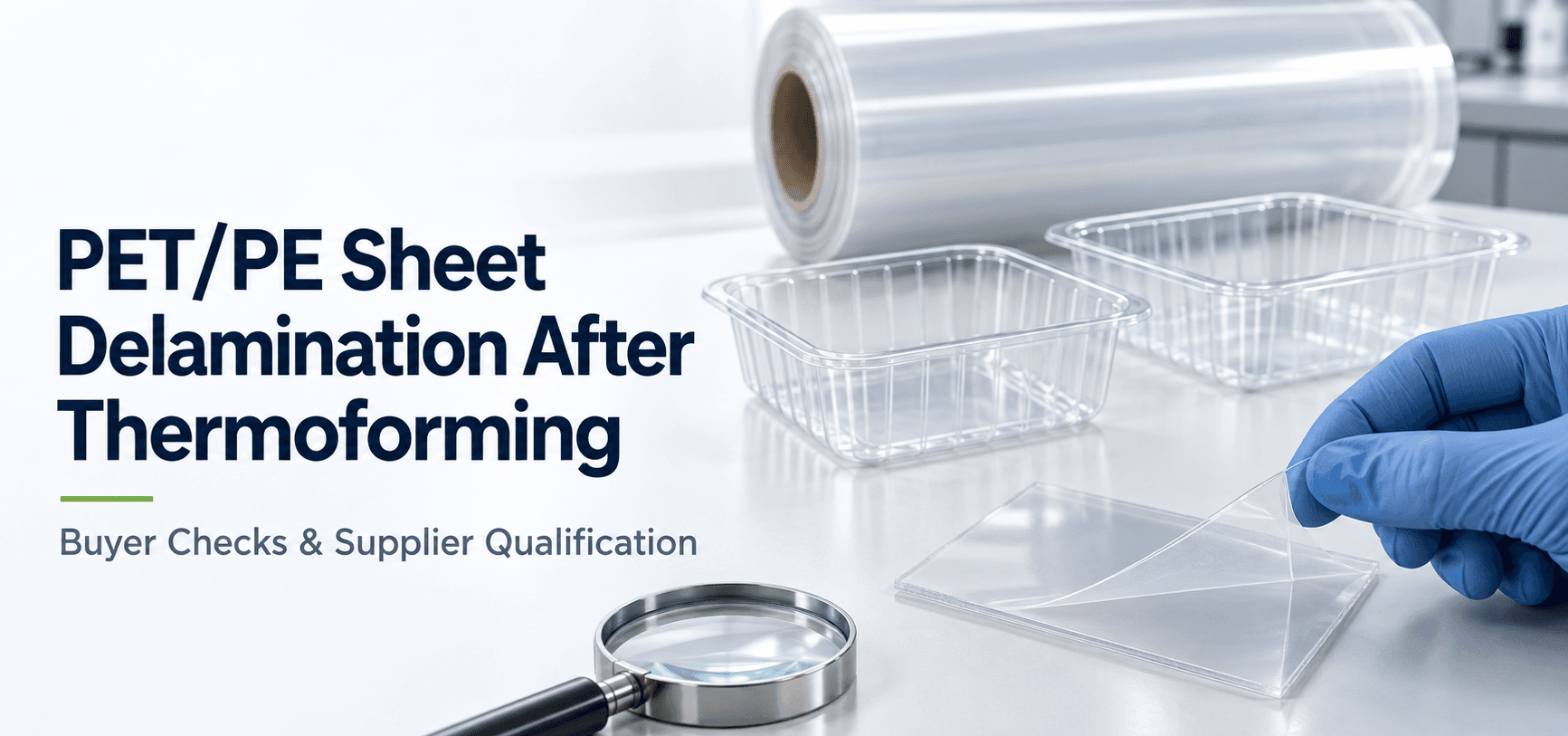
If layers separate, the PET/PE sheet delamination guide provides a separate troubleshooting route. Retained film, flat laminate and formed parts should use the same sample identity so that results can be compared meaningfully.
7. Applications for PE-laminated PET thermoforming sheet
PE-laminated PET sheet can be evaluated for thermoformed packaging projects that require a structural PET base and an identified PE-based surface. Candidate applications include food trays, chilled-product packaging components and other formed parts specified for that surface function.
Selection should follow the packed product, part geometry, handling and conditions of use. Chilled, frozen, reheating or other demanding service conditions need their own approval; a PET/PE name alone does not establish a temperature rating.
For food-contact applications, request documentation matching the proposed construction, contact conditions and target market. Approvals for one material or application should not be transferred to an unspecified finished structure.
8. What should a PE film RFQ include?
To evaluate PE lamination film for an existing or planned PET line, send WANSYN the following information:
- Purchasing scope: film for your own online lamination line, or finished PET/PE sheet.
- PET sheet: grade or current sample, thickness, width and known surface condition.
- PE film: target thickness and tolerance, width, exposed-surface requirements and current film specification if available.
- Equipment: line model, lamination-station drawing, heat/nip/cooling arrangement and intended speed range.
- Roll format: core ID, maximum OD, roll weight or length, unwind drawing and splice requirements.
- Thermoforming: part drawing, forming depth, critical areas and downstream process.
- Acceptance: bond, appearance, forming, storage and intended-use criteria, with agreed methods.
- Commercial plan: trial quantity, forecast consumption and delivery destination.
If a parameter has not been decided, describe the current material and equipment instead of selecting a number without a technical basis. A line sketch, sample and part drawing often provide a more useful starting point.
Discuss PE online thermal lamination film with WANSYN
WANSYN supports PE-based functional-film selection for PET sheet producers evaluating online thermal lamination. Share your PET sheet specification, line layout, film dimensions and intended formed product so that a suitable candidate and trial plan can be reviewed.
For film enquiries, contact WANSYN or email info@wxchemgroup.com. If you need finished sheet rolls, visit the PET sheet roll category.
Frequently asked questions
Can PE film be laminated to PET sheet online?
A specially designed PE-based film can be evaluated on a compatible PET sheet line. Confirm the bonding face, equipment configuration and results after lamination and thermoforming.
Is ordinary PE film suitable for online thermal lamination?
Do not assume so. Resin family, thickness and appearance do not establish PET adhesion. Use an identified grade selected for the thermal lamination route.
Does the process require a separate glue application?
A qualified heat-bonding film can avoid separate liquid-glue application at the lamination station. Functional bonding components may still be part of the film construction.
What film thickness should be used?
Choose a thickness proposal based on the film grade, PET substrate, forming geometry and required surface function. Confirm it through trials rather than treating one gauge as universal.
What lamination temperature and speed are recommended?
These are grade- and equipment-specific. Review heat transfer, nip design, substrate condition, tension and cooling with the film and equipment suppliers.
Which film side should face PET?
The designated PET bonding face. Identify both faces on the specification, label and unwind drawing, then verify the final surface location after forming.
What should be checked after thermoforming?
Inspect bond condition, surface appearance, local thinning, corners, sidewalls, flange and trimmed edges. Include the agreed conditioning and end-use checks before approval.
What information is needed for a quotation?
Provide the PET specification, film dimensions, line layout, roll requirements, application, trial criteria, estimated consumption and delivery destination.