
Quick Answer: How Should You Select a VSP Bottom Web?
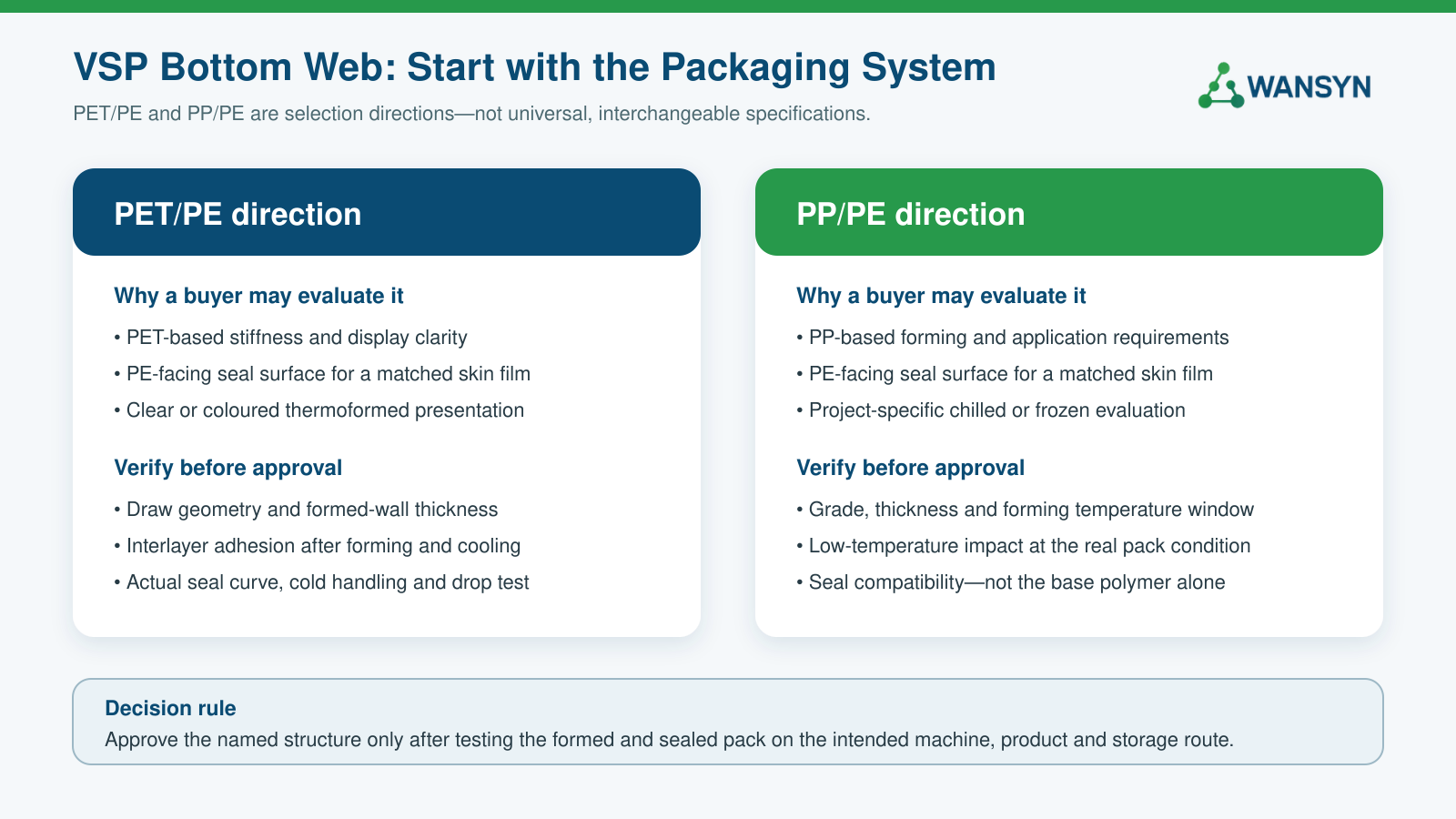
A vacuum skin packaging bottom web should be selected as part of a complete packaging system, not by resin name alone. PET/PE may be a useful starting direction when PET-based stiffness, presentation and a PE-facing seal surface are required. PP/PE may be evaluated when the project calls for a PP-based thermoforming structure plus a PE-facing seal surface. Neither construction is automatically suitable for every skin film, forming tool, food, cold-chain route or shelf-life target.
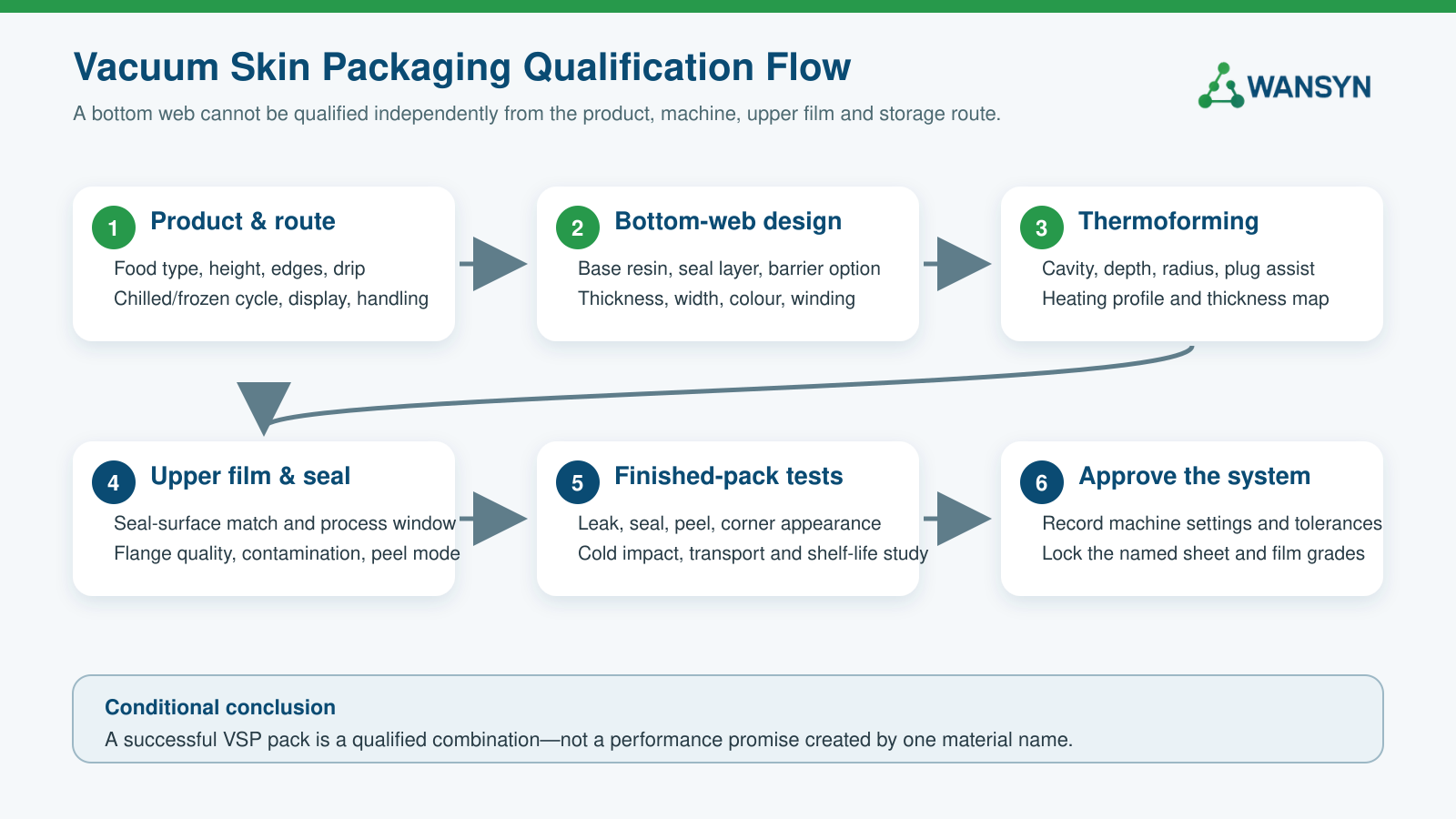
The reliable qualification sequence is:
- define the product, pack geometry and storage route;
- identify the base sheet, seal-facing layer and any required barrier layer;
- thermoform the named structure on the intended machine;
- match the upper skin film to the actual sealing surface;
- test the formed and sealed pack under production and distribution conditions.
If any one of these steps is missing, a flat sheet that looks acceptable may still fail through poor forming, weak corners, film lifting, channel leaks, difficult peeling or cold-handling damage.
What Is a Vacuum Skin Packaging Bottom Web?
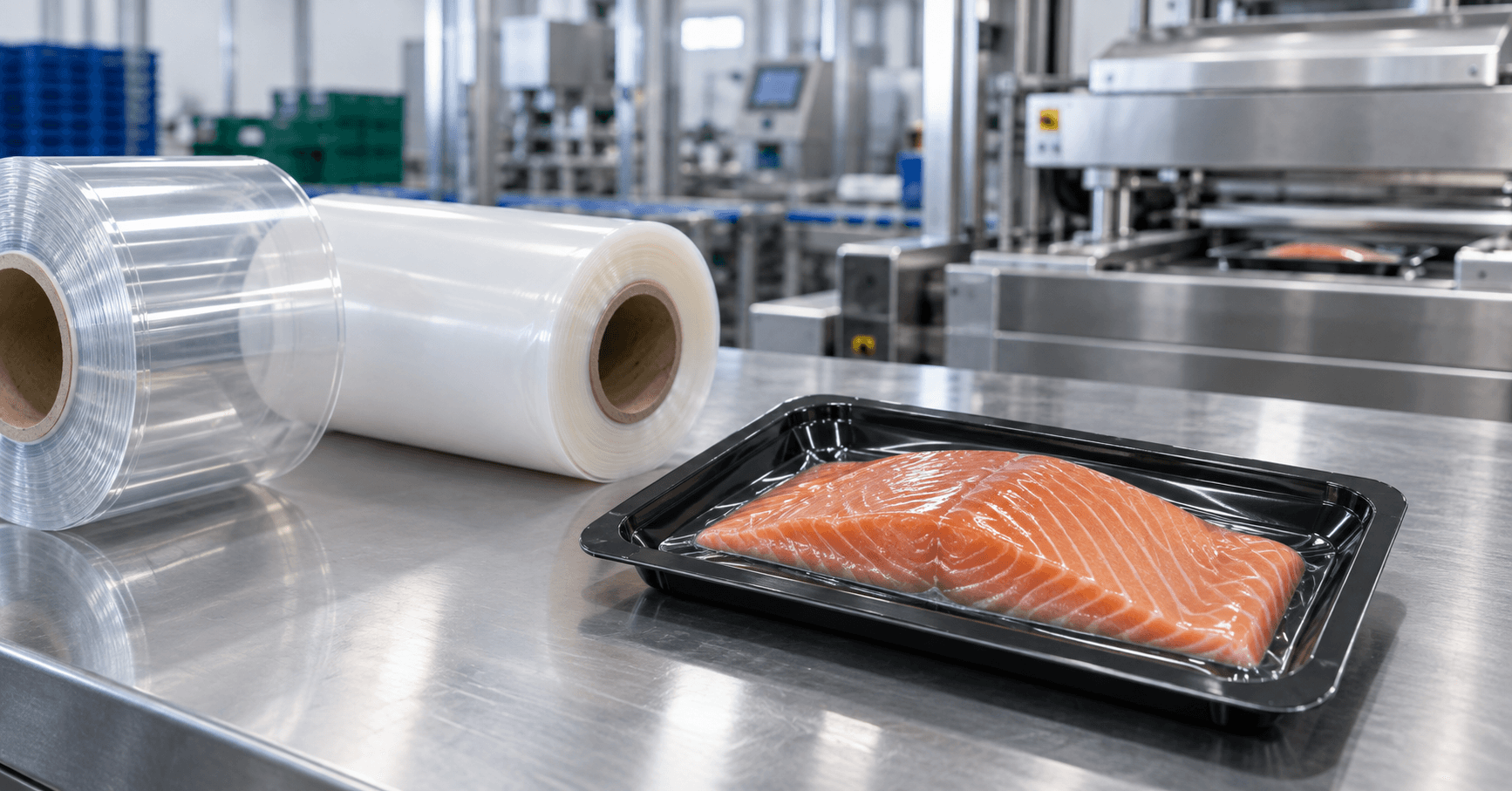
In vacuum skin packaging, a formable upper film is heated and drawn closely around the product. It seals to the accessible, sealable surface around the product on a rigid or semi-rigid lower web or a pre-made tray. The upper skin film conforms over the food; the thermoforming bottom sheet provides the carrier. A conventional perimeter-sealed MAP lid and a VSP upper film are not automatically interchangeable. The result depends on the interaction among the upper film, lower material, product shape, vacuum cycle, heating, tooling and sealing conditions.
The term bottom web may describe:
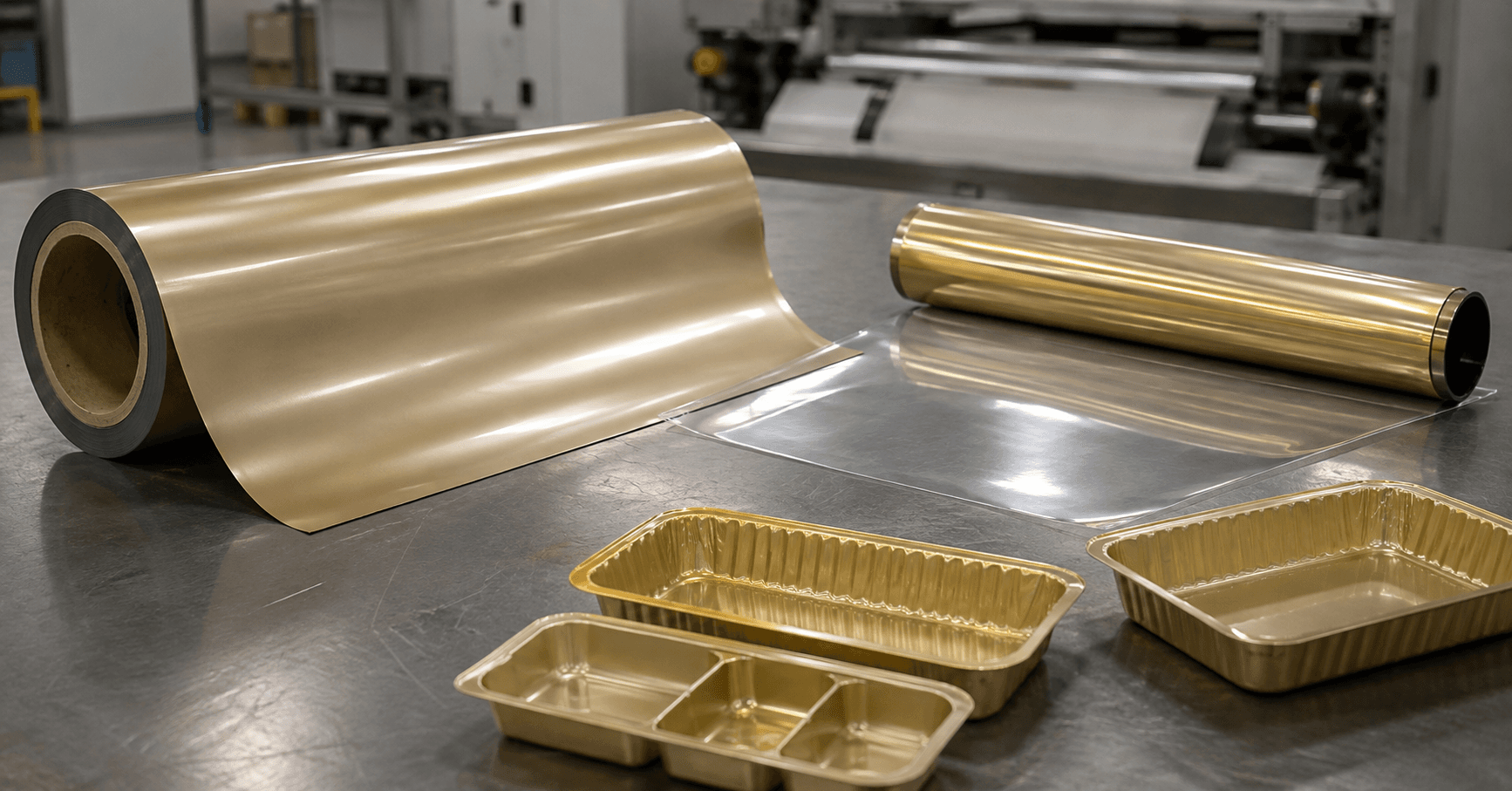
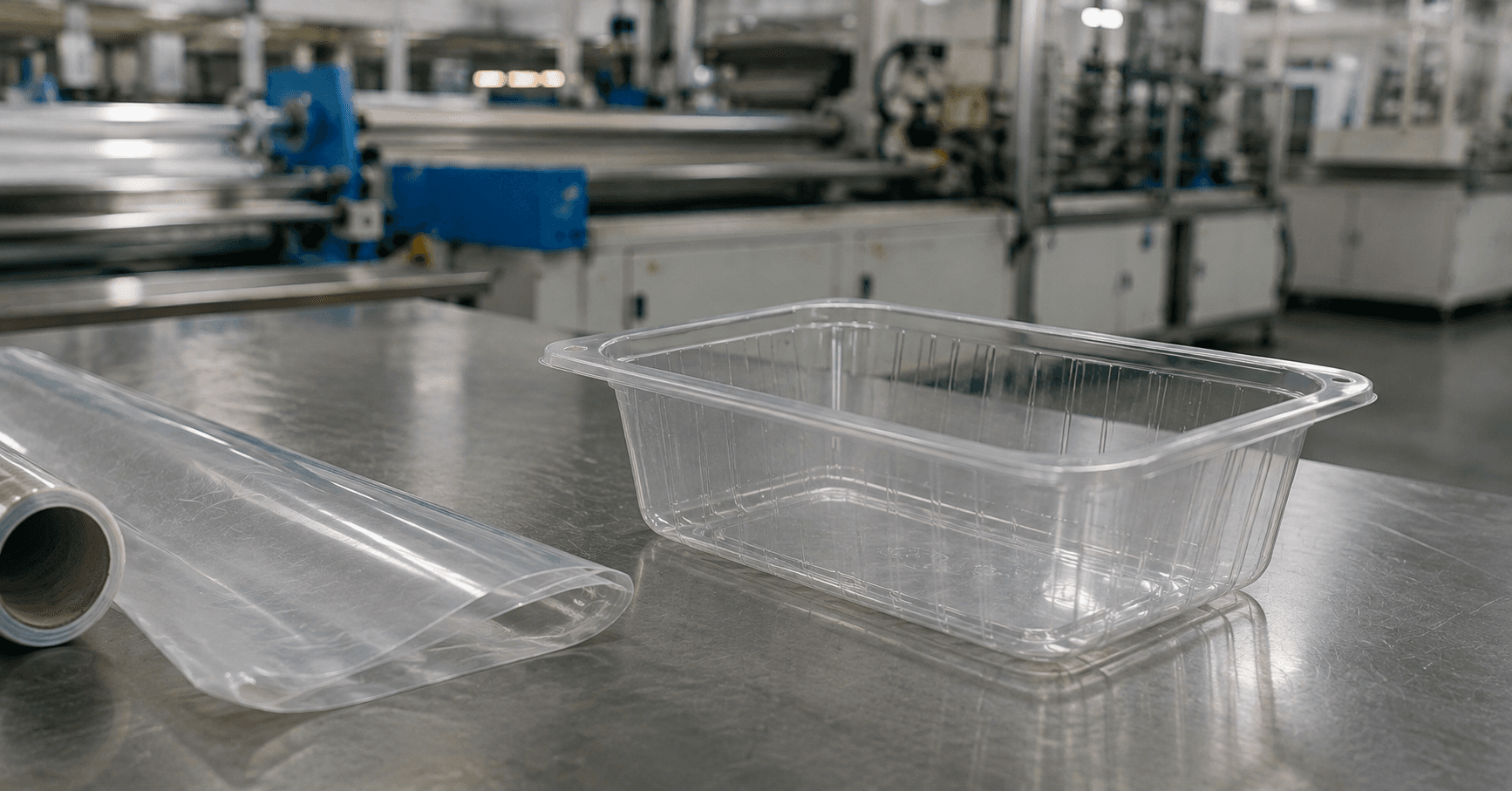
- a roll-fed sheet that is thermoformed into cavities on the packaging line;
- a semi-rigid forming web;
- a rigid lower web;
- or, in broader purchasing language, the material used to make a pre-formed VSP tray.
MULTIVAC’s skin-pack description explains the coordinated upper-film, lower-web and machine system.
These formats should not be treated as interchangeable. A buyer should state whether the material will be formed in-line, converted into trays before packing, or used as a flat board or carrier. The required stiffness, draw, winding, seal area and machine handling may be different.
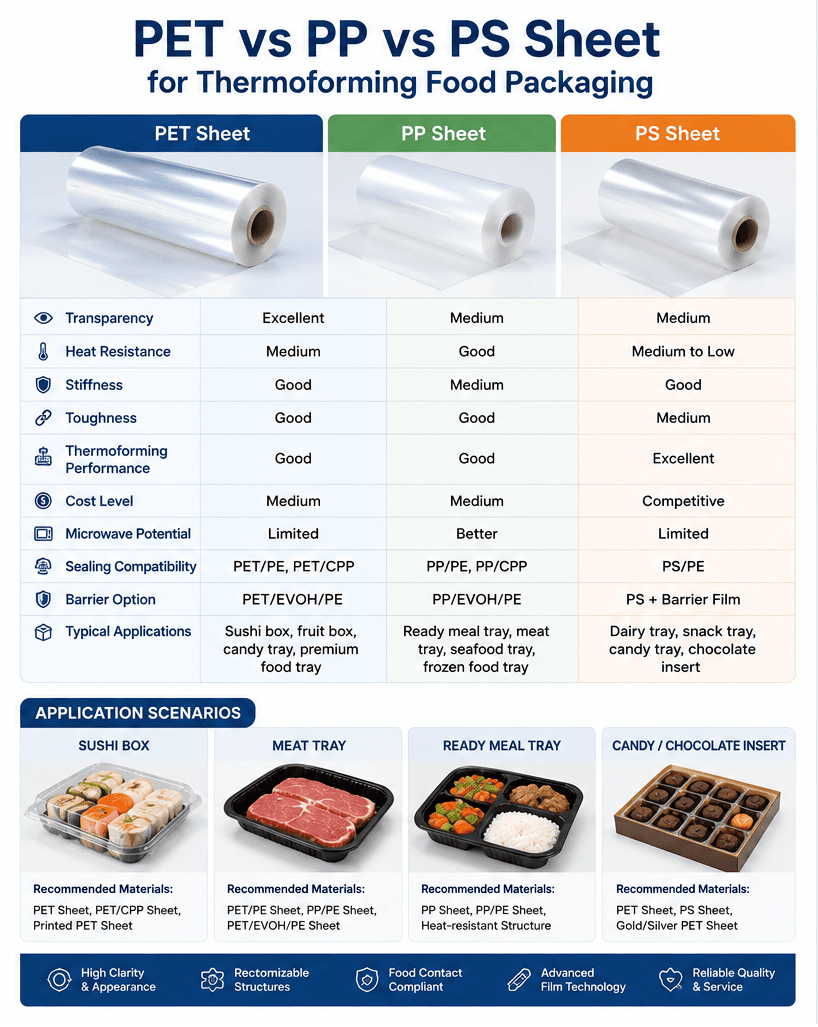
For a broader resin-level comparison, see WANSYN’s PET vs PP vs PS sheet guide. This article focuses specifically on the bottom web and seal system used for VSP.
The Bottom Web Has More Than One Job
A VSP bottom web is not merely a support sheet. Depending on the pack design, it may need to perform several functions at the same time.
1. Form into the required cavity
The sheet must form around the tool geometry without unacceptable thinning, whitening, tearing, webbing or loss of dimensional stability. Total thickness alone does not predict this result. Heating profile, draw ratio, corner radius, plug assist, line speed, sheet temperature and the behaviour of every layer all matter.
2. Provide a compatible sealing surface
The upper skin film seals to the exposed surface of the bottom web or tray. The seal therefore depends on the seal-facing layer, not only on the base resin. A PET-based sheet with a PE-facing surface and a PP-based sheet with a PE-facing surface may both be described as PE-sealable, but their complete structures and forming behaviour remain different.
3. Maintain package stiffness and appearance
The formed pack must remain suitable for filling, sealing, cutting, stacking, transport and display. The required stiffness depends on tray size, product weight, flange design, nesting, distribution conditions and whether the pack is handled chilled or frozen.
4. Support the required barrier system
If oxygen or moisture barrier is required, the buyer must define a measurable target and test method. A PET/PE or PP/PE name does not, by itself, establish the barrier of the finished package. A project may require an additional barrier layer, such as an EVOH-containing construction, but its suitability must be evaluated after forming and sealing.
5. Survive the intended temperature and handling route
“Chilled,” “frozen” and “deep-freeze” are not complete specifications. The material supplier needs the lowest product and ambient temperature, cooling or freezing profile, dwell time, handling impacts, transport route and test method. Performance at one temperature does not automatically prove performance throughout the full cold chain.
PET/PE vs PP/PE: A Practical Starting Comparison
The following table is a selection framework, not a universal performance ranking. Actual properties depend on the named grades, layer ratios, manufacturing route and test conditions.
| Evaluation point | PET/PE direction | PP/PE direction |
|---|---|---|
| Structural base | PET-based forming layer | PP-based forming layer |
| Seal-facing layer | PE or a specified PE-based sealing layer | PE or a specified PE-based sealing layer |
| Why buyers may evaluate it | PET-based stiffness, clarity or display requirements combined with a PE-facing seal surface | PP-based application or forming requirements combined with a PE-facing seal surface |
| Forming question | Can the PET-based laminate reach the required cavity without harmful thinning or interlayer stress? | Is the selected PP grade and laminate construction stable across the required heating and forming window? |
| Cold-chain question | Does the formed tray resist cracking, corner damage and delamination at the actual temperature? | Does the selected PP formulation and total structure retain adequate impact performance at the actual temperature? |
| Seal question | Is the upper film approved against the exact PE-facing layer and surface treatment? | Is the upper film approved against the exact PE-facing layer and surface treatment? |
| Barrier question | Is a separate barrier layer needed, and what happens to it after forming? | Is a separate barrier layer needed, and what happens to it after forming? |
| Approval basis | Formed-and-sealed pack testing | Formed-and-sealed pack testing |
When PET/PE may be the better direction to evaluate
PET/PE can be considered when the buyer wants a PET-based structural layer and a PE-facing surface for the selected skin-film system. Projects may also prefer this direction for clear presentation or a particular stiffness profile.
However, the commercial name does not tell you:
- whether the PET is virgin, recycled-content or another specified grade;
- the thickness of each layer;
- whether a tie or adhesive layer is present;
- which side faces the product;
- whether a barrier layer is included;
- or which upper skin film and machine conditions have been validated.
Ask for a written layer order from the outside surface to the food-facing or product-facing surface. Do not approve the material based only on “PET/PE” printed on a quotation.
When PP/PE may be the better direction to evaluate
PP/PE can be considered when a PP-based forming structure fits the product, equipment or downstream requirement and a PE-facing seal surface is needed. It may be relevant to chilled or frozen applications, but low-temperature performance must be confirmed for the specific PP formulation and finished laminate. “PP” is not a guarantee of freezer toughness. Ask whether the PP grade is a homopolymer, random copolymer or impact copolymer, and request grade-specific cold-impact evidence. Adding a PE seal layer does not by itself establish the cold toughness of the PP structural layer.
The buyer should also avoid inferring microwave suitability from the PP base layer alone. A PP/PE laminate includes more than one polymer and may include tie layers, pigments or other components. Any heating claim must be supported for the complete finished package and its intended conditions of use.
Structure Design: Specify the Layer Order, Not Just the Name
Commercial descriptions such as PET/PE and PP/PE are useful shorthand, but they are not universal standards. Two suppliers can use the same name for structures with different layer thicknesses, bonding systems and sealing surfaces.
A useful written description should identify:
- outside surface;
- structural base layer;
- optional recycled-content layer, if applicable;
- tie layer or adhesive interface, if used;
- barrier layer, if required;
- product-facing seal layer;
- surface treatment, coating or peel function;
- total nominal thickness and tolerance;
- layer ratio or critical functional-layer thickness where relevant.
The structure should be reviewed from both a forming and a sealing perspective. A thicker PE layer is not automatically better: it can change stiffness, heating response, draw behaviour, interlayer stress, sealing and trim handling. The correct balance is project-specific. For example, a PET structural base / bonding interface / PE-based seal layer is a conceptual stack, not a fixed WANSYN specification; tie layers, adhesives and functional-layer thicknesses must be named. Where adhesive lamination is used, confirm the specified cure and release conditions before forming. A decorative online PET film is not automatically a VSP sealing film.
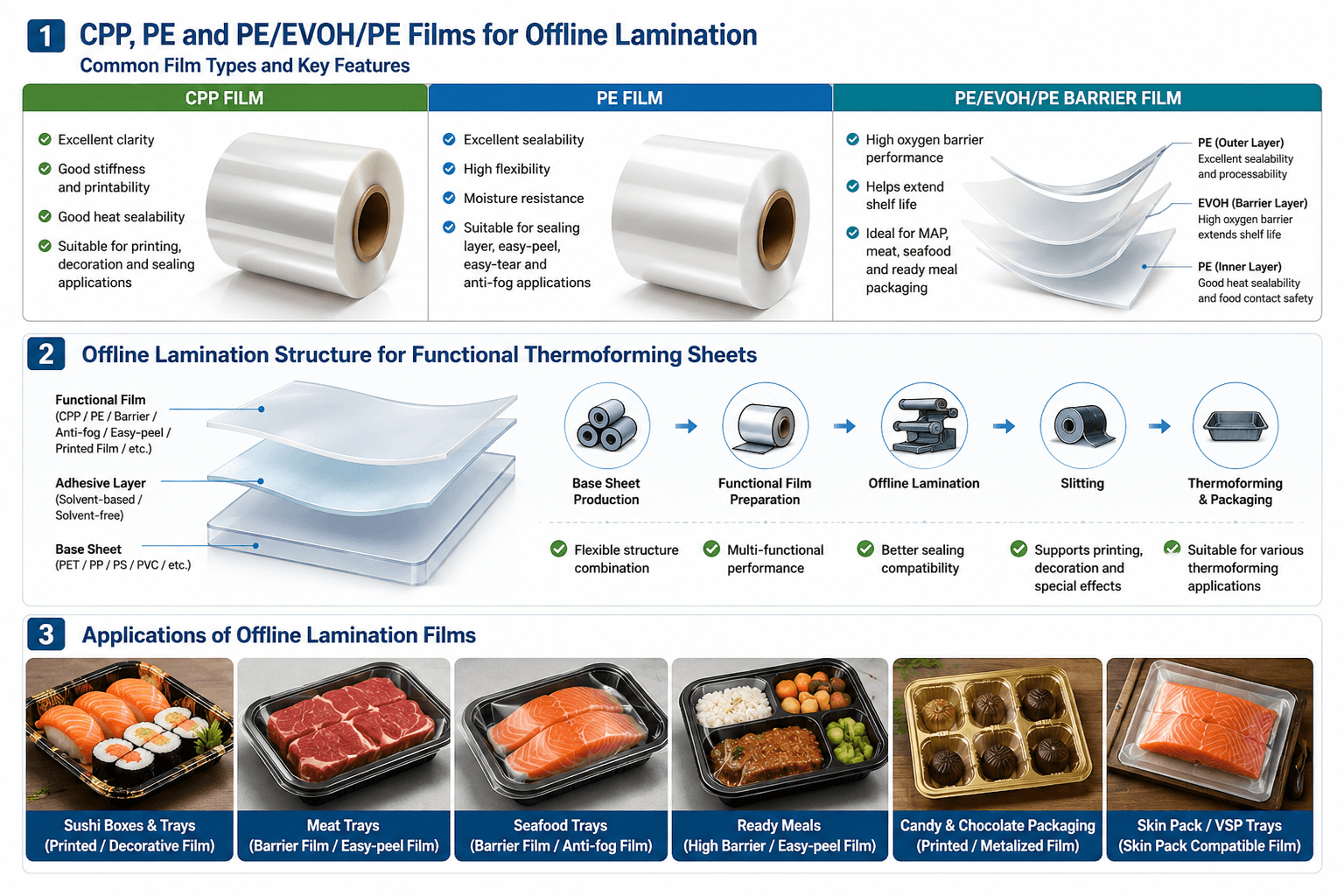
For converting-route background, see CPP & PE films for offline lamination. If the project requires high barrier, review WANSYN’s PET high-barrier sheet and roll options, but confirm the actual structure and test conditions for the requested grade.
Thermoforming: Why Flat-Sheet Approval Is Not Enough
Thermoforming redistributes material. The flange, sidewall, base and corners do not retain the same thickness after forming. Deep cavities, small corner radii, uneven heating and poor plug design can concentrate strain in the areas most likely to crack, whiten or lose functional-layer continuity.
For a laminate, all layers must deform together. The qualification plan should check:
- total formed-wall thickness at representative locations;
- minimum thickness at corners and transitions;
- interlayer adhesion after forming and cooling;
- surface appearance and colour consistency;
- tray flange flatness;
- rim definition and cut quality;
- resistance to nesting and de-nesting damage;
- distortion after filling and sealing.
If an oxygen-barrier layer is included, the flat-sheet OTR may be useful for incoming-material control, but it does not replace formed-pack validation. Local thinning can alter barrier performance, while a channel leak or incompatible seal can dominate the result regardless of the flat-web data.
Read the detailed explanation in Thermoforming Draw Depth and Barrier Layer Thinning.
Match the Skin Film to the Seal-Facing Layer
The phrase “suitable for VSP” is incomplete unless the upper film and sealing surface are named. The skin film must heat, stretch around the product and seal reliably to the intended landing area. The bottom web must present a clean, consistent surface across the flange and the area where full-surface sealing is required.
Before ordering production material, confirm:
- upper-film supplier and exact grade;
- whether the upper film is designed for the machine and product height;
- bottom-web seal-facing resin or coating;
- required seal temperature, time and pressure range;
- peelable, lock-seal or other opening behaviour;
- sealing-area design;
- tolerance to product moisture, fat or contamination;
- top and bottom web barrier requirements;
- pack cutting and edge-finish requirements.
Separate upper-film heating from bottom-web forming and sealing settings; machine setpoints do not directly equal the temperature at the sealing interface. MULTIVAC’s thermoformable-film specifications distinguish polymer grades, barrier options and PE, PP or PET sealing media.
A single “seal temperature” is rarely enough for qualification. Build a seal curve or operating window by varying the relevant machine settings within an agreed test plan. Evaluate more than initial bond strength: inspect for channels, edge lifting, tearing, fibre or film transfer where applicable, difficult opening and loss of integrity after cold storage or transport simulation.
Chilled and Frozen VSP Applications
VSP is widely used for products such as meat, seafood, poultry, cheese and prepared foods. These applications do not share one universal material specification.
Chilled meat and seafood
Define the product shape, height above the flange, bone or shell edges, drip level, target display orientation and storage temperature. A high product profile can place more demand on the upper film, while a heavy product can require greater bottom-web stiffness and stronger handling performance.
Frozen fish and seafood
For a frozen application, ask what happens before, during and after freezing. A pack may be sealed while the product is chilled and then frozen, or it may experience other sequences. The test plan should reproduce the real sequence, including temperature transitions, handling, drop or impact events, carton packing and thawing if relevant.
Do not approve a sheet only because a supplier quotes a minimum temperature. The complete formed-and-sealed pack should be tested at the agreed temperature and after the agreed conditioning time.
For seafood, barrier selection also needs a food-safety decision. Reduced-oxygen packs can introduce a risk of Clostridium botulinum toxin formation. The processor should define the validated controls, frozen/chilled route and thawing instructions for the destination market before choosing the barrier system. Higher oxygen barrier is not automatically the correct choice for every seafood application; see FDA’s reduced-oxygen seafood guidance. This article does not prescribe a food-safety process.
Products with bones, shells or sharp edges
The upper film usually carries much of the puncture challenge, but the bottom web and cavity geometry still matter. Provide product-height distribution and sharp-edge information to both the upper-film and bottom-web suppliers. A successful trial with a smooth fillet may not represent a bone-in or shell-on product.
Retail-ready and vertical display
If the product will be displayed vertically, verify product fixation, flange integrity, seal continuity and pack stiffness in that orientation. Transport vibration and temperature cycling should also be represented in the approval plan.
Barrier and Shelf Life: Treat the Pack as One System
VSP can support product protection, but no responsible bottom-web recommendation can promise a shelf life from material name alone. Shelf-life performance may be influenced by:
- product microbiology and preparation;
- initial product temperature and hygiene;
- oxygen and moisture barrier of both webs;
- formed thickness distribution;
- residual oxygen or vacuum level;
- seal integrity and microleaks;
- storage temperature and temperature abuse;
- light exposure;
- distribution time;
- the retailer’s acceptance criteria.
If a shelf-life target is commercially important, define the required test protocol with the food producer, film supplier, packaging technologist and laboratory. Material data should always state the test method, temperature, relative humidity and specimen condition. Finished-package testing may be required in addition to flat-film or flat-sheet testing.
A Practical VSP Qualification Plan
Stage 1: Document the application
Record the food type, product dimensions, weight range, maximum height, sharp edges, liquid or fat exposure, storage route, display orientation and target shelf life. Include the intended market and the regulatory or customer-document requirements that apply to the final use.
Stage 2: Define and identify the candidate structures
Assign a unique name to each candidate bottom web and upper film. Record the written layer order, total thickness, critical layer information, surface direction and roll winding. Do not compare unidentified samples.
Stage 3: Run a forming trial
Use the intended tool where possible. Record heating-zone settings, cycle time, plug-assist conditions, vacuum profile and sheet orientation. Measure the formed part rather than relying only on the machine recipe.
Stage 4: Establish the seal window
Test the candidate skin film against the exact seal-facing surface. Inspect full-surface adhesion and the flange. Include realistic product loading and contamination conditions where safe and appropriate.
Stage 5: Condition and challenge the finished packs
Condition packs through the intended chilled or frozen cycle. Evaluate leak integrity, visual appearance, peel or opening behaviour, drop/impact resistance, stacking, transport simulation and any agreed barrier or shelf-life endpoints.
Stage 6: Lock the approved specification
The approval record should name the bottom web, upper film, surface orientation, machine, tool, recipe range, product family and test conditions. A generic approval such as “0.7 mm PP/PE passed” is not enough to control future supply.
Common VSP Problems and What to Check First
| Symptom | Possible areas to investigate |
|---|---|
| Skin film lifts from part of the tray | Wrong seal-facing layer, insufficient or uneven heat/pressure, contamination, poor flange flatness, incompatible film grade |
| Channels or leak paths | Product or moisture in the seal area, uneven flange, incomplete full-surface contact, tooling or vacuum issue |
| Bottom-web corner whitening or cracking | Local over-stretch, low formed-wall thickness, sharp radius, heating imbalance, unsuitable grade or cold-condition brittleness |
| Laminate bubbles or local separation | Interlayer stress, inadequate bonding, moisture/conditioning issue, excessive forming strain or incompatible process window |
| Tray deforms during sealing | Insufficient stiffness at sealing temperature, unsuitable support/tooling, heating interaction or thickness distribution |
| Pack passes warm but fails cold | Grade or structure not suitable for actual temperature, seal becomes brittle, cold impact not represented in the original test |
| Difficult or inconsistent opening | Upper-film/seal-layer mismatch, excessive or uneven sealing, peel system not specified, contamination or ageing effect |
| Good flat-sheet barrier but poor shelf-life result | Forming-induced thinning, top-web barrier, seal leak, residual oxygen, product or cold-chain variables |
This table is diagnostic guidance, not a substitute for a controlled root-cause trial.
RFQ Checklist for a Vacuum Skin Packaging Bottom Web
To receive a useful recommendation and quotation, send the following information:
Product and application
- food or non-food application;
- product type, weight range and dimensions;
- maximum height above the flange;
- sharp bones, shells or edges;
- chilled or frozen process sequence;
- lowest operating/storage temperature and conditioning time;
- target market and final-use conditions.
Bottom-web specification
- PET/PE, PP/PE or “supplier to recommend”;
- required barrier target, if any;
- nominal total thickness and tolerance;
- roll width, roll length or outer diameter;
- core size;
- colour and surface appearance;
- seal side and winding direction;
- roll-fed forming web or pre-formed tray application;
- annual or monthly consumption.
Tool and process
- packaging-machine brand and model;
- thermoformer or traysealer;
- cavity drawing or tray drawing;
- draw depth and minimum corner radius;
- number of cavities;
- plug-assist details, if used;
- current forming and sealing settings;
- line speed or cycle target.
Upper film and performance
- skin-film supplier and exact grade;
- top-web thickness and barrier data;
- target seal mode and opening behaviour;
- leak-test method;
- cold-impact or drop-test method;
- shelf-life target and validation owner;
- existing sample, drawing, video or trial report.
Use WANSYN’s general thermoforming sheet RFQ checklist for additional roll and tolerance details. You can also review the PET/PP/PS thermoforming sheet category.
Frequently Asked Questions
Is PET/PE always better than PP/PE for VSP?
No. PET/PE and PP/PE are different structure directions. The better option depends on the product, tool geometry, stiffness and appearance requirements, seal-facing layer, skin-film grade, storage route and validated finished-pack results.
Can a PE-sealable skin film seal to every PET/PE or PP/PE bottom web?
Not automatically. “PE-sealable” covers different resin, coating and peel systems. The exact upper film must be trialled against the exact seal-facing layer under the intended machine conditions.
Does PET/PE or PP/PE automatically provide high oxygen barrier?
No. Barrier depends on the complete structure and test conditions. If a high-barrier layer is required, specify the target OTR/WVTR, method and conditioning, then verify the formed and sealed package.
What thickness should a VSP bottom web use?
There is no universal thickness. It depends on tray size, draw depth, corner radius, product weight, required stiffness, formed-wall distribution, machine handling and storage conditions. A forming trial should confirm the minimum acceptable construction.
Can PP/PE VSP trays be used in a freezer?
Some specifically designed structures may be suitable, but suitability must be demonstrated for the named PP formulation, layer structure, thickness, formed geometry, seal system and actual temperature cycle. The resin name alone is insufficient.
Can a PP/PE tray be assumed microwave-safe because it contains PP?
No. A laminate includes PP, PE and potentially other functional layers or additives. Any microwave or heating claim must apply to the complete package under defined conditions of use and be supported by the relevant supplier documentation and validation.
Should barrier be tested before or after thermoforming?
Flat-web testing is useful for material control. For performance-critical packs, formed-web or finished-package testing may also be needed because forming changes thickness distribution and sealing introduces another potential failure path.
What is the fastest way to troubleshoot a VSP sealing problem?
First identify the exact upper film, seal-facing layer, machine recipe, flange condition and location of the failure. Then change one controlled variable at a time. Replacing the bottom web without identifying the seal interface can hide the actual cause.
Request a VSP Bottom-Web Review
WANSYN supplies functional PET, PP and PS sheets and rolls for thermoforming, including laminated and project-specific sealing or barrier directions. A material recommendation should begin with the real pack, not a generic product name.
Review WANSYN’s PET VSP sheets and rolls as a product starting point, with the final construction and performance agreed by project.
Send your bottom-web specification, tray drawing, upper-film grade, packaging-machine model, product height and chilled/frozen conditions through Contact WANSYN. If available, include photos or video of the current forming or sealing issue.