
Quick answer
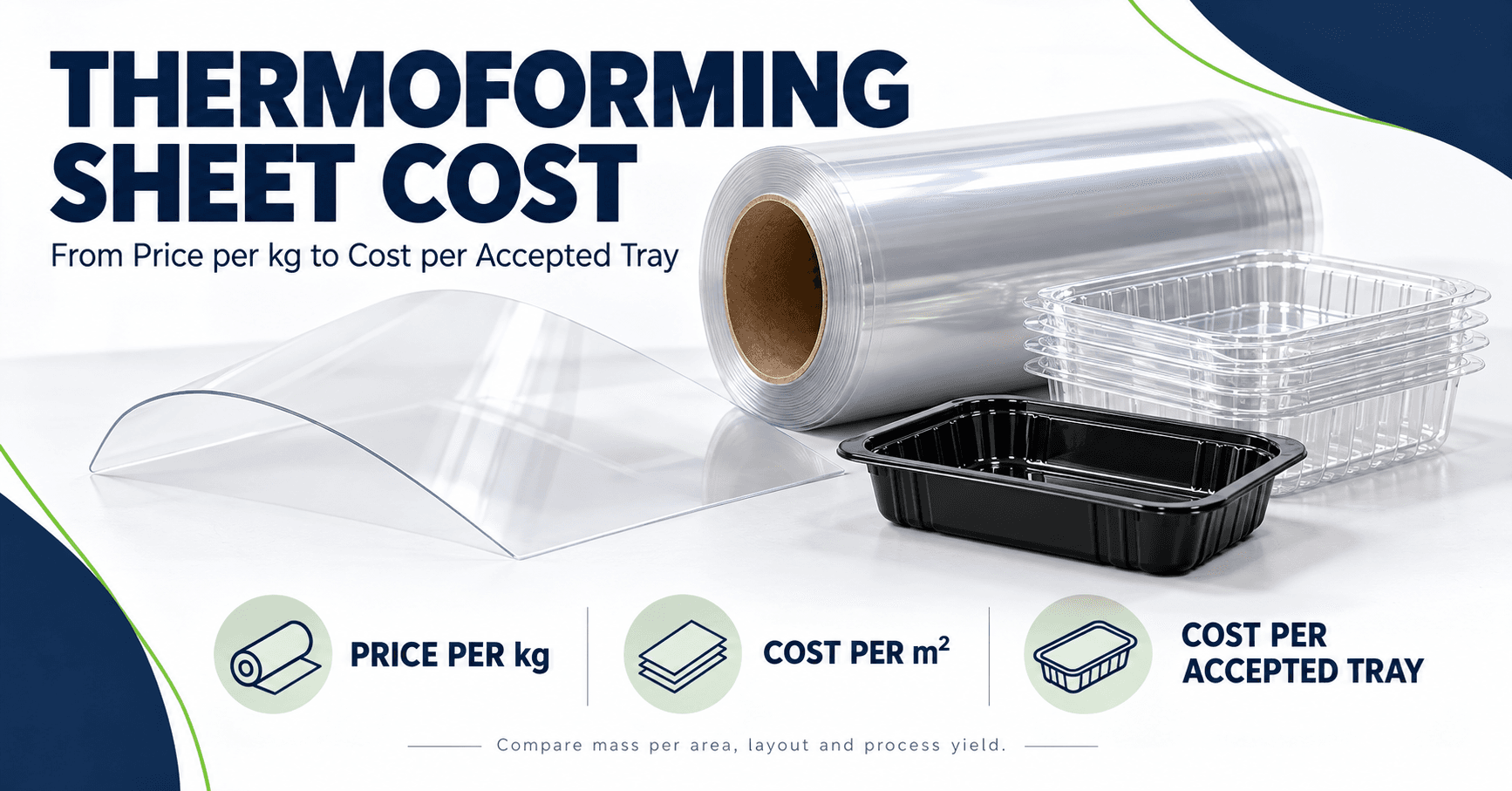
To compare thermoforming sheet cost, convert the quoted price per kilogram into cost per square metre using the sheet’s measured mass per area. Then calculate the web area consumed per cavity and account for startup losses and rejected trays. Compare only candidates that meet the same forming, sealing and end-use requirements.
Material cost per accepted tray = price per kg × kg per m² × web area per nominal cavity ÷ usable-run fraction ÷ tray acceptance fraction.
This is a material-cost model, not a complete production-cost model. A lower price per kilogram does not necessarily mean a lower cost per accepted tray. Equally, a lighter structure is not a saving if it cannot meet the approved package specification.
1. Compare the same purchasing scope first
A quotation for an APET sheet roll, a laminated PET/PE sheet roll and a PE lamination film describes three different purchasing scopes. Before comparing prices, identify what the buyer will actually receive and which processing steps remain.
| Purchasing scope | What belongs in the comparison |
|---|---|
| Finished PET, PP or PS thermoforming sheet | Delivered net sheet mass, measured mass per area, roll format and conversion results |
| Finished laminated thermoforming sheet | The complete structure, including the functional film and any bonding layers or coatings |
| Film for an in-house lamination line | Film cost plus the base sheet, bonding materials, conversion losses and relevant processing costs |
| Finished formed tray | Accepted tray quantity and specification; do not compare its unit price directly with a sheet price per kg |
Use the same currency, quotation validity period and delivery-cost boundary. Separate the net material weight from cores, pallets and other packaging. Confirm whether a quoted roll weight is net or gross and whether the invoice quantity includes packaging mass.
WANSYN’s PET, PP and PS thermoforming sheet range is a starting point for finished-sheet enquiries. For a converter purchasing film, the functional films category identifies a different supply route. The two scopes need separate cost calculations.
2. Convert thermoforming sheet cost per kg into cost per square metre
To calculate sheet cost per square metre, first establish mass per area, sometimes called grammage or basis weight. Express it in grams per square metre, or g/m². In this guide, G is the measured mass per area and P is the agreed material price in USD/kg. These units apply whether the starting quotation is a PET sheet price per kg, a PP sheet offer or a finished multilayer sheet price.
- Sheet mass per area in kg/m² = G ÷ 1,000.
- Area yield in m²/kg = 1,000 ÷ G.
- Material cost in USD/m² = P × G ÷ 1,000.
- Estimated area in a roll = net material mass in kg × 1,000 ÷ G.
- Estimated roll length in metres = roll area in m² ÷ roll width in metres.
These conversions assume that the stated mass per area represents the material being purchased. A small sample from one edge does not establish a whole roll’s average. Agree a representative sampling plan, specimen dimensions, conditioning and weighing procedure before using the result for commercial acceptance.
For example, a hypothetical sheet measuring 450 g/m² yields approximately 2.222 m²/kg. At an illustrative, non-market price of USD 1.50/kg, its material cost is USD 0.6750/m². A net 100 kg roll at that mass per area contains approximately 222.22 m²; at 0.600 m width, its calculated length is approximately 370.37 m. These are arithmetic examples, not WANSYN quotations or roll-length guarantees.
When a quotation is in USD per metric tonne, divide by 1,000 to obtain USD/kg. For a rectangular test specimen, mass per area in g/m² equals specimen mass in grams divided by its measured area in square metres. For example, 4.50 g from a 0.100 m × 0.100 m specimen gives 450 g/m². This arithmetic illustration is not a sampling procedure; agree the actual specimen size, balance resolution and sampling plan.
When discussing thermoforming sheet yield, keep this definition of area yield separate from production yield. Area yield describes square metres per kilogram. Production yield describes how much input becomes acceptable output under a defined process.
3. Why nominal thickness alone is insufficient
For a uniform, solid, single-material sheet, a nominal estimate can be calculated as:
G in g/m² = thickness in µm × density in g/cm³.
This follows from mass, volume and unit conversion. It is a nominal estimate when density and thickness are nominal values. Use the appropriate grade data; do not assign one assumed density to every PET, rPET, PP or PS formulation. For foamed sheet, a solid-resin density will overstate the mass estimate; use measured mass per area or a justified apparent density.
For a multilayer construction, estimate each layer’s mass contribution separately and add them. Include the mass contributions of bonding layers, coatings and printing where relevant. If a coating is specified by dry mass per area, add that value directly rather than inventing a thickness. Avoid counting a layer twice when a supplier has already provided the complete laminate’s measured mass per area.
Commercial names such as PET/PE, PET/CPP, PP/PE and PET/EVOH/PE do not define fixed layer ratios or necessarily list every tie, adhesive or interface layer. Confirm the actual full construction. Two laminated PET sheet offers with the same total nominal gauge may have different mass per area and different functional behaviour. Conversely, matching mass per area does not prove matching thickness distribution, layer integrity or package performance.
For incoming control, agree both the relevant average mass-per-area check and the local thickness checks needed for the application. An average can conceal a thin band across the web. A cost calculation must not replace the approved gauge tolerance or minimum functional-layer requirement.
Method references include ASTM D4321-24, whose published scope concerns plastic-film area yield, and ISO 4591:1992, which addresses gravimetric thickness and yield for film and sheeting. Their procedures are not interchangeable. Select an applicable method with the supplier or laboratory; this article does not reproduce those standards or claim that a particular sheet has been tested to them.
4. Calculate web consumption from the actual tool layout
For a regular roll-fed layout, define:
- W: the full purchased web width entering the process, in metres.
- L: the machine-direction advance per forming cycle, in metres.
- n: the number of nominal cavities produced per cycle.
Then:
Web area per nominal cavity = W × L ÷ n.
Use the actual layout, including side margins, gaps between cavities and the web consumed between cycles. Do not substitute the finished tray’s footprint or developed three-dimensional surface area. Those values do not describe the purchased web consumed per cycle.
With an illustrative 0.600 m width, 0.300 m advance and four cavities, the consumed web area is 0.0450 m² per nominal tray. That figure already contains the layout’s trim allocation. Adding another general “skeleton scrap percentage” would count the same loss twice.
If material is slit before forming, include the slitting loss once: either allocate the full original width across the output or account for the lost material separately. Do not use the narrower useful width while silently excluding purchased edge trim.
Sheet-fed machines, variable-pitch layouts and mixed cavity arrangements need their own allocation. For an actual production run, measured input mass and accepted output usually provide a clearer result than a theoretical layout alone.
5. Calculate thermoforming sheet cost per accepted tray without double-counting losses
Define the usable-run fraction U as the web area entering normal production cycles divided by the total web area consumed for the run, including startup waste, discarded ends and other excluded sections. Usable material returned to stock is outside this consumed-area denominator. At constant width, the equivalent length ratio can be used. Define the tray acceptance fraction Q as accepted trays divided by nominal trays produced during those normal cycles.
For planning:
Material cost per accepted tray = P × (G ÷ 1,000) × (W × L ÷ n) ÷ U ÷ Q.
Use U and Q as fractions: 92% becomes 0.92. Both must be greater than zero and no greater than one. Their definitions must be consistent between suppliers and must not overlap. The equation allocates the cost of material consumed for the run to accepted trays before any scrap credit. It assumes one representative mass per area, price and repeating layout. If grades, widths, gauges or layouts change, calculate each segment separately and reconcile the combined material cost with the accepted output. Define nominal cavities consistently so a disabled cavity or rejected tray is not counted twice.
For retrospective verification:
Actual material cost per accepted tray = attributable purchased material cost for the run ÷ accepted tray count.
Account for opening and closing usable inventory. For example, do not charge the full roll against a short trial if a substantial usable remainder is returned to stock. Conversely, do not omit discarded startup material merely because it was removed before the production counter started.
If scrap has a demonstrable recovery value, show the net credit separately. Do not assume that all trim can be reused in the same product or recovered at the original sheet purchase price. Mixed layers, print, contamination and the intended application can affect the feasible recovery route.
6. Worked example: the cheaper kilogram is not always the cheaper tray
The following figures are hypothetical purchasing scenarios. They are not current market prices, material recommendations, measured WANSYN results or evidence that one polymer outperforms another. Both candidates must first meet the same approved end-use requirements.
| Input or result | Candidate A | Candidate B |
|---|---|---|
| Illustrative price, USD/kg | 1.50 | 1.58 |
| Illustrative measured mass per area, g/m² | 450 | 420 |
| Calculated area yield, m²/kg | 2.222 | 2.381 |
| Calculated cost, USD/m² | 0.6750 | 0.6636 |
| Consumed web area per nominal tray, m² | 0.0450 | 0.0450 |
| Usable-run fraction U | 0.92 | 0.92 |
| Tray acceptance fraction Q | 0.96 | 0.96 |
| Material cost per accepted tray, USD | 0.03439 | 0.03381 |
Under these assumptions, Candidate B costs more per kilogram but less in material per accepted tray. The calculated difference is about USD 0.58 per 1,000 accepted trays before scrap credit and conversion costs. At this small difference, measurement variation or a change in the rejection rate can affect the purchasing decision; the displayed decimal places are calculation results, not demonstrated measurement precision.
Now change only Candidate B’s acceptance fraction to 0.90. Its material cost rises to approximately USD 0.03607 per accepted tray. The apparent advantage disappears. This sensitivity is why a supplier comparison needs an actual forming trial and agreed rejection criteria.
At the same mass per area, geometry and acceptance rates, the lower price per kilogram would produce the lower material cost. The purpose of this model is to reveal the assumptions, not to dismiss kilogram pricing.
7. Keep forming, sealing and application performance as approval gates
Final supplier approval should follow technical qualification; preliminary cost calculations can help shortlist candidates for trials. For APET sheet or rPET sheet, confirm the named grade, recycled-content specification where relevant, appearance, forming behaviour and destination-market documentation. The abbreviation alone does not establish these properties.
For PET/PE sheet, PET/CPP sheet or PP/PE sheet, identify the complete construction, bonding route and exposed seal face. Validate the formed tray with the actual lid or upper film, tool and operating conditions. Count accepted output against agreed criteria for appearance, dimensions, flange condition and the required package tests.
For high barrier thermoforming sheet such as a proposed PET/EVOH/PE structure, a lower overall mass is not automatically an acceptable design change. Confirm the barrier target, test conditions and performance after forming and sealing. See the barrier-layer thinning guide for the geometry question and the PET/EVOH/PE product page for a project enquiry.
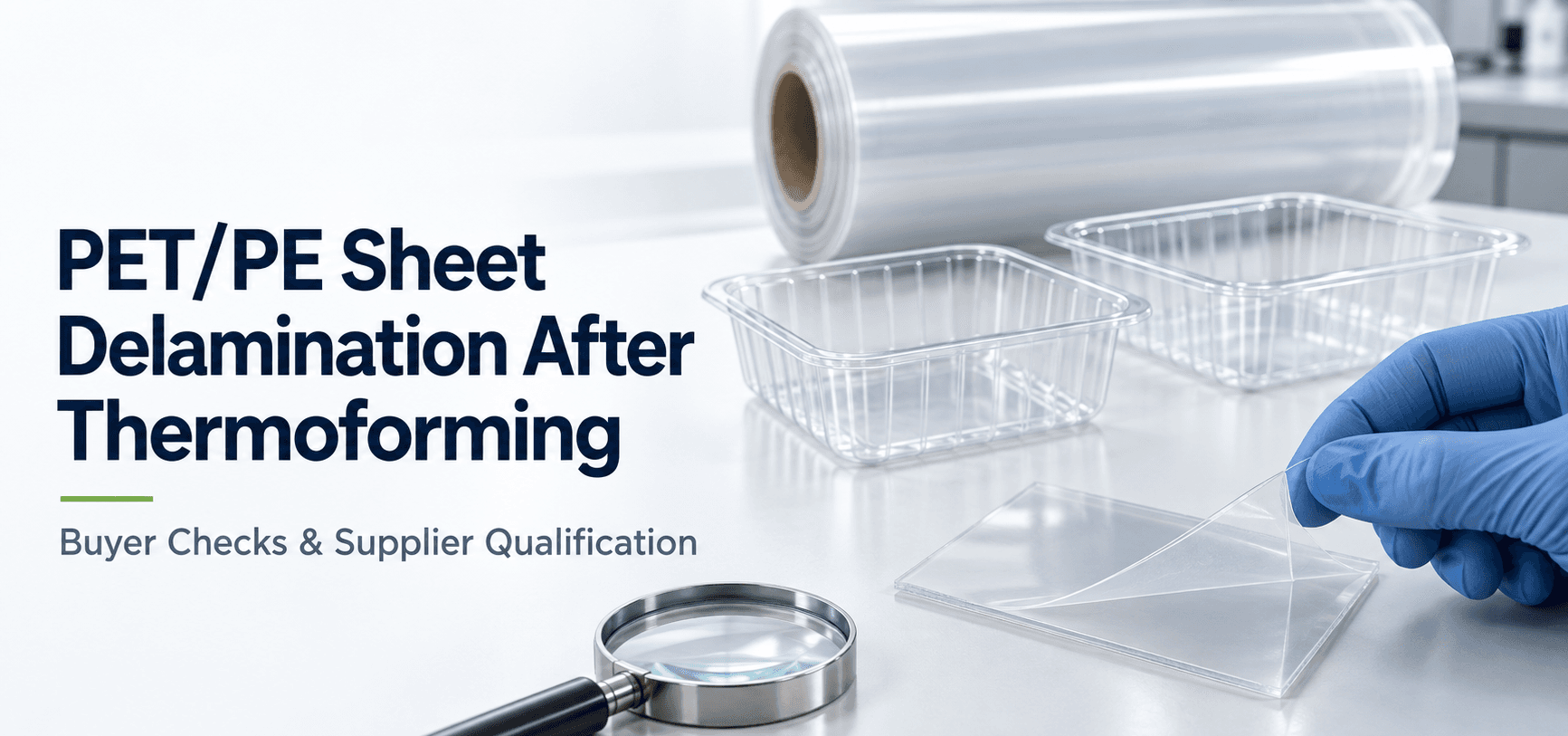
If layers separate during a trial, investigate the failed interface using the PET/PE delamination checks. Do not simply improve the spreadsheet’s acceptance fraction without resolving the defect.
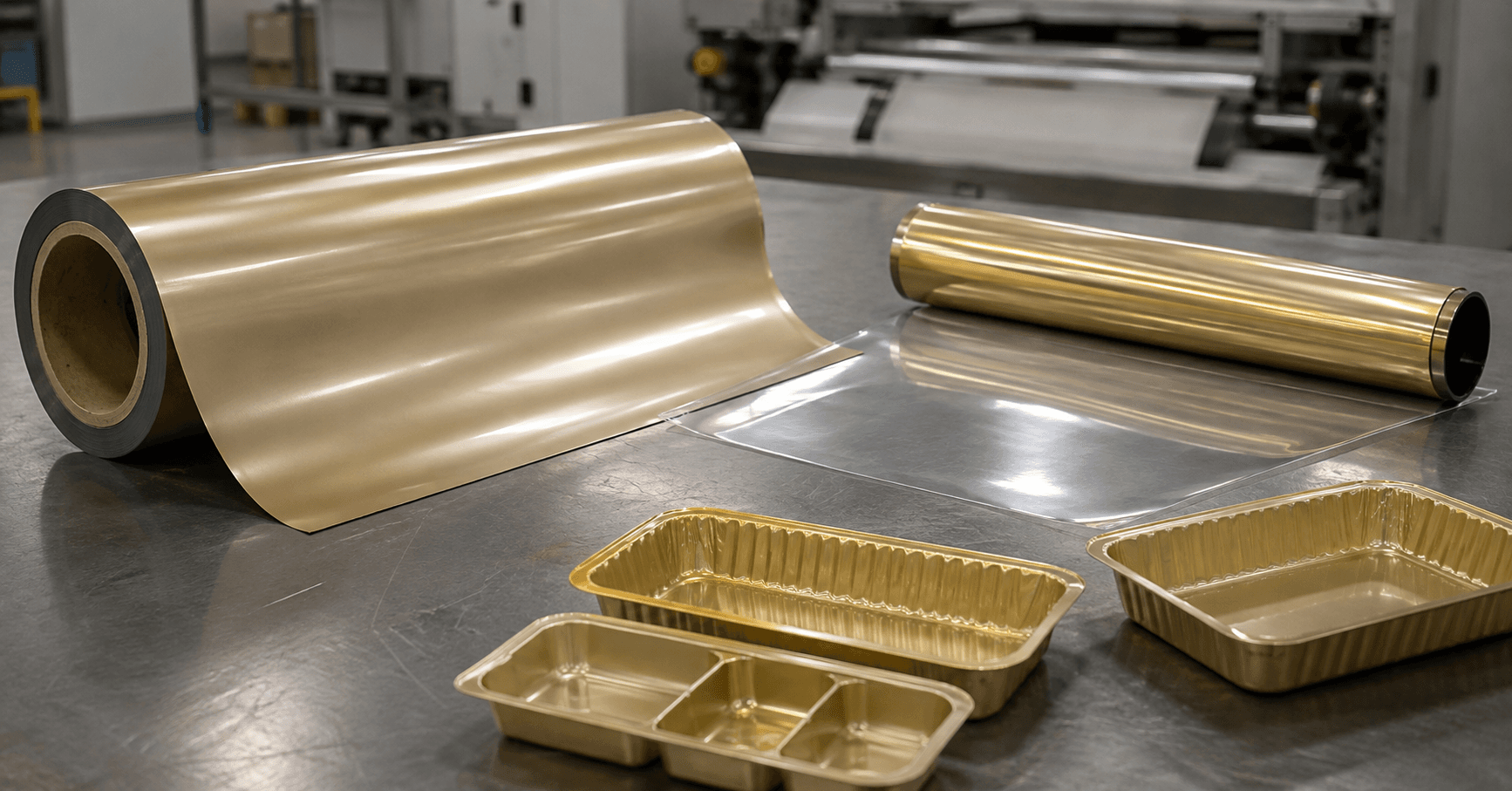
For a sushi printed PET sheet, sushi printed PP sheet, gold PET sheet or silver PET sheet, include the approved post-forming appearance and nesting condition in acceptance. If a registered print requires a specific repeat, use the compatible cycle advance in the layout calculation. Decorative finish, barrier performance and sealing behaviour are separate requirements. No universal gauge reduction or saving percentage is recommended here.
8. Compare lamination film cost with finished laminated sheet cost
A sheet producer comparing PET thermal lamination film, CPP lamination film, PE lamination film or barrier lamination film should first establish the required function and qualified process route. These are not automatically interchangeable films.
Express lamination film cost per purchased square metre using each film’s own mass per area. To compare finished laminated sheet cost, include all material inputs needed for the accepted output. Then build the finished-laminate calculation from the base sheet, film, any bonding materials and the output area that actually passes release inspection. Account for differences in input widths, edge trimming, startup losses and rejected laminate once each.
A practical run-based approach is:
Purchased-material cost per accepted laminate m² = total attributable input-material cost ÷ accepted laminate area.
Use actual material consumed, with unused stock reconciled. Add energy, labour, equipment time and other conversion costs separately when comparing in-house lamination with purchasing finished laminated sheet. A film’s USD/kg figure alone cannot settle that make-or-buy decision.
WANSYN’s CPP, PE and PE/EVOH/PE offline lamination films and PET films for online thermal lamination provide enquiry routes for the two processes. Film compatibility, layer design, cure or conditioning requirements where applicable, and available specifications must be confirmed for the intended line.
9. Send an RFQ that supports a usable cost comparison
For a sheet or film proposal, provide:
- Supply scope: finished sheet roll, cut sheet, lamination film or formed tray.
- Application and approval criteria: packed product, handling and storage conditions, appearance, forming, seal and barrier requirements where applicable.
- Current material: exact grade or complete structure, nominal thickness and tolerance, measured mass per area if available, seal side and winding direction.
- Roll and tool information: purchased width, core, maximum roll diameter or weight, cycle advance and cavity layout.
- Trial records: net material consumed, accepted output, startup waste, rejection categories and usable stock returned.
- Commercial comparison basis: trial and forecast volume, currency, delivery basis and destination, packaging treatment and quote validity.
- Documentation: required grade-specific declarations, traceability and agreed test methods for the destination and intended use.
Use the general thermoforming sheet roll RFQ checklist for the wider specification. For a thermoforming sheet cost comparison, send your current structure, roll dimensions, measured mass per area and trial output through Contact WANSYN or email info@wxchemgroup.com. Mark unavailable data as “to be confirmed.”
A proposed structure remains subject to technical review and trial acceptance. Quotation, sample availability, minimum quantity and production timing are confirmed for the individual project.
Frequently asked questions
How do I convert a PET sheet price per kg into price per m²?
Multiply price per kg by the sheet’s measured g/m² and divide by 1,000. Use a representative measurement or an agreed supplier value, and state whether it is measured or nominal.
Does PP always cost less per tray than PET?
No. The required gauge, complete formulation or laminate, tool layout, process losses and accepted output all matter. Compare candidates that satisfy the same finished-package requirements rather than assigning a result from resin names alone.
Can I calculate PET/PE laminate weight using PET density for the whole sheet?
That would treat the complete construction as PET. Use the actual mass per area of the finished laminate, or sum the mass contributions of its specified layers and coatings for a provisional estimate.
Is finished tray weight enough to calculate material cost?
Not by itself. It omits material consumed as the trim skeleton, startup waste and rejected output. Reconcile purchased input and accepted output, with any verified scrap credit shown separately.
Does equal nominal thickness mean equal area yield?
Not necessarily. Different formulations, layer proportions and actual gauge distributions can change mass per area. Equal area yield also does not establish equal barrier, sealing or forming performance.
Should skeleton scrap be added after calculating width × advance ÷ cavities?
Not if the full purchased web width and actual cycle advance already include that skeleton. Add only losses excluded from the layout calculation and record each loss once.
Can a cheaper lamination film lower total laminate cost?
It may, if it delivers the required function with acceptable input consumption and qualified output. Compare the complete laminate’s cost per accepted area, including base sheet and bonding inputs, then add the relevant conversion costs.
Does this calculation include labour, energy, lidding film or logistics?
Only costs explicitly included in the defined boundary. The worked example includes sheet material alone. A complete packaging-cost comparison must add the relevant conversion, upper-film, transport and other costs on a consistent basis.