
Quick Answer
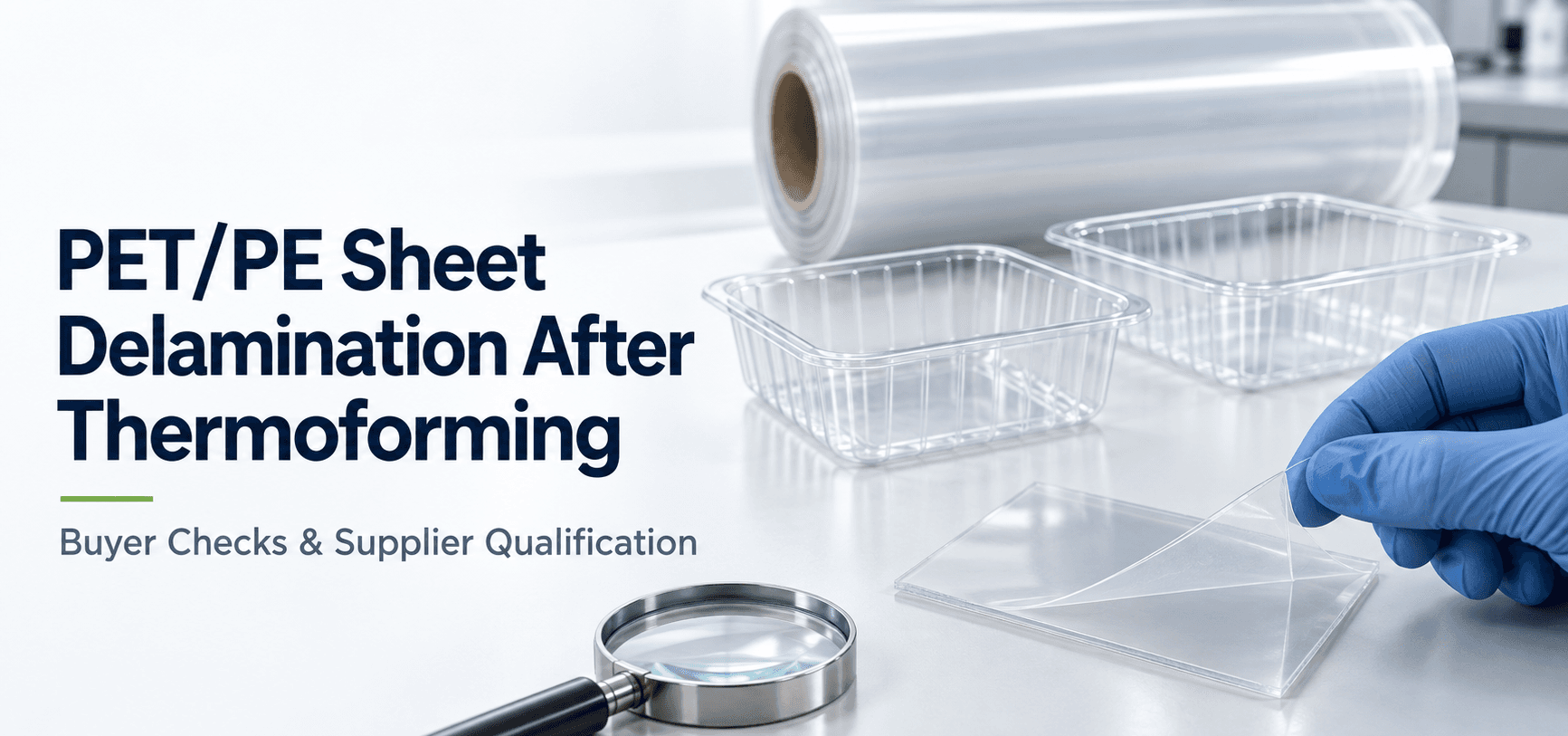
PET/PE sheet delamination after thermoforming means that layers in the tray material separate during or after conversion. Before changing the material or raising the forming temperature, identify which interface separated, when the defect first appeared, and whether it occurs in the flat roll, the formed tray or only after sealing. Compare a retained flat-sheet sample with the defective part under an agreed test method.
A useful qualification decision combines laminate bond testing, a mapped forming trial and finished-pack checks. A dyne reading, a strong lid seal or an attractive flat roll cannot, by itself, approve the complete laminated thermoforming sheet.
This guide focuses on interlayer failure and supplier acceptance for PET/PE sheet. It also explains which checks transfer to PET/CPP sheet, PP/PE sheet and functional films purchased for lamination. These are candidate material families, not interchangeable specifications.
First Identify What Has Actually Failed
Three observations can look similar but require different corrective actions.
Interlayer delamination: separation occurs inside the sheet construction—for example, between the structural sheet and a laminated functional film. The location needs examination; a product label such as PET/PE does not identify every interface.
Lid-to-tray seal failure: the lidding film separates from the tray's seal-facing surface. This is a different bond. A lid may remain attached to a thin surface layer while that layer separates from the tray below it; in that case, inspect the tray laminate as well as the seal.
Whitening or a crack without confirmed separation: a white corner or damaged edge does not prove delamination. Examine the cross-section and both surfaces of any separated material. Do not assign a cause from colour alone.
An intentionally engineered peel system may be designed to open at a specified interface. That controlled opening must be distinguished from unintended separation that damages the tray or package integrity. The expected failure path should be part of the approved specification.
If the problem is mainly wrinkles, channels or inconsistent opening at the lid, start with WANSYN's tray-sealing troubleshooting guide.
Define the Structure Before Comparing Suppliers
Ask each supplier to describe the layer sequence from the outside of the tray to the product-facing surface. A conceptual adhesive-laminated PET/PE construction might contain a PET structural sheet, a bonding interface and a PE-based functional film. That description is not a fixed WANSYN recipe. Other production routes and additional layers are possible.
For each candidate, record the base-sheet grade, total gauge and tolerance, functional-film identity, bonding route, exposed sealing surface and winding direction. Where relevant, identify print, coatings, tie layers and barrier layers separately. A commercial abbreviation may omit them.
| Material family | Question to resolve before a trial |
|---|---|
| PET/PE sheet or laminated PET sheet | Which PE-based film is bonded to which PET surface, and which side is the seal face? |
| PET/CPP sheet | Is the CPP lamination film qualified for the required forming strain and the intended lid system? |
| PP/PE sheet | Are the PP grade, PE film and bonding system identified and approved together? |
| PET-based sheet with PE/EVOH/PE barrier lamination film | Is the failure at the sheet-to-film bond or within the multilayer film? |
Do not describe PET/CPP as an automatic performance upgrade over PET/PE. Nor does adding a PE layer prove that a PP-based structure will withstand a specified freezer route. Selection depends on the exact construction and its measured results.
WANSYN's CPP, PE and barrier films for offline lamination are a starting point for discussing film requirements, not evidence that every listed option fits the same process.
Buying a finished sheet versus buying a functional film
A thermoformer buying finished laminated sheet rolls should request the laminate identification, release status and agreed incoming and formed-part checks.
A sheet producer buying PE lamination film, CPP lamination film or barrier lamination film must additionally qualify the film on its own bonding line. The film supplier cannot infer the result of an unspecified adhesive, surface preparation or conversion recipe.
Use the same retained sample and structure code across purchasing, the laminator, the thermoformer and the laboratory. Otherwise, apparently conflicting test reports may simply describe different constructions.
Find the First Stage at Which Separation Appears
Inspect material at successive checkpoints rather than examining only the rejected finished tray.
1. Flat roll before forming
Sample agreed positions across the roll width and along the production run. Keep an untouched reference. Record whether separation already exists, whether it is limited to edges, and whether it follows a coating or printing pattern.
Ask the laminator to review surface identity, treatment history, cleanliness and its approved bonding records. For an adhesive route, these may include adhesive identification, application uniformity and the relevant cure/release record. These are investigation points—not proof that the laminator caused the defect.
2. Heated but unformed material
If a safe, machine-approved trial can isolate heating from drawing, compare a heated specimen with an unheated reference. Separation appearing here warrants a review of the heat exposure and laminate construction before changing the tool.
Record actual trial conditions. A heater setpoint is not a direct measurement of the temperature at a buried bond interface. Avoid prescribing one universal forming temperature for all PET/PE sheet rolls.
3. Formed, cooled and trimmed tray
Map defects by location: flange, sidewall, bottom transition, corner and trimmed edge. Note when they become visible. Separation concentrated at corners calls for investigation of local deformation, thickness distribution and the bond together. Separation limited to a cut edge also warrants a trimming review.
Use the actual cavity drawing and retain good and defective parts. Do not infer an acceptable maximum draw depth from another customer's tray. The separate draw-depth and layer-thinning guide covers the geometry question in more detail.
4. Sealed and conditioned package
Keep unsealed trays as controls. If the defect appears only after sealing, compare seal-area location, lid identity, tooling support and the applied heat cycle. If it appears only after storage or distribution simulation, preserve the conditioning record and examine the same locations again.
This sequence helps narrow the investigation. It does not establish a single cause without a controlled comparison.
Separate Surface Screening, Laminate Bond and Seal Tests
These measurements answer different questions and should not be substituted for one another.
| Check | What it can help establish | What it does not establish alone |
|---|---|---|
| Surface-wetting check | Whether the tested surface meets an agreed preparation indicator | Adhesion through the whole roll or survival after forming |
| Interlayer bond test | Behaviour of the identified laminate interface under the stated method | Leak integrity or acceptable opening of the finished pack |
| Lid-seal strength test | Force and failure behaviour at a tested package seal | Strength of every internal sheet interface |
| Finished-pack integrity check | Performance under the selected leak or integrity method | Every barrier, shelf-life or end-use requirement |
Enercon's surface-adhesion guidance explains why a dyne result is an indicator, not an adhesion guarantee. Specify the tested side, test procedure and material condition; do not use a universal dyne number as the sole purchasing release criterion.
For laboratory planning, ASTM F904-22 concerns separating plies of flexible laminates so a bond can be measured. It is not a universal pass/fail bond-strength specification for every rigid thermoforming sheet. The laboratory must select an applicable measurement procedure and document any limitations or adaptations for a rigid substrate.
ASTM F88/F88M-23 addresses seal-strength measurement, including flexible material sealed to a rigid material. A seal-strength result should not be presented as a leak test or as proof of internal laminate adhesion.
What a useful bond-test report should contain
Agree the following before comparing batches:
- Sample identity and exact interface being separated.
- Flat-sheet or formed-part location, including machine and cross direction where relevant.
- Specimen width, preparation, grip arrangement, test speed and conditioning.
- Age and release state of the laminate at testing.
- Force trace or agreed summary, units and how any width normalization was performed.
- Failure description: interface separation, cohesive splitting, film stretching or film break.
- Replicate count, variability and photographs of the separated surfaces.
Values recorded with different widths or peel arrangements are not directly interchangeable. If the film breaks before the interface separates, report film break under those conditions; do not invent an exact bond-strength value from that observation.
No universal minimum peel force is specified here. Buyer, converter and laboratory should agree acceptance criteria that are relevant to the named structure and application.
Adhesive Cure Is a Release Condition, Not a Universal Waiting Time
Where a reactive adhesive is used, ask for its specified cure and conversion-release conditions for the actual laminate. Initial handling strength does not automatically mean the material is ready for every downstream process. ASTM's public F904 description distinguishes initial and cured bond states for systems that develop performance over time.
Do not copy a fixed waiting period from another adhesive or a different structure. A calendar delay alone does not demonstrate that mixing, application or cure conditions were correct. If the laminate was made by a different bonding route, an adhesive-cure explanation may not apply at all.
Any odour, residue or food-contact concern requires its own investigation and appropriate documentation. An acceptable mechanical bond does not establish food-contact suitability, and additional waiting should not be offered as an unsupported guarantee of safety.
Run a Controlled Supplier-Qualification Trial
The following is an illustrative engineering plan, not a report of a WANSYN factory trial.
Define the decision first. For example: can candidate roll B replace approved roll A in the existing tray, using an agreed process window and the same package requirements? Do not combine a supplier change, a thinner sheet, a new lid and a faster cycle in the first comparison.
Compare like with like. Where practical, run the approved reference and the candidate on the same tool and line. Record their actual gauges and construction differences. A comparison between unlike structures may still be useful, but it is a development trial rather than proof of equivalence.
Map the result. Assign repeatable inspection positions on the flat web and tray. Record location, defect type and failure path rather than a single pass/fail photograph. Include more than one agreed sampling position so a local good area does not stand for the entire roll.
Investigate one controlled variable at a time. If the reference passes and the candidate fails under the same conditions, investigate candidate/process compatibility; that observation alone does not prove an incoming manufacturing defect. If both fail, investigate shared process or test conditions as well as material records.
Validate downstream use. Repeat the relevant checks after sealing and intended conditioning. Approve only the structure, tool, process range and use conditions supported by the trial. A meaningful change should trigger a documented review of whether requalification is needed.
The general thermoforming sheet roll RFQ checklist covers the accompanying dimensional and roll-handling information.
Application-Specific Acceptance Checks
For chilled food trays, inspect the sealed package after the intended storage and handling sequence. Define the product-facing surface and the required opening behaviour. Do not assume that passing an empty-tray inspection represents a filled pack.
For high barrier thermoforming sheet and MAP projects, laminate integrity is only one acceptance item. State the oxygen/moisture-barrier test conditions and the finished-pack requirements separately. Neither an intact-looking laminate nor the name PET/EVOH/PE proves a shelf-life result. Review PET/EVOH/PE high-barrier thermoforming sheet as a product enquiry route, with performance to be agreed for the project.
For printed thermoforming sheet, include the printed region when investigating the failure path. Do not assume that an unprinted specimen represents every printed construction. Decorative options, including sushi printed film, require their own named print and bonding systems.
For a VSP bottom web, distinguish the lower sheet's internal bond from the upper skin film's attachment. Use the dedicated VSP bottom-web selection guide for system selection; this article is not a substitute for that qualification.
Food-contact documentation must match the destination market, complete construction and intended conditions of use. No certification, migration result, freezer rating or heating suitability is implied by the material names in this guide.
RFQ: What to Send for a Delamination Review
For a replacement laminated thermoforming sheet or a new lamination film, send a compact technical file:
- Supply role: finished sheet roll or film for your own lamination line.
- Current construction: PET/PE, PET/CPP, PP/PE or other, with layer order and grade information available.
- Dimensions: total thickness and tolerance, width, core, roll diameter or weight, winding and seal side.
- Failure evidence: photographs of both separated surfaces, affected location, first process stage, roll/batch identification and an unaffected control.
- Process: machine, cavity drawing, forming conditions, trimming setup and the relevant bonding/release records if you laminate in-house.
- Package: exact lid or upper-film grade, sealing conditions, intended contents and storage/handling sequence.
- Acceptance: applicable bond-test procedure, required failure behaviour, finished-pack tests and destination-market documentation requirements.
- Commercial scope: trial quantity, forecast consumption, destination and quotation basis.
Identify any unavailable data as “to be confirmed.” A photograph can guide the first discussion, but a replacement recommendation should remain provisional until the failure path and test conditions are understood. Trial quantity, sample availability and production timing are confirmed separately; they are not promised by this article.
Frequently Asked Questions
Why does PET/PE sheet look sound on the roll but separate after forming?
The conversion step may expose a weakness not visible in a flat specimen. Compare the incoming bond, heating-only behaviour where safely testable, local forming deformation and downstream sealing. Appearance alone does not identify the cause.
Will a thicker PE film stop delamination?
Not necessarily. Thickness changes the construction but does not establish compatibility at the failing interface. First identify that interface and qualify any revised structure on the actual tool and process.
Is a high dyne reading enough to approve CPP or PE lamination film?
No. Surface-wetting measurements support process control, but the film, bonding system and downstream conversion still need relevant adhesion tests and trials.
Can PET/CPP replace PET/PE without changing the lid?
Do not assume so. Confirm the exposed sealing surface and exact lidding-film compatibility as well as forming and laminate-bond performance. A successful internal bond does not approve the lid interface.
Does a strong lid seal prove that the laminate is good?
No. The lid seal and internal sheet interfaces are different. Inspect whether the lid detached from the surface or pulled part of the tray laminate away with it.
How long should laminated sheet cure before thermoforming?
There is no universal time. For an adhesive-laminated structure, use the specified adhesive system's cure and release conditions and verify the agreed properties. Other bonding routes may not involve reactive-adhesive curing.
What is the correct minimum laminate bond strength?
It depends on the structure, test arrangement, failure mode and end use. Agree a relevant method and acceptance criteria with the laboratory and supplier rather than comparing isolated numbers from unlike tests.
Can WANSYN review finished sheet and film-only requirements?
Both enquiries can be discussed, but they require different data. Finished-sheet enquiries need the tray and package specification; film-only enquiries also need the customer's substrate and lamination process. Availability and suitability are confirmed for the proposed grade and project.
Request a Material and Trial Review
WANSYN's PET/PP/PS sheet-roll range and offline lamination-film category provide two enquiry routes: a finished functional sheet or a film for your own converting line.
Send the structure, tray drawing and defect-stage record through Contact WANSYN. State whether you need a replacement PET/PE sheet roll, a PET/CPP or PP/PE development direction, or a CPP/PE functional film for an existing line. The next step is a defined candidate and test plan—not an unsupported promise that one material name will solve every delamination issue.
Dana Chen · WANSYN Industry
Email: info@wxchemgroup.com
WhatsApp: +86 159 5847 3100