
Quick answer: Direct metallized PET sheet and gold-film laminated PET sheet can create a similar premium gold appearance, but they are not the same construction. In a direct-metallized route, the metallic-effect layer is deposited or applied to a prepared PET surface and may be protected by a coating. In a laminated route, a pre-made gold metallized PET film is bonded to a PET sheet or another thermoforming substrate. Neither route is universally better. The correct choice depends on the required shade, draw geometry, surface orientation, scratch protection, sealing structure, trim strategy and the results of an actual mould trial.
This guide explains how buyers should compare direct metallized PET sheet vs gold-film laminated PET sheet from a product-engineering perspective. Because trade names such as “gold PET sheet,” “metallized PET sheet” and “gold laminated PET” are used inconsistently, the first requirement is always a written layer sequence—not just a product name.
Direct-Metallized PET vs Gold-Film Laminated PET Sheet: Quick Comparison
| Evaluation point | Direct-metallized PET route | Gold-film laminated PET route |
|---|---|---|
| Where the gold effect is created | On a prepared PET sheet surface or coating system | On a separate decorative PET film that is later bonded to the base sheet |
| Typical construction logic | Optional topcoat / gold-toned metallic layer / prepared PET sheet | Protective surface / metallized PET film / bonding interface / PET base sheet |
| Decorative flexibility | Depends on metallizing and coating capability | Can use pre-made mirror, matte, brushed, printed or holographic film options |
| Additional interface | No separate full-film lamination interface in the simplest route | Includes a thermal-bonding, tie-layer or adhesive interface |
| Thermoforming risk | Metallic layer can lose continuity or visual uniformity under local strain | Film and bonding interface must stretch together without lifting, wrinkling or delaminating |
| Scratch protection | Depends on whether a suitable protective topcoat is used | The metallic layer may be buried and protected, depending on film orientation and laminate design |
| Trim handling | Depends on coatings, metal loading and the plant’s approved regrind practice | PET/PET constructions may be easier to manage as a PET-rich stream than mixed-polymer laminates, but must still be validated |
| Best decision method | Confirm the cross-section, then test flat sheet and formed parts under the customer’s actual heating, mould and stacking conditions | |
1. The Industry Terms Are Procurement Descriptions, Not Universal Standards
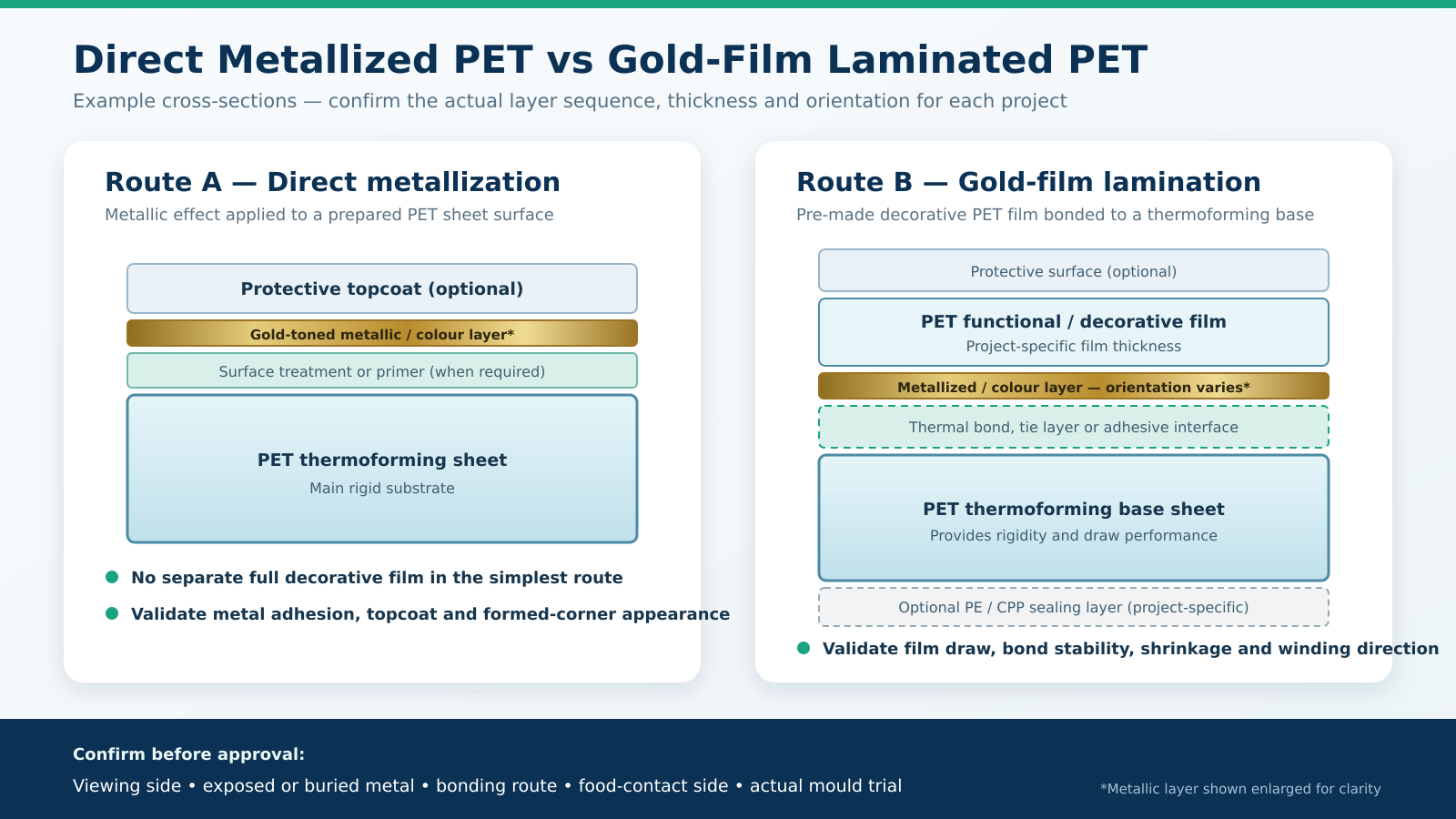
“Direct metallization” and “gold-film lamination” describe process routes, but they do not define one globally standardized layer structure. Two suppliers can use the same commercial name for products with different coatings, film thicknesses, bonding layers, surface directions or food-contact sides.
Before comparing quotations, ask each supplier to state the construction from the outside surface to the product-contact side. For example:
- Example direct route: protective lacquer or functional coating (optional) / gold-toned metallized layer / surface-treated PET sheet.
- Example laminated route: protective surface / gold metallized PET functional film / thermal-bonding or adhesive layer / PET base sheet / optional PE or CPP sealing layer.
These are examples rather than specifications. A “double-side gold appearance” also does not necessarily mean that identical metallic layers exist on both surfaces. Optical transmission, base-sheet colour and layer orientation can make a construction appear gold from both sides. Ask for the actual cross-section and identify which face will contact the mould, food, lidding film or stacking surface.
2. What Is Direct Metallized PET Sheet?
In a direct-metallized PET route, a very thin metallic layer is deposited or otherwise applied to a prepared PET surface. Vacuum metallizing commonly uses aluminium because it can provide a highly reflective metallic effect at a very low coating weight. A gold shade is normally created by the coating, lacquer, tint or optical construction; the phrase “gold PET” should not be interpreted as real gold metal.
Surface preparation matters. PET surface energy, pretreatment, coating selection, metallic-layer uniformity and protection all influence adhesion and appearance. Commercial metallized PET film manufacturers also tell converters to evaluate end-use suitability independently because processing conditions can change performance. For background on vacuum-metallized PET film and gold-coloured grades, see the Polyplex metallized-film overview.
Potential advantages
- A comparatively direct metallic-effect construction when no separate decorative film is required.
- Reduced dependence on a full-area film-to-sheet lamination interface in the simplest design.
- Strong mirror-like appearance when the metallic layer and protective coating are uniform.
Points that require validation
- Metal adhesion before and after heating.
- Scratch and rub resistance on the exposed face.
- Shade consistency across the roll and between production lots.
- Continuity of the metallic layer after thermoforming, particularly at corners.
- Suitability of coatings and surface orientation for the intended food-contact or non-food application.
3. What Is Gold-Film Laminated PET Sheet?
A gold-film laminated PET sheet combines a thermoforming base sheet with a separately manufactured gold metallized or decorative PET film. The film can be joined online during sheet extrusion/lamination or offline in a separate converting step. Depending on the system, bonding may use heat-activated layers, a tie layer or an adhesive.
The laminated route separates visual design from base-sheet manufacture. This can make it practical to offer several gold shades, silver, printed patterns, brushed effects or holographic designs using a common PET sheet platform. The decorative film may also be oriented so that the metallic layer is protected inside the laminate rather than exposed at the outer surface.
WANSYN supplies PET sheet rolls and PET functional films for project-specific structures. For online PET-to-PET applications, see films for online thermal lamination. For the main gold sheet product route, see PET gold metallic-effect sheet roll.
Potential advantages
- Broader decorative choices using pre-made functional films.
- Opportunity to bury and protect the metallic layer through correct film orientation.
- Flexible combination with clear, black or other coloured base sheets.
- Online PET/PET lamination can reduce reliance on a separate adhesive-lamination step when the film and line are compatible.
Points that require validation
- Film-to-sheet bond under heating and drawing.
- Film shrinkage, curl and winding tension.
- Wrinkles, silvering, bubbles or local lifting after forming.
- Compatibility of film coating, print, tie layer or adhesive with the intended process.
- Curing, residual odour and migration review when an adhesive route is used.
4. Why Thermoforming Changes the Gold Appearance
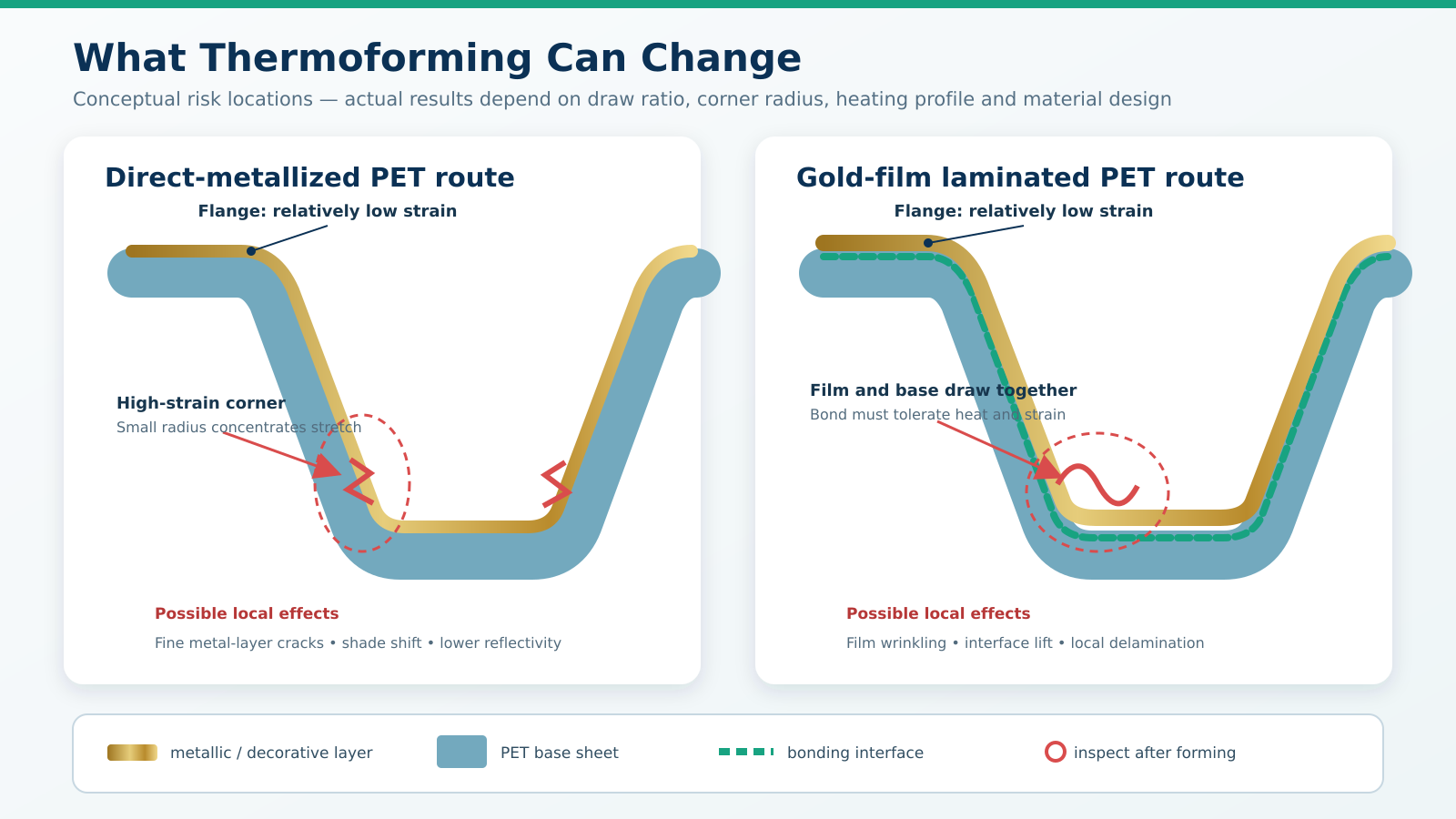
A flat-sheet sample cannot fully predict a formed tray. During thermoforming, material does not stretch uniformly. Sidewalls, bottom corners and small radii can experience much more local strain than the flange or tray bottom. The PET base becomes thinner in these zones, and the decorative system must accommodate the same deformation.
A metallic layer is much less extensible than its polymer substrate. Research on aluminium-coated PET films shows that substrate strain can produce cracks in the metal coating, while crack density and electrical or barrier behaviour depend on coating thickness and surface treatment. The practical implication is visual as well as functional: local stretching may create shade change, loss of reflectivity, fine lines or base-colour show-through. See the study on strain in aluminium-coated BOPET films.
In a laminated structure, the decorative film must draw with the thicker substrate. A well-matched film and bonding interface can form cleanly, but an incompatible combination may wrinkle, lift or delaminate. Heat history, film orientation, film thickness, base-sheet thickness, mould geometry and plug-assist conditions all influence the result.
Critical process variables
| Variable | Why it matters | What to check |
|---|---|---|
| Draw depth and area draw ratio | Higher local stretch can thin both PET and the decorative layer | Corner shade, metallic continuity and minimum wall thickness |
| Corner radius | Small radii concentrate strain | Fine cracking, whitening and exposed base colour |
| Heating profile | Uneven heating changes material flow | Colour uniformity, film shrinkage and flange flatness |
| Plug assist and mould type | Redistributes material before final forming | Sidewall thickness and surface scuffing |
| Surface orientation | Determines which face touches heaters, mould, food or stacked parts | Rub resistance, release and product-contact documentation |
| Cooling and nesting | Hot or tightly nested parts can rub decorative surfaces | Blocking, transfer marks and scratches |
There is no universal “maximum safe draw depth” for either route. A shallow tray with a tight corner may be more demanding than a deeper tray with generous radii and optimized plug assist. Approve the material using the customer’s actual mould or a representative geometry.
5. Appearance, Surface Protection and Direction Matter
Metallic colour is not adequately controlled by a simple colour name. “Champagne gold,” “yellow gold” and “rose gold” may look different under daylight, retail lighting and camera inspection. Gloss, haze, base-sheet colour and the viewing direction can change the perceived shade.
Define an approved physical sample, lighting condition and acceptable colour range. For critical projects, include instrumental colour measurement together with visual approval, but do not rely on a standard colour code alone to describe a metallic surface.
Also specify:
- Gold appearance on one side or visual appearance from both sides.
- Whether the metallic layer is exposed or buried.
- Which side faces the mould and which side faces the product.
- Winding direction and which surface is inside/outside the roll.
- Required scratch, tape, rub and stacking resistance.
- Whether printing, protective lacquer, anti-static or sealing functionality is added.
6. Online Thermal Lamination vs Offline Adhesive Lamination
Online PET-to-PET thermal lamination
For a compatible PET functional film and PET base sheet, online thermal lamination can combine sheet production and decoration without a separate solvent-based adhesive-lamination stage. WANSYN commonly evaluates functional PET films around 30 μm, but the final film specification must be selected for the line, heating window, draw geometry and appearance target.
A PET/PET structure may make edge trim easier to manage as a PET-rich production stream than a PET/PE or PET/CPP laminate. This is a manufacturing consideration, not an automatic recyclability claim. Coatings, metallic layers, inks, contamination, regrind ratio and local recycling systems still matter.
Offline adhesive lamination
Offline lamination can combine PET, CPP, PE or other functional layers and may be appropriate when a sealing surface or different substrate behaviour is needed. However, buyers should review adhesive chemistry, coat weight, curing conditions, residual odour, bond stability during heating and the relevant food-contact documentation.
For a wider structure comparison, see the PET/PE, PS/PE and PP/PE laminated sheet selection guide.
7. Metallic Appearance Does Not Automatically Mean High Barrier
An intact vacuum-metallized layer can reduce gas, aroma or moisture transmission in certain film structures. That does not mean every decorative gold PET sheet is a validated high-barrier package. Optical density, coating continuity, pinholes, surface protection and subsequent strain all influence performance. Thermoforming may create microcracks in a brittle coating, so flat-film barrier data should not be used as a guarantee for a formed tray.
If shelf life is a design requirement, define the target OTR or WVTR, test the correct finished structure under specified temperature and relative humidity, and evaluate the formed package with its lidding film and seal—not only the unformed sheet.
8. Food Contact and Compliance Must Be Evaluated by Layer and Market
A gold appearance alone does not establish food-contact suitability. Identify which surface can contact food and request documentation for that complete contact-side construction. Metallic coatings, colour coatings, printing inks, adhesives and functional layers may require different controls depending on whether they are exposed, behind a functional barrier or outside the package.
Buyers should state the destination market, intended food type, contact temperature and time, and whether the tray is used for chilled, frozen or ambient products. The required declaration or test package must correspond to the actual supplied structure, not a visually similar sample.
9. Recycling and Production Trim: Use Conditional Language
Direct-metallized PET and PET/PET laminated sheet may both be compatible with certain PET-rich production strategies, but neither should be labelled universally recyclable without a full design review. The complete package includes the base sheet, metallic layer, coatings, inks, adhesives, sealing layers, labels and lidding material.
RecyClass design-for-recycling guidance emphasizes evaluating all package components and using testing protocols when compatibility is uncertain. Refer to the current RecyClass Design for Recycling Guidelines and the requirements of the target collection and recycling system.
For internal trim, ask the converter to define whether trim can be returned to the sheet process, at what controlled ratio, and how colour, filtration, gel level and mechanical properties are monitored. “Same polymer family” is useful, but it is not the only acceptance criterion.
10. Which Gold PET Route Should You Choose?
| Project priority | Route to evaluate first | Reason |
|---|---|---|
| Simple mirror-gold surface with no separate film design | Direct-metallized PET | Can provide a direct decorative surface when coating protection and forming behaviour are proven |
| Multiple shades, patterns, holographic or printed effects | Gold-film laminated PET | Pre-made functional film offers broader visual design options |
| Metallic layer should be protected inside the structure | Laminated PET with confirmed film orientation | A buried metal layer may improve handling resistance if the laminate is correctly designed |
| Deep draw or tight corners | Trial both qualified structures | Local strain distribution, not the route name, determines performance |
| Need PE or CPP sealing functionality | Project-specific laminated structure | A separate sealing layer may be required; confirm bond and food-contact side |
| PET-rich online production and trim strategy | Compatible PET/PET thermal laminate or validated direct route | Evaluate the entire coating/film system and actual regrind practice |
Applications can include premium sushi trays, confectionery and chocolate inserts, cosmetic trays, gift-box inserts and decorative industrial packaging. The application name alone is not sufficient for selection: a shallow chocolate insert and a deep sushi tray impose different forming and stacking demands.
11. Quality-Control Checklist for Flat Sheet and Formed Parts
Incoming roll checks
- Declared layer sequence and total thickness.
- Base-sheet and decorative-film thickness where applicable.
- Roll width, core size, roll diameter, winding direction and surface orientation.
- Shade, gloss, haze and visual uniformity against an approved reference.
- Metal/coating adhesion or laminate bond strength using an agreed method.
- Scratch, rub, tape and blocking resistance.
- Surface defects, wrinkles, bubbles, gels and telescoping.
Thermoformed-part checks
- Gold shade at flange, sidewall, bottom and tight corners.
- Fine cracks, lines, whitening or base-colour show-through.
- Film lifting, bubbles, wrinkles or delamination after forming.
- Flange flatness, dimensional stability and trimming quality.
- Stacking, nesting, denesting and transport rub performance.
- Seal compatibility when PE, CPP or lidding-film functionality is part of the structure.
Retain formed approval samples, not only flat colour swatches. A useful trial report records heater settings, sheet surface direction, mould dimensions, forming cycle, plug-assist conditions and the inspected locations.
12. RFQ Information for a Reliable Gold PET Recommendation
Send the following details when requesting a gold PET thermoforming sheet:
- End application and destination market.
- Preferred route, if known: direct metallic effect, PET functional-film lamination or an open comparison.
- Physical colour sample and required gloss or pattern.
- One-side or two-side visual requirement and base colour.
- Required total thickness, width and tolerances. WANSYN PET sheet projects can be evaluated within a typical 0.15–2.0 mm range, subject to structure and line capability.
- Roll core requirement (commonly 3-inch or 6-inch), maximum roll diameter and winding direction.
- Tray opening, bottom dimensions, depth and corner radii.
- Thermoforming method, heating system, mould type and plug-assist use.
- Need for printing, protective coating, anti-static treatment or PE/CPP sealing layer.
- Food-contact side, food type, temperature/time conditions and required market documents.
- Trial quantity and estimated monthly volume.
For base-sheet options, visit PET sheet rolls for thermoforming. To discuss a mould trial or request a project review, contact WANSYN.
Frequently Asked Questions
Is gold PET sheet made with real gold?
Normally, no. Most gold metallic effects use a very thin aluminium-based metallized layer together with a tinted lacquer, coating or optical design. Confirm the actual supplier construction rather than assuming the metal type from the colour name.
Is direct-metallized PET better for deep drawing?
Not automatically. Its metallic layer may crack or lose visual continuity under local strain. A laminated film may offer a protected appearance but introduces film-draw and bond-interface requirements. The real mould geometry and heating profile decide which qualified structure performs better.
Can gold-film laminated PET show gold on both sides?
It can produce a visual gold effect from both viewing directions in some transparent or specially designed constructions. This does not prove that the same metallic layer exists on both surfaces. Confirm the layer sequence and viewing direction.
Does metallized PET provide oxygen and moisture barrier?
A continuous metallized layer can improve barrier in certain flat-film structures, but decorative gold appearance alone does not guarantee a target OTR or WVTR. Forming strain, pinholes, humidity, lidding and seal integrity must be included in package testing.
Can a PE or CPP sealing layer be added?
Yes, a project-specific PET/PE or PET/CPP structure can be evaluated when sealing functionality is required. The selected bonding route, heat resistance, seal window and food-contact documentation must match the application.
Is PET/PET gold-film laminate recyclable?
A PET/PET construction may support a PET-rich material strategy, but recyclability depends on the complete design, coatings, metal, inks, adhesives, labels, lidding and local infrastructure. Use market-specific design guidance and testing rather than a blanket claim.
What is the best way to approve a gold PET sheet?
Approve a documented cross-section, flat-sheet properties and formed samples from the intended mould. Inspect colour at high-strain zones, adhesion, rub resistance, nesting and any sealing function under actual production conditions.