
PE/EVOH/PE Film for Online Thermal Lamination to PP Sheet
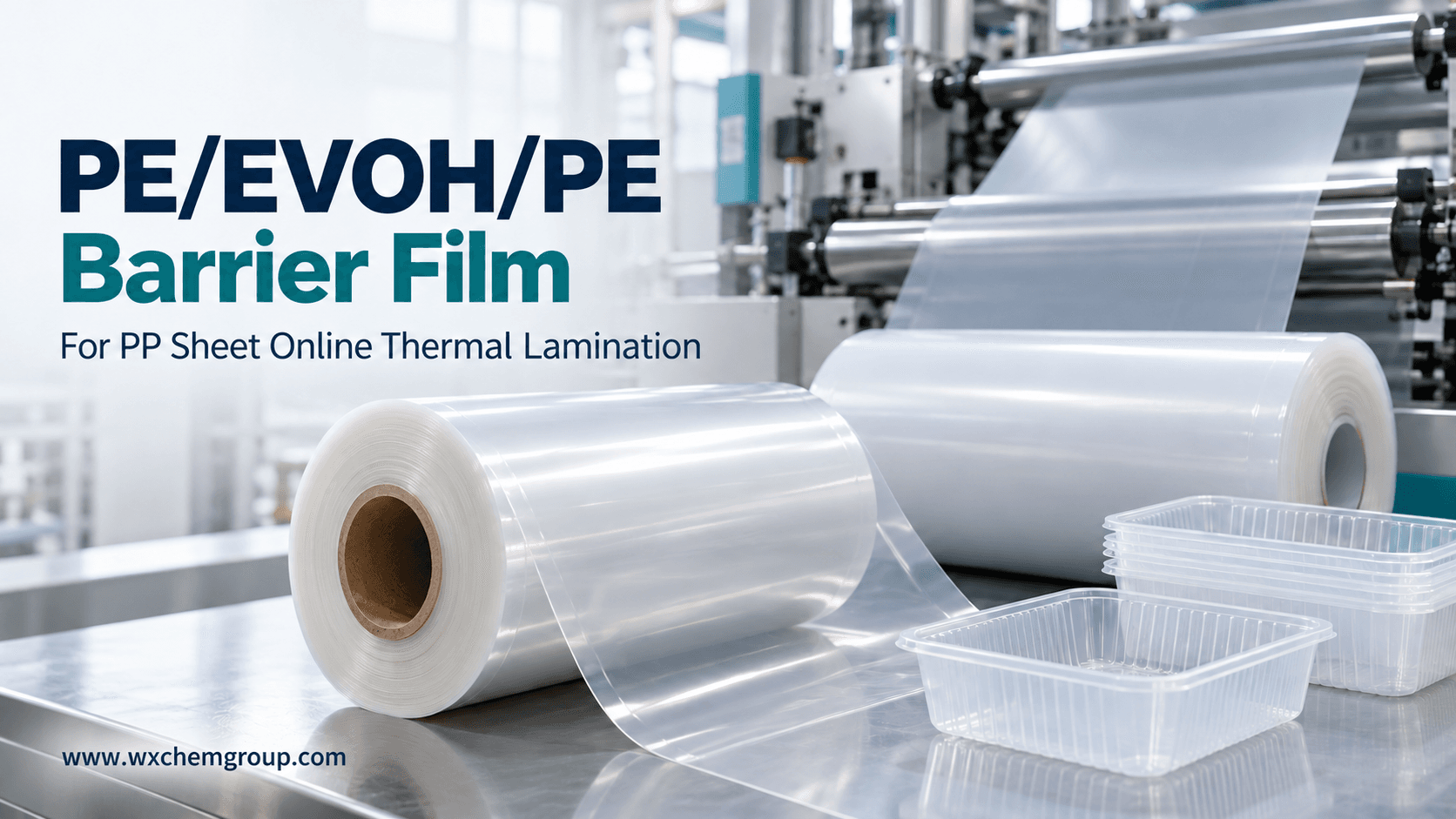
PE/EVOH/PE barrier film for PP sheet lamination gives polypropylene sheet producers a route to adding an oxygen-barrier function during sheet production. WANSYN offers dedicated film options for online thermal lamination to PP sheet, alongside separately matched options for PET sheet lines.
The first selection question is the substrate: will the film run on a PP line or a PET line? The same PE/EVOH/PE description does not mean that one film grade is approved for both.
Quick answer
A PP-compatible PE/EVOH/PE film is designed with a bonding face matched to the proposed PP substrate and thermal lamination route. On a suitably equipped line, it combines the PP structural sheet with an EVOH-containing functional film. The selected grade must then be qualified for lamination, winding, thermoforming and the intended package conditions.
1. What is PE/EVOH/PE film for online thermal lamination to PP sheet?
This product is a premanufactured barrier film supplied in rolls to a PP sheet producer. The film feeds into a thermal lamination station integrated with the sheet line, where the designated bonding face meets the PP substrate under controlled conditions.
The resulting material combines a PP base with an EVOH-containing film and an exposed PE-based functional surface. A simplified description is PP/PE/EVOH/PE sheet. This is commercial shorthand: the actual construction may include functional bonding or tie layers that must be identified when relevant to the specification.
PE/EVOH/PE film for online thermal lamination to PP sheet is a different purchasing scope from finished sheet rolls. A film buyer needs to qualify the material on its own lamination line; a thermoformer purchasing finished sheet needs the approved laminate and its conversion requirements.
2. Dedicated grades for PP lines and PET lines
The barrier-film family can include grades for different substrates. The EVOH-containing construction describes a barrier function, while the bonding face and process window determine how the film is joined to a particular sheet.
| Selection point | PP-line film option | PET-line film option |
|---|---|---|
| Structural substrate | The specified polypropylene sheet | The specified PET-based sheet |
| Bonding interface | Designed and qualified against the proposed PP surface | Designed and qualified against the proposed PET surface |
| Process proposal | Matched to the PP line's heat, nip, cooling and web control | Matched to the PET line's heat, nip, cooling and web control |
| Downstream approval | The actual PP-based laminate, tool and application | The actual PET-based laminate, tool and application |
| Grade substitution | Requires review before changing substrate or route | Requires review before changing substrate or route |
A shared film name or nominal thickness is not evidence of interchangeability. Identify the intended substrate and approved grade on the quotation, trial record and purchase order. For the other substrate family, see WANSYN's PE/EVOH/PE online lamination guide for PET sheet.
3. How does the PP sheet online lamination process work?
- Produce the PP base sheet. Establish the specified resin grade, sheet thickness, width and surface condition.
- Introduce the barrier film. Unwind the PP-compatible grade with the designated bonding face toward the sheet.
- Thermally laminate. Apply the qualified heat and nip conditions while controlling line speed and film tension.
- Cool and wind. Meet the agreed flatness, bonding, surface and roll-build requirements.
- Thermoform and verify. Evaluate the laminate in the intended tray geometry and conditioning sequence.
This route uses a preformed film. It is distinct from feeding EVOH and other resins through a multilayer sheet coextrusion system. It is also distinct from producing PP sheet first and transferring it to a separate dry adhesive lamination operation.
A PP sheet extrusion line needs a compatible lamination station and appropriate film handling. An existing PP extruder alone does not establish readiness for the process. Review the station layout and equipment limits before selecting a trial film.
4. Why add an EVOH barrier film to PP sheet?
The purpose is to combine a structural PP substrate with a defined oxygen-barrier function. EVOH barrier film can support development of high-barrier PP thermoforming sheet for oxygen-sensitive food-packaging projects.
- Broaden the sheet portfolio. PP sheet producers can evaluate barrier-laminated constructions alongside their existing grades.
- Integrate barrier-film application. Lamination takes place within the qualified sheet-production flow.
- Reduce intermediate handling where applicable. A successful integrated route may avoid transferring the sheet to a separate lamination operation.
- Match barrier and surface requirements. Specify the EVOH-containing film and exposed PE-based surface together for the project.
These are production and development opportunities, not fixed savings. Compare actual accepted output, startup scrap, changeovers, speed and quality costs when assessing commercial value.
The addition of EVOH does not establish a shelf-life duration. Product characteristics, atmosphere, package integrity, temperature and distribution conditions also matter.
5. Define the PP substrate and bonding face
A useful specification identifies more than “PP sheet.” Record whether the substrate uses a homopolymer or copolymer grade, and declare relevant pigments, fillers, recycled-content construction, treatments, coatings or surface additives. Provide an accepted current sample where the surface history is uncertain.
The PP bonding face of the film must be matched to that substrate. The opposite surface has its own declared function. Use the same face names on the film roll, unwind drawing and production record so that the approved orientation reaches the formed part.
Review the available heat at the lamination station, nip arrangement, pressure uniformity, film tension, speed, cooling and winding. Grade-dependent PP forming and cooling behaviour is another reason to test the actual substrate rather than transfer settings from a PET line.
A heater or roller setting is not automatically the buried interface temperature. No universal PP lamination temperature, pressure or speed is specified here.
6. Specify barrier performance beyond EVOH percentage
An EVOH percentage is incomplete without its basis. Ask whether it refers to mass within the input film, the complete laminated sheet or another defined scope. A layer-thickness share is not automatically the same as a mass share.
A barrier specification should identify:
- the film grade and declared construction;
- the relevant EVOH layer design or content basis;
- oxygen transmission rate (OTR), units and test method;
- test temperature, humidity and gas-pressure basis;
- whether the specimen is film, flat sheet, a formed tray or a complete package;
- conditioning and acceptance criteria.
EVOH performance depends on moisture exposure as well as grade and structure. Protective layers help manage exposure but do not make the barrier result independent of humidity. Where water-vapour transmission rate (WVTR) is important, specify it separately from OTR.
ASTM D3985-24 provides an oxygen-transmission method for film and sheeting, including laminates. A suitable laboratory method and measurement range should be selected for the required specimen. A flat-film result is not a direct measurement of a finished tray or sealed package.
7. Check the barrier after PP thermoforming
PP barrier sheet thermoforming redistributes material over the part. A good average gauge can hide a thinner corner or sidewall. The EVOH-containing layer must remain suitable in the formed zones that determine the package's barrier path.
Record the actual part drawing, forming process and repeatable thickness-measurement positions. Compare retained input film, flat laminate and formed parts under one sample identity. Examine adhesion, local thinning, surface damage, flange flatness and edge condition.
Research on mono- and multilayer thermoformed trays, including PP/EVOH/PP constructions, shows why thickness distribution and geometry must be considered when interpreting OTR after forming. That research is process background, not a performance certificate for a WANSYN film or a different laminate.
Use the draw-depth and barrier-layer-thinning guide for geometry considerations. For critical applications, agree formed-tray or finished-package testing in addition to incoming flat-sheet controls.
8. Applications and a practical qualification plan
Candidate projects include PP MAP tray material for meat, seafood, cheese, deli foods and prepared-food packaging where the specification calls for oxygen-barrier performance. The proposed construction should be reviewed against the food, package design and actual conditions of use.
A PP structural base does not automatically qualify the complete laminate for microwave heating, hot filling, retort or freezing. Specify any such conditions and validate the finished system. Food-contact documentation should match the grade, full construction, target market and contact conditions.
For a controlled production trial:
- Freeze the material identity. Record PP sheet and barrier-film grades, lots, dimensions, faces and roll format.
- Approve a line-specific trial matrix. Document the equipment layout and conditions to vary within approved limits.
- Inspect the flat laminate. Assess bond consistency, wrinkles, trapped air, curl, blocking and winding.
- Form the intended part. Map local thickness and inspect critical corners, sidewalls, flange and trimmed edges.
- Test the defined specimens. Measure barrier and other required properties under agreed conditions.
- Condition and release. Recheck after the specified storage or distribution sequence and retain the approved record.
For lamination bond strength, agree specimen preparation, geometry, width, speed, conditioning and failure-interface reporting. ASTM F904-22 concerns separating plies of flexible laminates to enable bond measurement; it does not alone define a complete test protocol for the semi-rigid PP sheet construction.
9. RFQ checklist for PP-line barrier film
When requesting PE/EVOH/PE film for a PP production line, identify PP as the substrate in the first line of the enquiry. Provide:
- Supply scope: barrier film for your own inline thermal lamination operation, or finished laminated sheet.
- PP substrate: grade or sample, construction, thickness, width and relevant surface details.
- Film: target thickness and tolerance, width, functional faces and any current material reference.
- Line: model, lamination-station sketch, heat/nip/cooling arrangement, tension control and intended speed range.
- Roll format: core ID, maximum OD, mass or length, unwind drawing and splice requirements.
- Thermoforming: tray drawing, depth, radii, flange and critical acceptance points.
- Barrier target: OTR/WVTR, units, methods, temperature, humidity, specimen and conditioning basis.
- End use: packed product, filling, storage and distribution conditions, destination market and required documents.
- Commercial plan: trial quantity, forecast consumption and delivery destination.
The general thermoforming sheet RFQ checklist provides a broader purchasing reference. The substrate and online film grade remain specific to this PP project.
WANSYN barrier-film options for PP and PET lines
WANSYN supplies PE/EVOH/PE barrier-film options for online thermal lamination to PP sheet and separate options matched to PET sheet production. Tell us which substrate and line you operate so that the appropriate grade and trial requirements can be reviewed.
For film enquiries, contact WANSYN or email info@wxchemgroup.com. For finished PP-based sheet enquiries, start with the PP sheet roll category.
Frequently asked questions
Can PE/EVOH/PE barrier film be online thermally laminated to PP sheet?
Yes, a dedicated PP-compatible grade can be supplied for evaluation on a suitable line. Match the bonding face, PP substrate and process, then qualify the laminated and formed material.
Can the PET-line grade be used on a PP line?
Do not treat the grades as interchangeable. Obtain confirmation for the proposed substrate and equipment before substituting a film qualified on another line.
What is the finished sheet structure?
A simplified description is PP/PE/EVOH/PE. The full declaration should identify any functional bonding or tie layers. It is not automatically the same construction as coextruded PP/EVOH/PP.
Does any PP sheet production line support this process?
No. Review whether the line has a compatible film-lamination station, heat and nip control, tension management, cooling and winding capability.
Does a higher EVOH percentage guarantee better final barrier?
No. Content basis, grade, layer design, humidity, forming distribution and test conditions affect the result. Specify the required performance of the defined specimen.
Should barrier be checked after thermoforming?
For a performance-critical package, agree formed-tray or finished-package verification. Forming changes geometry and local thickness, so incoming flat-film data alone is insufficient.
Is this automatically a microwaveable or retort-grade construction?
No. Any thermal processing or heating application requires approval of the complete construction under the actual conditions. PP as the base polymer is not sufficient evidence.
What should I send for a PP-line film quotation?
Send the PP substrate, film dimensions, line sketch, roll format, tray application, barrier target with test conditions, required documentation and expected quantity.
Technical reference
Buntinx et al., Polymers (2014): research on thickness distribution and oxygen transmission before and after thermoforming selected mono- and multilayer sheets. Its results do not establish specifications for the film proposed here.