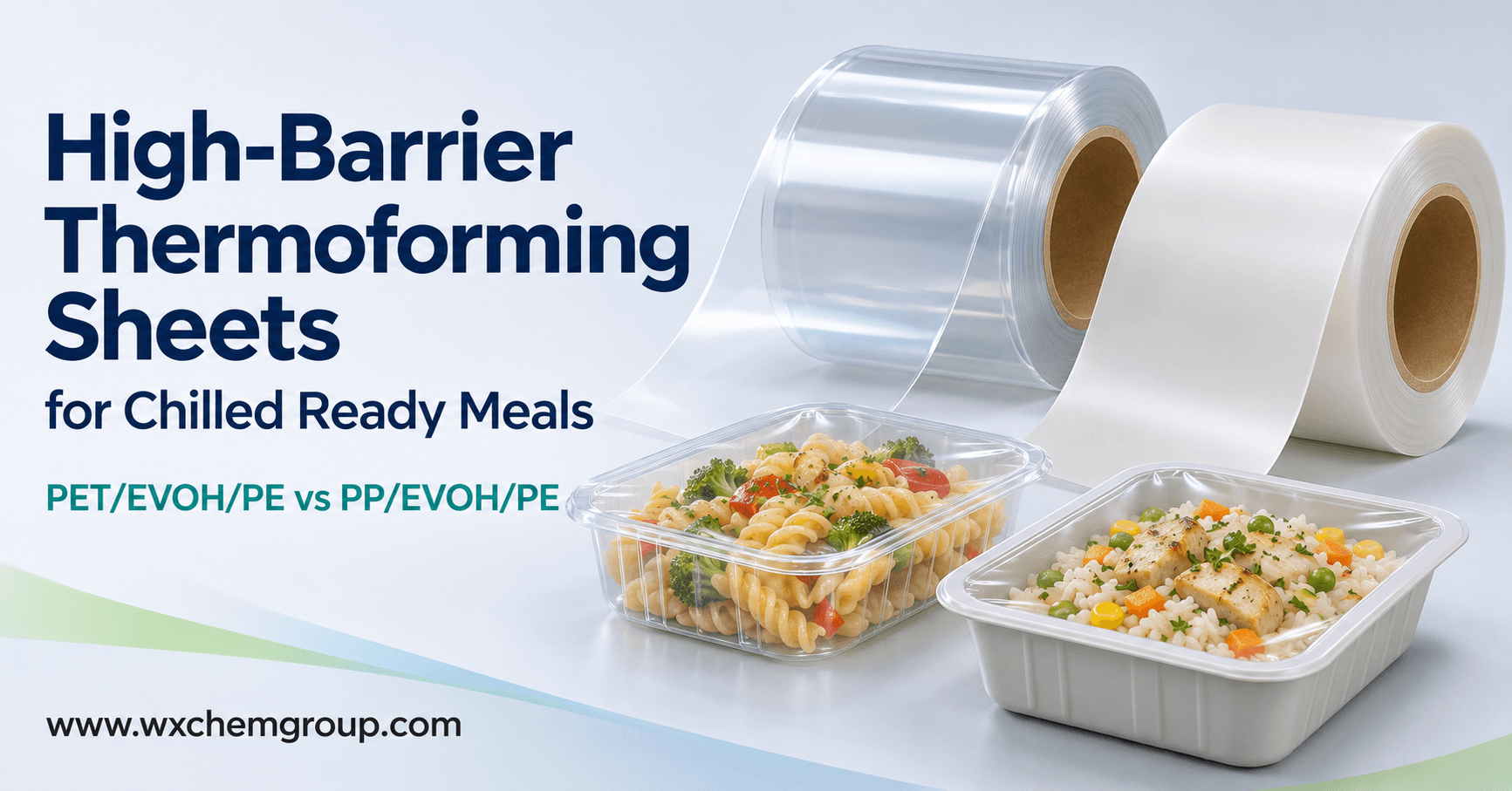

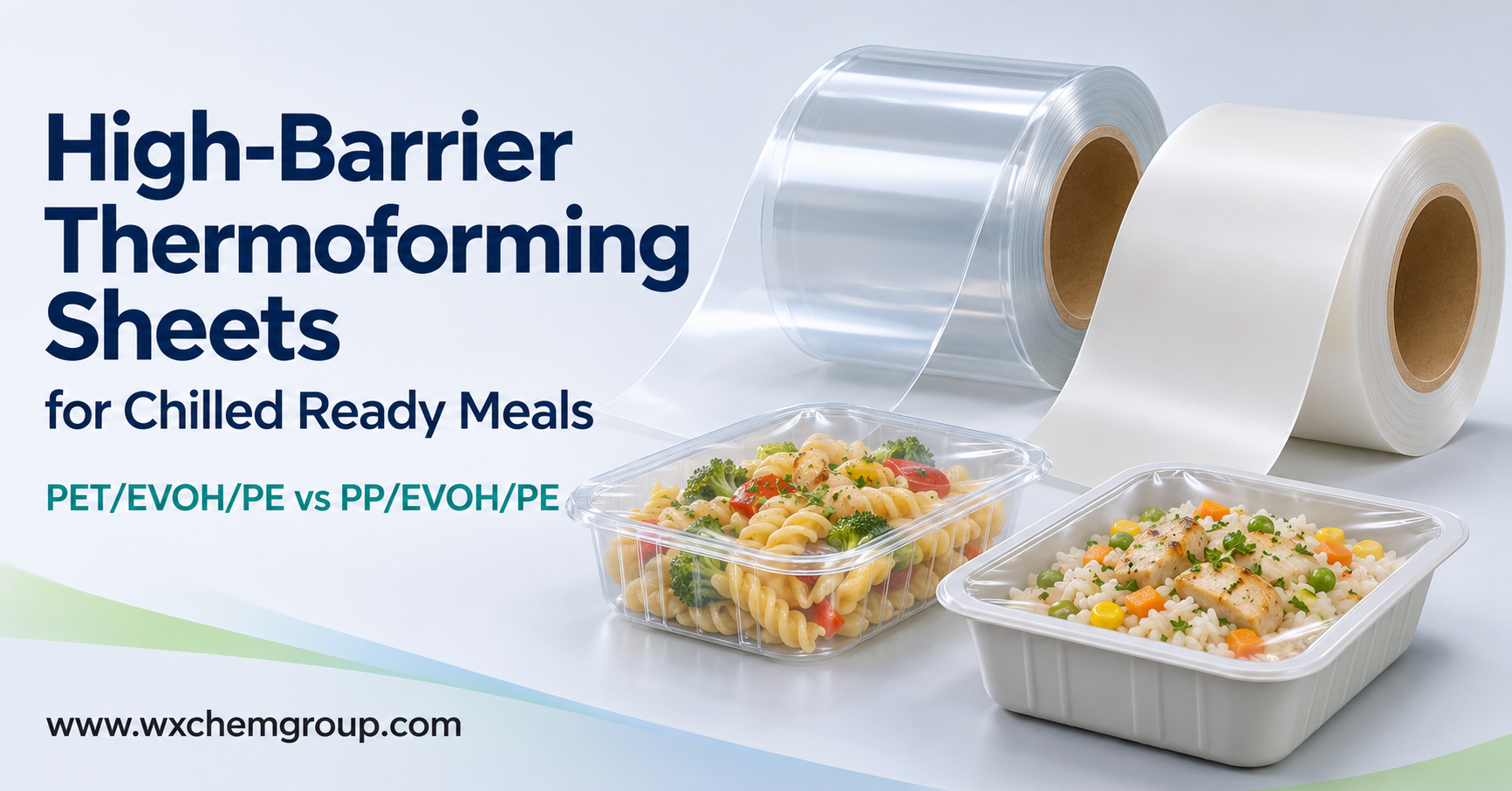
High-barrier thermoforming sheets for chilled ready meals form the bottom trays of sealed food packs. Choose the sheet by working backwards from the finished pack: the food and its storage conditions, the tray geometry, the lidding film and any reheating instructions. PET/EVOH/PE is a candidate for a clear, PE-sealable tray. PP/EVOH/PE is a candidate when a PP-based tray suits the application and the design still calls for a PE seal face. For either structure, test the formed, sealed pack under its intended conditions.
A chilled pasta meal sold in a clear tray and a chilled rice meal reheated in its tray can require different sheet and lid combinations. Start with what the consumer will do with the pack. Then decide how much oxygen protection the food needs, how the lid should open and what the tray must withstand.
PET/EVOH/PE vs PP/EVOH/PE: which sheet should you trial?
The names below identify the main functional layers. A production specification may include additional bonding layers or sublayers. Ask for the full structure and identify the side that faces the food and lid.
| Buyer question | PET/EVOH/PE | PP/EVOH/PE |
|---|---|---|
| When should I shortlist it? | When tray clarity and rigidity matter for chilled retail display, the line is set up for PET, and the pack calls for a PE seal face. | When a PP-based tray suits the tool, handling or intended use, and you still need a PE sealing surface. |
| What does EVOH do? | It provides an oxygen barrier. Confirm the performance of the exact sheet and formed tray. | It serves the same function. The name alone does not show which finished tray admits less oxygen. |
| What lid should I trial? | A barrier lidding grade, if required, specified for the actual PE seal surface and desired opening mode. | Match the lid to the exposed PE seal surface where specified. A lid intended only for direct sealing to PP may not be suitable. |
| What if the consumer reheats the food? | Start with chilled use. Confirm the exact tray, lid and heating instructions before making any reheat claim. | Qualify the entire laminate, including its PE layer, and the lid if it remains on. A PP base by itself does not establish microwave or oven suitability. |
For a clear high-barrier food tray, start with the PET/EVOH/PE high-barrier thermoforming sheet product specification. If your machine is configured for PP, share the tray drawing and intended use so the PP-based option can be assessed against the same pack requirements.
Specify oxygen protection for the formed tray and sealed pack
Ask for the oxygen transmission rate (OTR) of the offered flat sheet, including the test method, temperature, relative humidity and units. A lower flat-sheet OTR can be useful for screening, but do not compare results reported under different conditions as if they were equivalent. If moisture transfer matters, specify water vapour transmission rate (WVTR) separately.
Thermoforming stretches the sheet unevenly. Corners and sidewalls can be thinner than the starting sheet, so a flat-sheet figure alone does not describe the formed tray. Compare the same tray geometry and clearly distinguish area-normalised film values from whole-tray or whole-pack results. See how draw depth affects barrier-layer thinning for guidance on what to measure.
For modified atmosphere packaging (MAP) ready meal trays, also check lid barrier, residual oxygen after packing and seal integrity. A leaking seal can undermine a high-barrier tray. Validate shelf life with the actual food, lid, gas mix, fill process and cold chain. Oxygen barrier is only one input to the product's shelf-life and food-safety validation.
Match the lid to the tray’s sealing face
For lidding film for PE-sealable trays, give the supplier the exposed seal-face material, the desired opening behaviour and the intended storage conditions. Easy peel and permanent seal need different acceptance criteria. Anti-fog is a separate requirement if condensation limits visibility.
Use production-formed trays to evaluate the sealing window at the target line speed. Record temperature, pressure and dwell time. Check the flange for distortion or food contamination and agree how to measure peel force, opening behaviour and package leaks. A good peel result does not prove the absence of leaks. Recheck filled packs after the intended storage cycle.
Define chilled storage and reheating separately
A tray approved for chilled storage is qualified only for the conditions in that approval. If the pack will be reheated, state whether the lid is peeled off, vented or left in place. Give the intended heating method, rated power or temperature, time, fill weight and food type. Test a representative filled pack, since an empty tray cannot reproduce the heating conditions of the meal.
Check tray shape and handling after heating, laminate integrity and opening or venting behaviour where applicable. Request food-contact documentation for the selected construction and intended conditions. For hot-fill, in-pack pasteurisation or retort, specify the exact process separately. Do not assume that a sheet described as high barrier for chilled meals is suitable for those uses.
What to send for a laminated sheet trial quotation
- Food and use: meal type, fill weight, fill temperature, storage temperature and shelf-life target. Add the reheating or processing instructions, if applicable.
- Tray and roll: drawing, depth, corner radius, flange dimensions, sheet thickness and width, core size, maximum roll diameter and winding direction.
- Seal and barrier: current lidding grade, sealing face, easy-peel or permanent seal target, MAP conditions if applicable, and any measured OTR/WVTR with test conditions.
- Trial and approval: machine configuration, target line speed, trial quantity, expected regular volume, acceptance tests and destination market.
Use WANSYN’s thermoforming sheet roll RFQ checklist for the complete roll specification. To discuss a trial, send WANSYN your tray drawing and current tray-and-lid specification or email info@wxchemgroup.com. Tell us whether the meal is sold chilled only or reheated in the tray.
Frequently asked questions
Does every chilled ready meal need an EVOH barrier tray?
No. The required oxygen barrier depends on the meal, process, headspace, pack and intended shelf life. Use finished-pack testing to decide whether an EVOH structure is justified.
Does a PP/EVOH/PE tray seal to the same lid as a PP tray?
Only if the lid is compatible with the actual sealing surface. On a PP/EVOH/PE tray with exposed PE at the flange, test a PE-compatible grade on the actual formed tray.
Can I approve the tray using only a flat-sheet OTR report?
Use the report for screening. Approval should also consider the formed tray, the lid and the seal, and the finished pack’s performance under the intended storage conditions.
Is PP/EVOH/PE suitable for microwave reheating?
Suitability must be verified for the named laminate, lidding system, food and instructions. The presence of PP or EVOH alone does not establish microwave suitability.