
Quick answer
Choosing a liquid methyl tin stabilizer for rigid PVC sheet requires a balance of initial color, clarity and processing heat stability. Selection should be based on the complete formulation and production route, followed by a controlled trial. Compare yellowness, haze, light transmittance, processing behavior and the appearance of any thermoformed part. A clear first sheet alone does not establish that the stabilizer is suitable for a sustained production run.
This guide focuses on rigid clear sheet made by extrusion or calendering, including sheet subsequently converted into transparent covers, folding packaging or thermoformed components. It does not treat soft, plasticized clear film as the same formulation, and it does not establish approval for food-contact or pharmaceutical applications.
Why evaluate liquid methyl tin for rigid transparent PVC sheet?
WANSYN's liquid methyl tin series is positioned for rigid transparent PVC applications. Buyers considering this chemistry usually want a combination of acceptable initial color and resistance to discoloration during processing. However, the result belongs to the entire PVC formulation: the stabilizer must work with the resin, lubricants, processing aid, impact modifier and other ingredients.
“Liquid” describes physical form; it does not identify every aspect of the stabilizer chemistry. Commercial descriptions may also use “methyltin” or, for relevant products, “methyl tin mercaptide.” Confirm the exact grade and chemistry in supplier documentation rather than assuming every organotin stabilizer is interchangeable.
RS-181: a liquid methyl tin candidate for clear rigid sheet
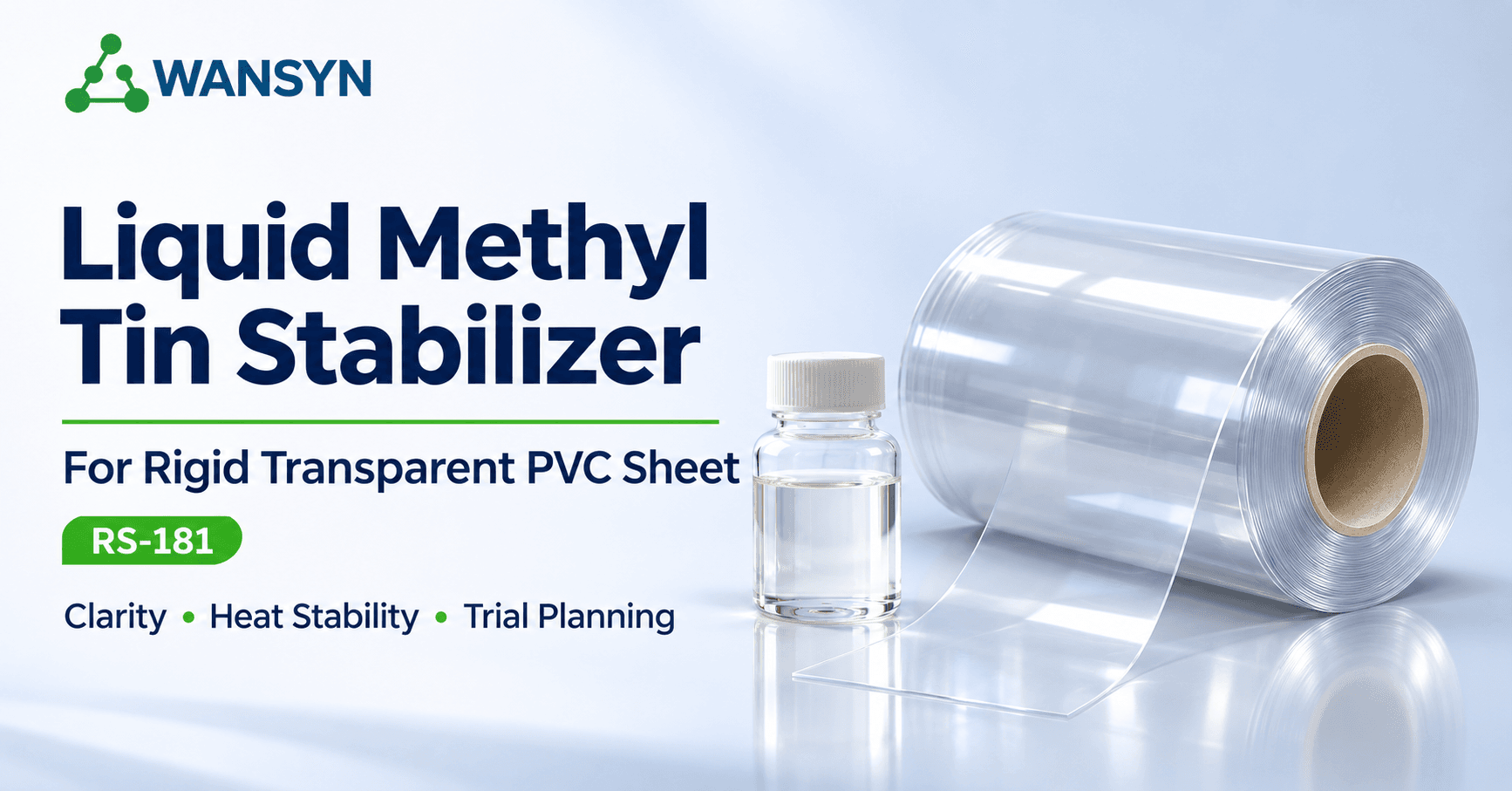
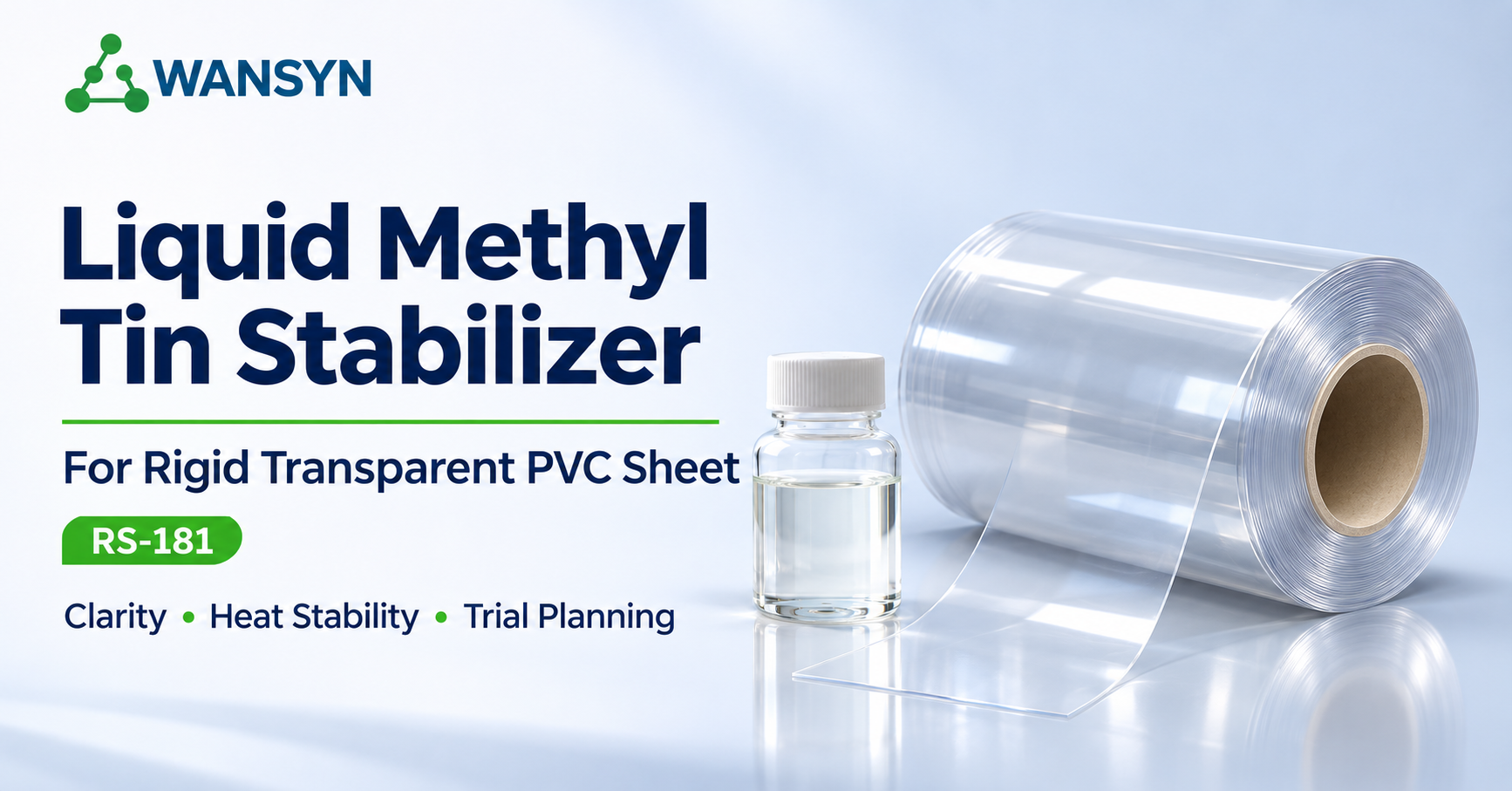
WANSYN lists RS-181 liquid methyl tin PVC heat stabilizer as a transparent liquid for applications including clear films and sheets. RS-181 can therefore be discussed as a candidate for rigid transparent PVC sheet. Confirm its current TDS, SDS and batch COA, then validate the dosage, lubrication balance, optical properties and processing behavior in your formulation. Product-page positioning does not replace a line trial or establish application-specific regulatory approval.
Define what “clear PVC sheet” means for your customer
Before comparing samples, write down the sheet thickness, surface finish, target color and end use. A thin, smooth sample viewed against a white background is not an adequate reference for a thicker sheet or a formed component.
Use separate acceptance criteria for the following properties:
- Initial color: the appearance of the sheet under agreed viewing and measurement conditions.
- Haze: light scattering that gives an otherwise transparent sheet a cloudy appearance.
- Luminous transmittance: the amount of visible light transmitted under the specified method.
- Surface quality: streaks, roll marks, deposits, scratches and visible inclusions.
- Converted-part quality: color, clarity and any whitening or defects after the actual downstream process.
Do not combine these into one informal “transparency score.” A sample can have an acceptable tint but unacceptable haze. A visually neutral color also does not prove that the material has enough processing stability.
Match the stabilizer trial to extrusion or calendering
Extruded rigid clear sheet
Record the resin and additive batches, mixing procedure, screw speed, throughput, temperature profile, measured melt temperature where available, melt pressure and die condition. Take samples at defined positions across the sheet width and at defined times during the run.
If pressure, color or surface defects change with production time, retain that sequence. A sample taken immediately after a clean start cannot represent the whole run. Diagnose local streaks or black specks separately from uniform yellowing.
Calendered rigid transparent sheet
Record the mixing and pre-plasticizing route, roll conditions, line speed, sheet gauge, release behavior and any deposit development. Keep these records alongside the optical results so that changes in appearance can be compared with changes in process conditions.
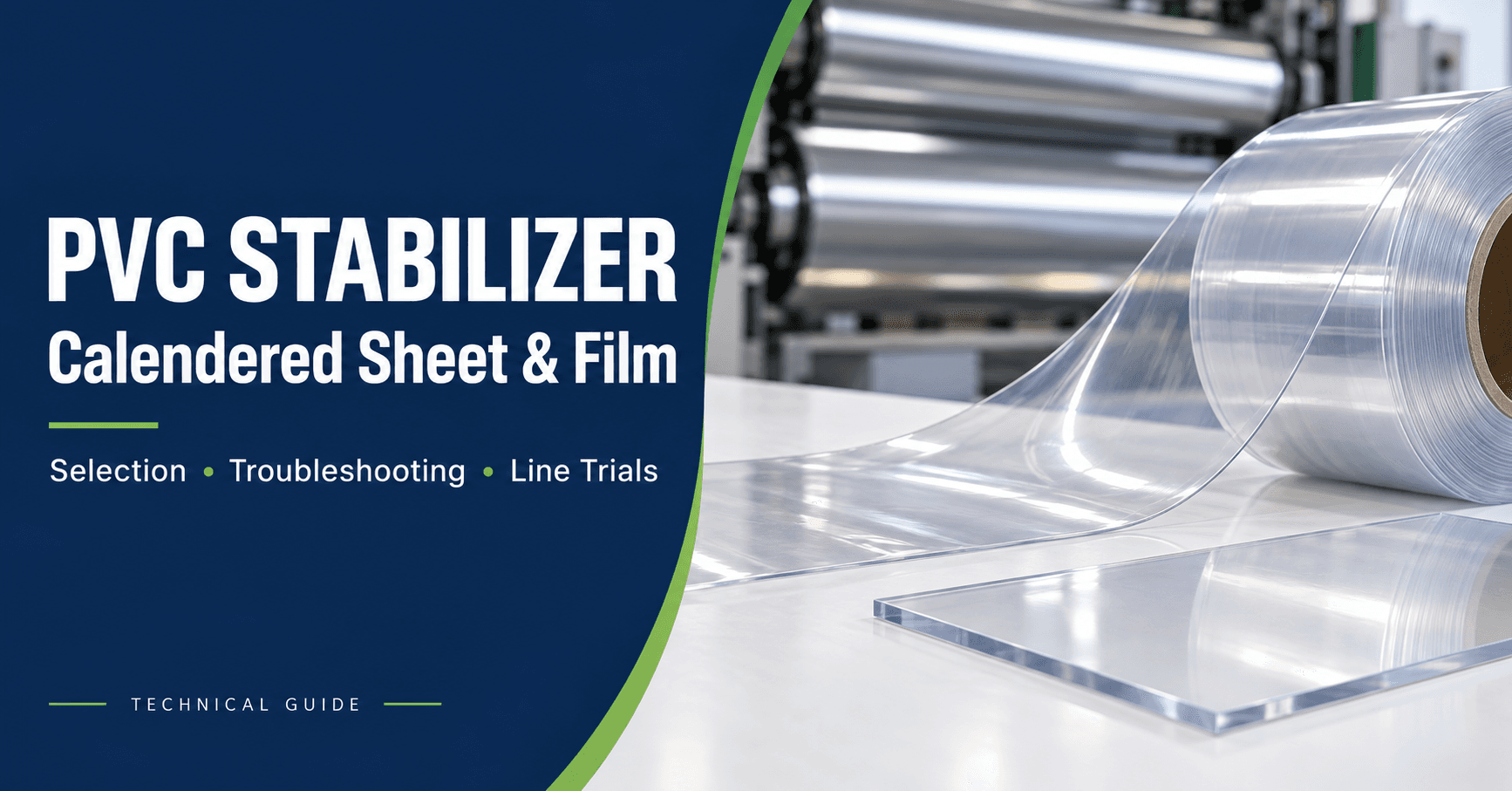
For broader chemistry and application selection, see our PVC stabilizer guide for calendered sheet and film. The trial described here is more narrowly focused on qualifying a liquid methyl tin system for rigid transparent sheet.
Review lubrication and dosage together
Do not assume that a liquid methyl tin stabilizer supplies a complete lubrication package. Confirm what the proposed grade contains and review the existing internal and external lubricants with the supplier. When replacing a different stabilizer system, the same lubricant recipe may need reassessment.
Changes in lubricant type or level should be documented separately from changes in stabilizer dosage. Otherwise, an improvement in sheet appearance may be attributed to the wrong ingredient. First compare agreed candidate formulations; then optimize selected variables in a second stage.
Specify the methyl tin stabilizer dosage basis
When dosage is expressed in phr, it means parts by mass per 100 parts of PVC resin. It is not automatically a percentage of the total compound. Record the resin mass, stabilizer mass and every other ingredient so the trial can be reproduced.
For formulations containing regrind, state whether the reported resin basis includes the PVC within that regrind and how that amount was determined. Regrind may already contain stabilizer and other additives. If its composition is unknown, disclose the limitation rather than presenting an uncertain resin-based dosage as exact.
No fixed addition rate is recommended here. Agree a starting range from the grade-specific information and full formulation, then validate it against both optical and processing requirements. Comparing products only by nominal tin content or price per kilogram does not replace that evaluation.
Use separate tests for optical quality and heat stability
Haze and light transmittance
ASTM D1003 provides methods for measuring haze and luminous transmittance of transparent plastics. For a useful comparison, identify the procedure, specimen thickness, preparation and conditioning. Keep surface condition and sampling position consistent. Results obtained on different gauges should not be treated as a direct stabilizer comparison.
Yellowness and color change
ASTM E313 addresses calculation of yellowness and whiteness indices from instrumentally measured color coordinates. Agree the appropriate measurement conditions with the laboratory. Report the method and settings along with the result, and compare like-for-like specimens rather than relying on photographs alone.
Oven discoloration
ASTM D2115 concerns comparative heat-related discoloration of PVC compositions under controlled oven conditions. Specimen thickness and previous heat exposure matter. The practice does not establish absolute thermal stability, and resistance to color change alone is not proof that other properties remain acceptable. It is not intended as a purchasing specification.
Acid evolution and processing behavior
If the trial includes the ISO 182-1 Congo red method, treat its acidic-product evolution endpoint separately from the color of the PVC specimen. The method is not recommended for dry blends. Do not label a Congo red result as an oven color-retention result.
A torque-rheometer study or recorded production run can add information about behavior under shear. It addresses a different question from a static oven exposure. Use an agreed protocol and compare the findings with the actual line; no single laboratory endpoint proves the full production window.
Troubleshoot yellowing, haze and deposits as different problems
The checks below are starting hypotheses, not diagnoses. Keep an approved reference formulation and change one planned variable at a time where practical.
PVC sheet yellowing from the first stable-production sample
Check dosing accuracy, mixing records, resin and regrind consistency, actual heat history and the candidate stabilizer formulation. Compare retained raw materials and sheet samples before deciding that more stabilizer is the answer.
Acceptable startup color followed by deterioration
Compare the time sequence with temperature, throughput, pressure and equipment observations. Investigate the available stabilization margin together with possible hold-up or locally overheated material. Record approved restart conditions if restart behavior is part of qualification.
PVC sheet haze with little change in yellow tint
Separate surface haze from internal haze. Examine surface marks, contamination, fusion behavior and additive compatibility. Review any changes in lubricants, processing aids or impact modifiers. Increasing methyl tin alone is not a reliable general remedy for PVC sheet haze.
Roll deposits, die buildup or streaks
Record where the deposit appears and how long it takes to develop. Retain deposit samples for examination where feasible. Review lubrication, material compatibility, mixing and operating conditions as well as stabilizer choice. A good oven-color result does not establish deposit-free production.
Check the sheet again after thermoforming
If the customer thermoforms the sheet, qualify the finished part as well as the flat sheet. Record the sheet lot, heating conditions, forming cycle and inspection locations. Compare equivalent areas of the part because drawn regions can have different thicknesses.
Distinguish thermal discoloration from stress whitening, surface defects and thickness-related optical differences. A change after forming does not automatically identify the stabilizer as the cause. Include the customer's relevant mechanical and dimensional requirements in the final approval.
The same principle applies to printing, folding or lamination: an optical pass on unconverted sheet does not establish performance in the next operation. Review each operation that matters to the supplied product.
A practical qualification sequence
- Define the target. Specify sheet gauge, optical limits, surface criteria, production route, downstream operations and required documents.
- Establish the baseline. Retain the current recipe, material lots, process records and representative approved samples.
- Screen candidate formulations. Use a documented mixing and specimen-preparation procedure, then assess color, optics and comparative heat response.
- Run the line comparison. Use comparable conditions and a duration suited to the production cycle and observed defect timing. Record both acceptable output and rejects.
- Validate conversion. Test thermoforming or other specified operations using traceable samples.
- Confirm repeatability. Repeat the successful conditions with representative batches before expanding approval beyond the trial conditions.
For purchasing decisions, compare the cost per accepted quantity of sheet, including additive consumption, rejects and relevant cleaning or downtime. State the accounting basis clearly; an apparent saving in stabilizer price may not produce a lower manufacturing cost.
Request the right supplier documents
Ask for a current TDS, SDS and sample-batch COA for the proposed liquid methyl tin grade. Confirm the product identity, controlled properties, test methods, storage instructions, batch traceability and how specification changes are communicated. Use the SDS for handling requirements.
For regulated packaging, specify the destination market, final article and conditions of use. Request evidence matched to that application and have it reviewed by the responsible compliance team. “Lead-free,” “organotin” or an acceptable optical test result does not by itself establish suitability for food-contact or pharmaceutical use.
Our PVC stabilizer documentation guide explains how to organize this review. This article makes no grade-specific regulatory approval claim.
Frequently asked questions
Is liquid methyl tin suitable for every transparent PVC product?
No. Rigid clear sheet is one application to evaluate. Flexible film, semi-rigid sheet and other transparent products have different formulation requirements. Select the exact grade against the intended formulation and processing route.
Will a higher stabilizer dosage always improve clarity?
No. Clarity also depends on the resin, additive package, processing and surface condition. Investigate the source of haze or discoloration before changing dosage, then test any adjustment against the full acceptance criteria.
Can liquid methyl tin replace a Ca-Zn system at the same dosage?
Do not assume a one-for-one substitution. The stabilizing and lubricating contributions of the existing package must be understood. Treat the change as a formulation trial with its own dosage basis and process review.
Does an oven test prove thermoforming performance?
No. Oven discoloration provides comparative information under its defined conditions. Thermoforming adds a specific heating and deformation history, so the actual formed part needs separate evaluation.
Is the highest tin-content product necessarily the best choice?
No. Tin content is one product characteristic. Grade chemistry, consistency, formulation compatibility and performance at the validated dosage also matter. Compare traceable products in the same application.
What should I send when requesting a stabilizer recommendation?
Send the sheet specification, resin and additive information, current stabilizer and dosage basis, production route, main defect, downstream process and target market. Photos are useful, but traceable samples and process records make the comparison more informative.
Discuss your rigid transparent PVC sheet project with WANSYN
To request a liquid methyl tin stabilizer review, share:
- Sheet thickness, intended use and agreed clarity or color requirements.
- Resin grade, regrind content and the relevant additive package.
- Current stabilizer identity, dosage and calculation basis.
- Extrusion or calendering conditions and any downstream thermoforming.
- The defect pattern, when it appears and available comparative test results.
- Destination market and required technical or application-specific documents.
Contact WANSYN to discuss the grade shortlist and trial requirements. The exact product and dosage should be confirmed against the formulation, application requirements and trial results.
Email: info@wxchemgroup.com
WhatsApp: +86 159 5847 3100