
Quick answer: To specify rPET/PE thermoforming sheet, define the recycled-content claim and its mass basis, identify the full laminate and exposed sealing face, and qualify the sheet with the actual tray geometry and lidding film. A recycled-content percentage alone does not establish forming performance, seal integrity, food-contact suitability or recyclability.
A useful enquiry separates three decisions: what material is being purchased, how its recycled content is documented, and what the finished package must do. This guide explains how to turn those decisions into a specification that suppliers can evaluate and quote against.
1. Define your rPET/PE thermoforming sheet specification
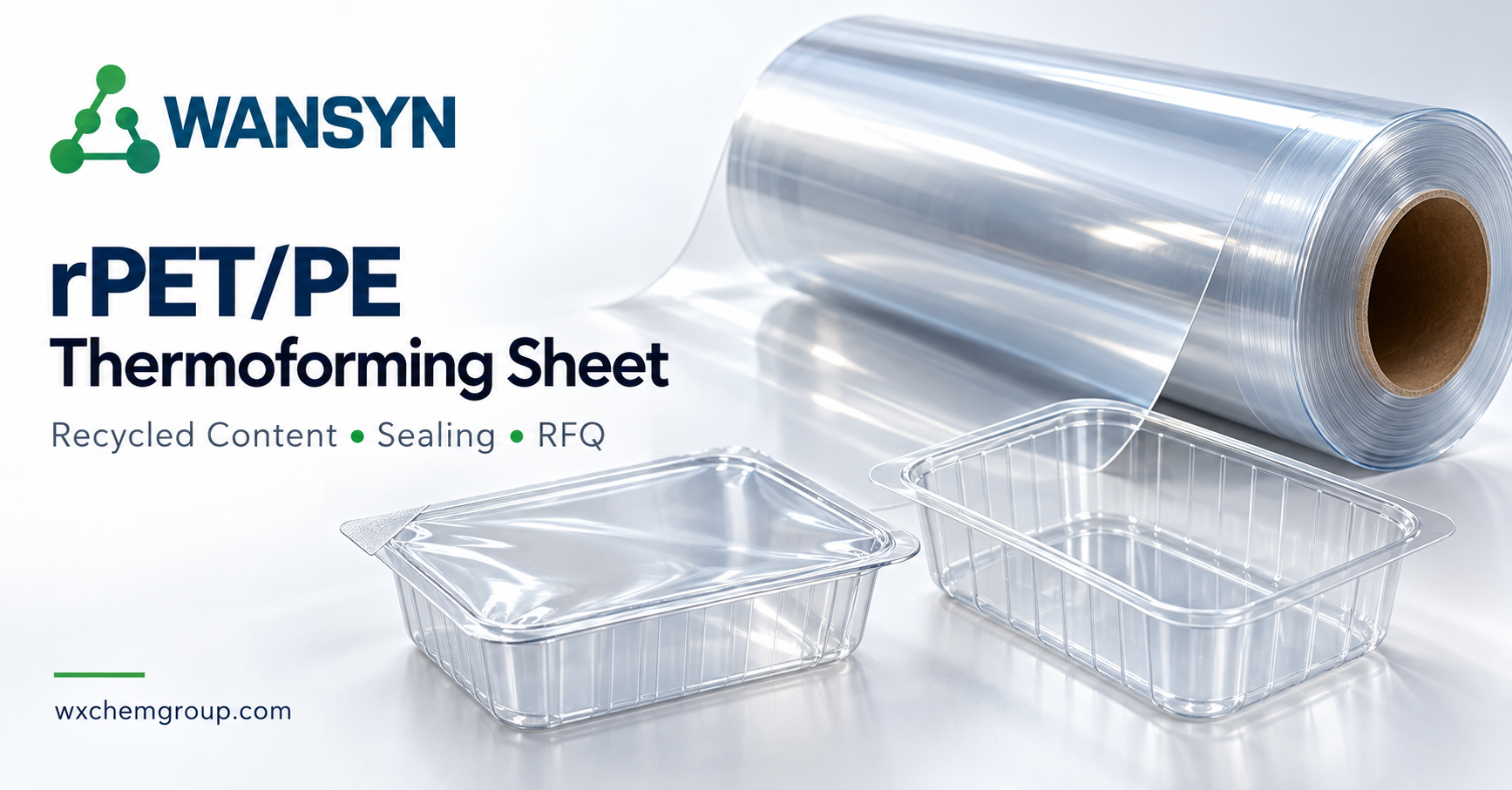
For this guide, rPET/PE describes a proposed thermoforming construction with a PET component containing recycled PET and a PE-based sealing component. The shorthand does not identify every layer, the recycling route, the recycled percentage, the bonding method or the sealing formulation. It is a project description, not a universal material grade.
For buyers comparing rPET sheet rolls, recycled PET sheet and laminated PET sheet, identify the full construction as well as the recycled-content requirement. An rPET/PE sheet roll is a finished laminate; PE lamination film is an input for a converter producing that laminate.
First state whether you need finished laminated sheet rolls or film for your own lamination line. WANSYN’s PET sheet category is a starting point for a sheet enquiry. Its offline lamination film product page covers a different purchasing scope, including PE-based film options. A film offer must not be treated as an offer for a complete rPET/PE sheet.
Ask the supplier to identify the proposed grade or project code, full construction, layer orientation, total gauge and tolerances. If there is no confirmed grade, request a feasibility review before writing a material code into your purchasing specification. For the broader terminology, see PET, APET and recycled-content terminology.
2. Recycled content calculation: define the mass denominator
“80% recycled PET” is incomplete without a defined scope. It could describe the PET component, the complete sheet, or an attributed-content claim under a specified chain-of-custody model. Those statements are not interchangeable.
For a physically incorporated content calculation, define the product boundary and count the qualifying recycled mass within that same boundary:
Recycled content by mass (%) = qualifying recycled material mass ÷ total mass of the specified product or component × 100.
For a finished laminate, include all constituent masses within the declared laminate boundary, such as the sealing component, bonding materials and coatings where present. Do not infer a mass percentage from layer thickness percentages alone. A claim for a complete pack also needs a defined treatment of the lid and other components; it cannot automatically reuse the sheet-only result.
Illustrative example: Assume 100 mass units of finished laminate contain 90 units of PET component and 10 units of other components. If 80% of the PET component is qualifying recycled PET and the other components contain none, the laminate contains 90 × 0.80 = 72 recycled mass units. The result is 80% within the PET component, but 72% within the complete laminate. This is arithmetic using invented inputs, not a WANSYN structure, offered recycled percentage or certification calculation.
The current ISO 14021:2026 addresses self-declared environmental claims. Its terminology distinguishes material in a product from attributed content; an attribution model does not necessarily guarantee the claimed amount in an individual supplied item. Agree the applicable claim method and evidence before approving label wording. The calculation above concerns physical constituent masses only and does not establish conformity with ISO 14021 or any other claim scheme.
3. Request traceability that matches the proposed claim
Ask the supplier to state the recycled material category, source controls, recycling route, calculation boundary and whether the statement concerns physical content or attributed content. Request supporting documentation for the actual proposed supply route, together with a link between the delivered roll lot and the relevant production records.
Clarify how pre-consumer and post-consumer inputs are treated under the selected definition. If the requirement is specifically post-consumer recycled PET (PCR PET), state that explicitly; the abbreviation rPET alone does not distinguish the source category. Do not automatically count all in-process trim or rework as additional qualifying recycled content. Avoid double-counting material already included in the calculation.
Write whether the purchase requires a minimum content, a target or an average over an agreed production scope. Define the evidence and acceptance basis for that requirement. Any certification claim should identify the applicable scheme, holder, scope and validity; none is assumed here.
4. Specify the PE sealing layer and heat seal compatibility
The PE-based surface must be evaluated with the actual lidding film. Request its sealing-face identity, intended peel or weld behaviour, relevant surface treatments and the proposed lamination route. A nominal “PE” description does not establish compatibility between two commercial films.
Include the complete construction in the technical review, with any bonding or tie layers where used. Avoid specifying one fixed layer count or a universal PE thickness before the package requirements are understood. If an oxygen-barrier function is needed, request a separately defined barrier construction and test target; the rPET/PE abbreviation does not supply that evidence.
Use the PET/PE laminated-sheet guide for the general material and sealing discussion. In this enquiry, the additional task is to preserve the agreed recycled-content basis while qualifying the proposed laminate and lid combination.
5. Qualify the formed tray and sealed package
Request trials with the proposed sheet lot, production-representative tool and actual lid. Record the forming setup, web orientation and sealing settings so the result is traceable. Do not treat a successful flat-sheet seal as proof that the formed package will meet the same requirements.
| Qualification stage | Evidence to agree | Decision supported |
|---|---|---|
| Incoming roll | Grade, lot, content documentation, full construction, gauge variation, appearance and winding condition | Trial material matches the proposed supply |
| Thermoforming | Actual tool and settings; flange condition; local thickness checks at defined locations; dimensions and visible defects | Tray geometry and material distribution meet the agreed limits |
| Lamination interfaces | Relevant bond assessment before and after forming and agreed conditioning; record the failed interface if separation occurs | Observed failure is correctly assigned and investigated |
| Sealing | Actual lid, temperature, pressure, dwell time, seal-strength method, failure mode and suitable package-integrity checks | The proposed sheet/lid combination has a usable production process |
| End use | Application-specific storage, handling, impact, appearance and other agreed package tests | The package meets the intended service requirements |
Set acceptance criteria before the trial. The appropriate gauge, process window and tests depend on the material, package and equipment; this guide gives no universal temperature, dwell time, peel force or layer thickness.
ASTM F2029-16(2021) concerns preparing laboratory heat seals and evaluating heat-sealability data; it does not validate production equipment. ASTM F88/F88M-23 measures the force required to separate a seal-containing strip and records the failure mode. Choose an applicable method and fixture with the laboratory. Seal-strength results do not replace package-integrity testing, and neither standard reference is a claim that WANSYN has tested or certified a particular sheet.
For a forming-related issue, consult the draw-depth and local layer-thinning guide. For separation, use the PET/PE delamination checks to distinguish an interface failure from a lid-seal failure.
6. Match the evidence to the application
For chilled lidded trays, define the actual product, storage conditions, seal contamination risks and desired opening behaviour. For technical or non-food packaging, define the handling, dimensional and protection requirements. A requirement to increase recycled content does not remove these application-specific approval steps.
If the intended use involves food contact, identify the destination market, food type, contact time and temperature, and the complete proposed construction. Request the documentation applicable to that specific use. A PE surface, a virgin outer layer or a recycled-content certificate does not by itself establish food-contact suitability.
The FDA’s recycled-plastics guidance overview explains concerns about source materials, contaminants and intended use. It is a reference for evaluation, not evidence of approval for WANSYN or this proposed structure. Applicable documentation must be reviewed for the actual supply and intended market.
Keep recycled content and end-of-life claims separate. Whether a finished PET/PE pack is accepted for recycling depends on the complete package and the relevant collection, sorting and recycling route. This article makes no recyclability or shelf-life claim.
7. Prepare an rPET/PE thermoforming sheet RFQ
Use this project-specific RFQ alongside the broader thermoforming sheet-roll RFQ checklist:
- Supply scope: finished laminated sheet roll or lamination film; proposed grade if known.
- Application: product to be packed, tray drawing, destination market, storage and use conditions.
- Recycled-content requirement: percentage, component or product boundary, material category, physical or attributed basis, and required evidence.
- Construction: available layer information, exposed seal face, total gauge and tolerances; note which details require supplier confirmation.
- Roll format: width, core, winding direction, diameter or net mass limits and splice requirements.
- Forming: machine, tool, draw depth, current settings and the relevant accepted reference material.
- Sealing: lid specification or reference sample, sealing equipment, opening requirement and agreed validation criteria.
- Documentation and trial: required traceability and end-use evidence; trial quantity and acceptance plan to be agreed.
- Commercial scope: expected order quantity, delivery destination and requested quotation basis. Ask the supplier to confirm availability, trial arrangements and timing.
Suggested enquiry wording: “Please evaluate a finished rPET/PE thermoforming sheet for the attached tray and lidding specification. Our recycled-content requirement is ___% by mass of ___, using ___ as the claim basis. Please identify the proposed grade, complete construction, available supporting documents and trial conditions. Items not yet verified should be listed for confirmation.”
Send WANSYN your rPET/PE project specification for review. The proposed recycled percentage, structure, documentation, performance and supply arrangements need written confirmation for the project; this guide does not constitute a product offer.
Conditional selection conclusion
An rPET/PE proposal can move toward approval when its recycled-content statement has a defined and supported basis, the proposed laminate forms acceptably in the intended tool, its seal face works with the actual lid, and the completed package meets the agreed end-use and documentation requirements. If any of those conditions remains unverified, retain the proposal as a trial candidate rather than an approved substitute.
FAQ
Does rPET mean the same thing as APET?
No. Recycled content and the description of the PET sheet material address different characteristics. Specify both the actual sheet grade and the recycled-content basis rather than using either abbreviation as a full specification.
Does 80% recycled PET mean 80% recycled content in the finished sheet?
Only if the stated 80% uses the complete sheet as its defined mass denominator. If it applies to the PET component alone, other constituent masses change the complete-sheet calculation. Require the boundary and calculation evidence.
Does a PE sealing layer guarantee compatibility with my lid?
No. Confirm the proposed sealing surface and test it with the actual lid and production-representative equipment. Define both the desired opening behaviour and package-integrity requirements.
Can recycled content be confirmed by a seal-strength test?
No. Seal-strength testing addresses a mechanical property of the tested seal. Recycled-content evidence requires its own sourcing, calculation and traceability basis.
Is rPET/PE automatically suitable for food-contact packaging?
No. Suitability depends on the specific materials, recycling route, complete construction, intended use and applicable market requirements. Obtain and review the relevant documentation before approval.
Can the same settings be used after increasing recycled content?
Do not assume so. Compare the proposed grade against the accepted material using documented forming and sealing trials. Release settings only after the required package results are verified.
What should I send before requesting a quotation?
Send the supply scope, recycled-content definition, tray drawing, sheet and roll requirements, actual lid specification, machine information, destination market and acceptance criteria. Ask which grade, evidence and trial arrangements the supplier can confirm.